






 Portuguese
  Spanish


ENGIE and the startup SunR turned a climate disaster into the country’s largest photovoltaic recycling achievement, with mobile technology powered by solar energy.
The recycling of solar panels gained an emblematic case in Brazil after a severe storm in April 2023 destroyed much of the Paracatu Photovoltaic Complex in Minas Gerais. Instead of sending the broken panels to the landfill, ENGIE, the owner of the complex, decided to recycle them, and what was expected to take at least three years was completed in less than one.
In total, about 2,900 tons of panels were processed, equivalent to approximately 100,000 modules. A climate disaster became the largest photovoltaic recycling achievement ever recorded in the country.
The storm that became an opportunity
The starting point was a problem. The Paracatu Photovoltaic Complex, consisting of four plants totaling 132 MW of installed capacity, was severely hit by a storm in April 2023, damaging tens of thousands of panels at once.
-
Your Door Lock, Gate Padlock, and Hotel Key Card Likely Come from the World’s Largest Lock Manufacturer, the Swedish Group Behind Yale and Brazil’s Papaiz

-
Major Brazilian Ethanol Producer Becomes Largest Owner of Planted Forest in Mato Grosso, Aiming to Power Plants with Renewable Energy Instead of Fossil Fuels
-
In 1980, three brothers in a Chinese village collected discarded buttons, sparking the transformation of the area into the world’s button capital, producing billions annually for global fashion.
-
Man Tests Powerful Laser Robot Capable of Damaging Phones, Cutting Through Glass, Melting Sand, and Fusing Volcanic Rocks, Highlighting the Need for Strict Regulation


A broken solar panel is a delicate waste: it contains glass, metals, and components that cannot simply go to regular trash. The accident put ENGIE before a choice: discard or recycle. The company chose the harder and nobler path.
According to Exame, the company recycled the 2,900 tons of panels from the complex in record time, turning the loss into a showcase of circular economy. Necessity accelerated innovation.
Three years expected, less than one year in practice
The most impressive number is the time. The initial expectation was that recycling all that volume would take at least three years. In practice, the work was completed in less than twelve months, thanks to the partnership with the technology startup SunR.
According to Cenário Energia, ENGIE and SunR set a new sustainability standard in the sector by recycling all this volume. Compressing three years into less than one is not a logistical detail, it’s a leap in capacity. It shows that large-scale photovoltaic recycling is no longer a promise and has become a viable operation in Brazil. The speed proves that the bottleneck was not technical, but rather one of organization and the right technology.
This pace was possible because the solution was designed for industrial scale from the start, and not as an improvised task force. Each step, from collection to processing, was designed for productivity.
How SunR’s Solar Panel Recycling Works
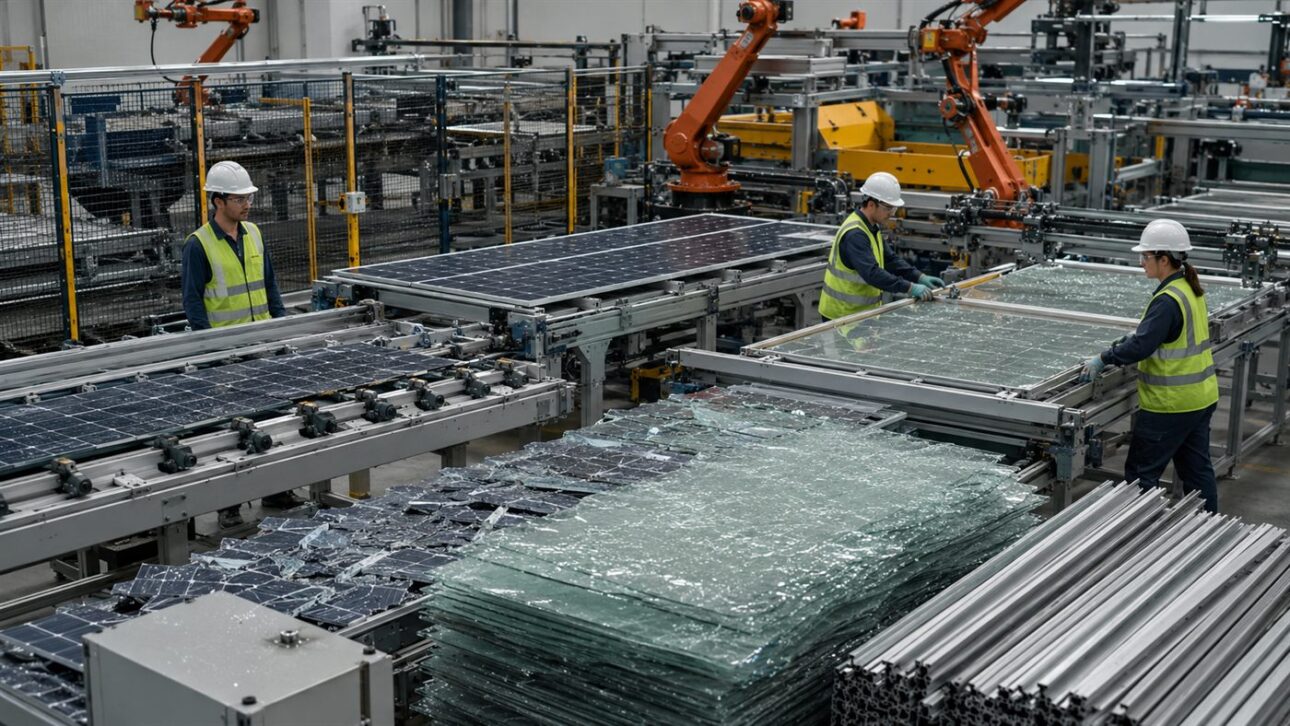
The heart of the operation is a technology called PV-MRC, an acronym for mobile photovoltaic recycling container. It is a unit capable of processing about 100 solar modules per hour and, symbolically, is powered by solar energy.
Mobility is the great idea. Instead of transporting thousands of heavy and fragile panels over long distances to a fixed factory, the equipment goes to the location, reducing cost and logistics risk. The factory moves to the waste, not the other way around.
Being powered by solar energy completes the cycle almost poetically: panels that generated clean energy are recycled by a machine also powered by the sun. The environmental coherence here is total.
Glass, Aluminum, Silver, and Copper: What is Recovered
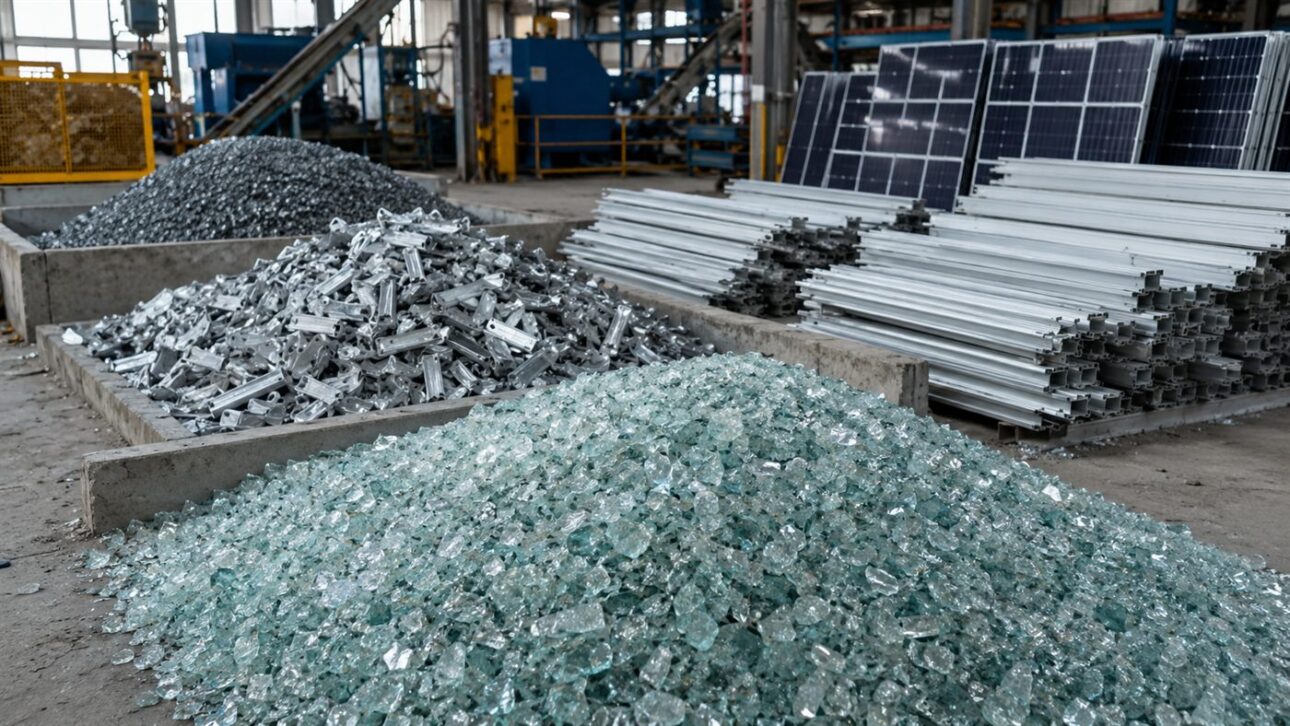
Recycling a panel means separating and reusing its components. Glass and aluminum together represent almost 90% of the mass of a photovoltaic module, and both have a solid reuse market. Cables, connectors, plastics, and metal mixtures are also part of the process.
The big attraction, however, is in the noble metals. The panels contain small amounts of silver and copper, valuable materials whose recovery adds economic value to recycling. Solar waste is not just an environmental liability, it’s an urban mine of metals.
The environmental gain is enormous, especially in aluminum: producing recycled aluminum consumes up to 95% less energy than making it from scratch. Each ton recovered avoids mining, energy, and emissions.
100 Thousand Panels and More Than 100 People
The human and material scale of the project gives the dimension of the effort. Approximately 100 thousand panels were processed, with more than 100 people involved in the logistics of collection, transport, and recycling.
Coordinating so many people and so much fragile material in such a short time is a management feat. Mass recycling requires orchestrating an entire chain, from disassembly in the field to the final separation of materials, without generating new waste along the way.
This type of operation also creates knowledge and specialized labor, a capital that remains in the country and can be applied to upcoming recycling projects that will inevitably come.
Why this matters: the solar waste that’s coming
The case of Paracatu is a rehearsal for a nationwide problem. Brazil has installed a massive amount of solar energy in recent years, and all these panels have a limited lifespan, around two to three decades.
This means a wave of end-of-life solar panels will arrive, and the country needs to be ready to recycle them instead of burying them. Those who master recycling technology now will be ahead when the volume explodes. Paracatu anticipated, by accident, a challenge that would be inevitable.
Having a national solution for this prevents Brazil from exchanging fuel dependency for a dependency on new technological waste without a destination.
Circular economy and surplus energy
Photovoltaic recycling closes the cycle of clean energy. There’s no point in generating renewable electricity if, in the end, the equipment turns into a mountain of toxic waste. The circular economy is what makes solar energy truly sustainable from start to finish.
Recovering glass, aluminum, and precious metals returns raw materials to the industry, reduces mining, and cuts emissions. True sustainability is thinking about the product even after its death, not just when generating energy.
The Paracatu model shows that this is possible with economic viability, as the recovered materials have market value that helps pay for the recycling costs.
The challenges of recycling panels in Brazil
Not everything is resolved. Recycling panels on a national scale will require many units like the one in Paracatu, clear regulation on the disposal of modules, and a reverse logistics chain that is still in its infancy in the country.
There is also the economic challenge of keeping the operation profitable when there isn’t a storm concentrating thousands of panels in one place. The real test will be recycling the diffuse waste, panel by panel, spread across millions of rooftops and plants.
Even so, the message from Paracatu is powerful and counterintuitive: a disaster turned into a record, and 100,000 broken panels that were going to be discarded became glass, aluminum, silver, and copper again. If it’s possible to recycle almost everything from a solar panel, why do we still bury any of them?


