Portuguese
  Spanish


The technique of floating molten glass over a tin bath, created by Pilkington in England, became the world standard and is behind almost every window, mirror, and screen you see
Look out the nearest window. It is almost certain that the smooth, transparent glass was made by a method that seems like industrial magic: melting sand at over 1,500 degrees and then letting the molten glass float over a lake of liquid tin. This is the float glass process, and it dominates the global production of glass sheets.
The technique is so efficient that it became the world standard for manufacturing glass sheets. Home windows, bathroom mirrors, car windshields, and even the base of your phone screen come from factories using the same principle, created by an English company over half a century ago and then licensed to manufacturers in various countries.
How the float glass process dominated the world
Before it, making a quality glass sheet was an expensive nightmare. The glass came out wavy and needed to be polished on both sides, a slow job that wasted material and made everything more expensive. Large, perfect mirrors and windows were luxury items, full of distortions that warped the image.
-
London Building Features 25 Apartments, Including 8 Social Housing Units, with Shared Spaces in a Model Combining Architecture, Community Management, and Aging Planning

-
After a court-ordered shutdown years ago, Onça Puma nickel mine in Brazil’s Pará region restarts, boosting production from 25,000 to 40,000 tons annually, becoming the largest ferronickel operation in Brazil while staying 13% under budget.

-
World’s Largest Playing Card Manufacturer is Belgian, Producing Everything from Market Decks to Pokémon, Magic, and Las Vegas Casino Cards
-
World’s Largest Cork Producer in Portugal Harvests Over 5 Billion Corks Annually from Trees Without Cutting Them Down


The float glass process solved this once and for all. By floating the molten glass over a perfectly flat tin bath, the surface comes out smooth on both sides naturally, without needing polishing. The quality that once required hours of manual work started coming ready from the production line, and the price plummeted, making good glass accessible to everyone.
The idea that supposedly came while washing dishes
The invention has a hero and a curious story. Engineer Alastair Pilkington developed the method at the Pilkington Brothers company in England. According to Pilkington, he began experimenting in December 1952, and a whole sheet made by the float process only emerged in July 1958. It is said that the inspiration came from a mundane moment, observing something floating in the water while washing dishes, but Pilkington itself treats the version of the genius spark as a myth that Alastair rejected.
A curious detail is that Alastair Pilkington was not even related to the company’s owners, despite the same surname. According to the same page from Pilkington, it took seven years of effort and about 28 million pounds of the time in research until the process worked on a scale. It was an expensive and risky bet that almost broke the company before becoming the greatest success in glass history.
Glass floating on molten metal
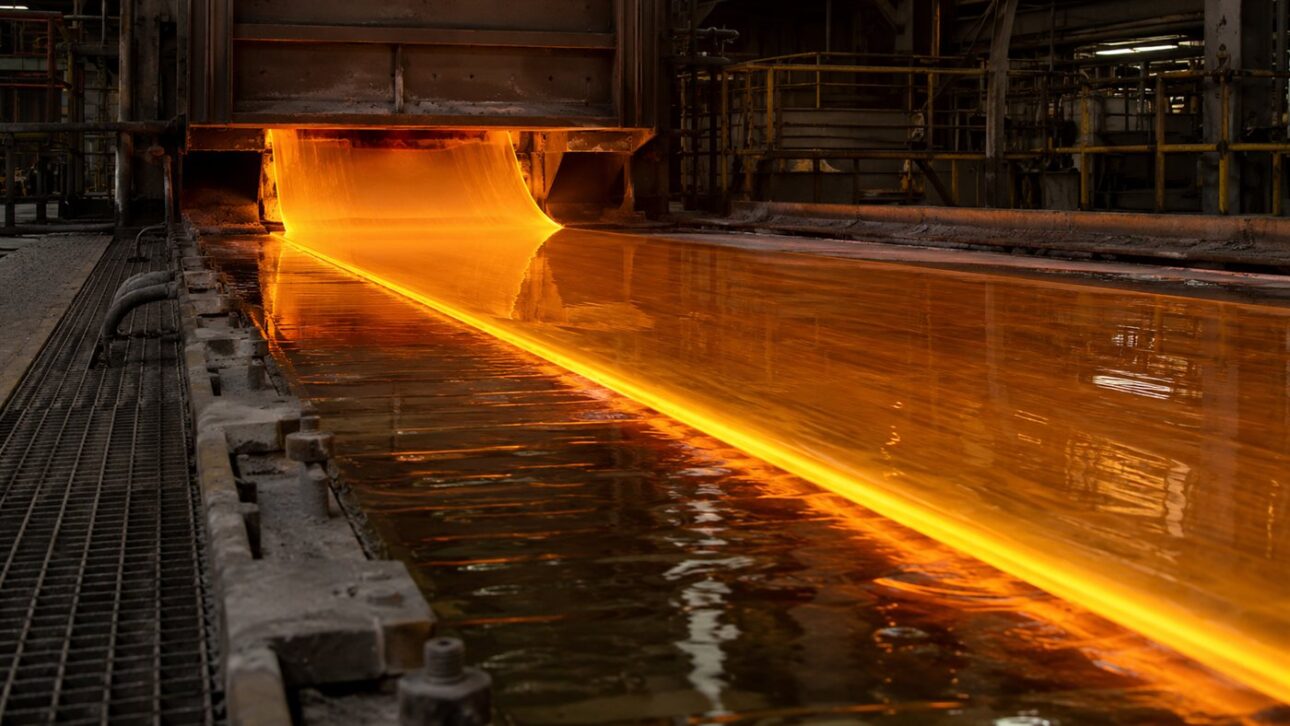
The process operation is elegant engineering. The mixture of sand, soda ash, and limestone is melted in a giant furnace and then poured, still liquid, onto a bath of molten tin. Since glass is less dense than tin, it floats and spreads into a layer of uniform thickness.
According to Pilkington, the molten glass at about 1,000 degrees is continuously poured onto this shallow tin bath, where it floats, spreads, and forms a leveled surface. Tin is used because it melts at a convenient temperature and does not mix with the glass. The glass cools as it advances floating until it hardens into a continuous and perfectly flat ribbon, which goes straight to be cut. All this happens in an uninterrupted flow that can last for years without stopping.
A perfect glass ribbon without polishing

The great trick is the automatic flatness. Since the surface of the molten tin is naturally smooth, the bottom face of the glass copies this perfection, while the top face remains flat due to gravity and surface tension. The result is a sheet with identical thickness from end to end.
This glass ribbon leaves the factory on a conveyor belt, is carefully cooled to prevent cracking, and then cut into sheets. No polishing step is necessary, which saves time, energy, and material, and explains why glass became so cheap. Glass manufacturing ceased to be a craft and became a precision production line.
From the window to the mirror and the cell phone screen
The glass sheet produced this way is the basis of things we use all day without thinking. It becomes a window, door, shower box, building facade, mirror, furniture top, and windshield. Later, it can be tempered to become more resistant or laminated to prevent shattering, becoming safety glass.
Even smartphone and tablet screens start as a smooth sheet made by processes derived from this same principle, before receiving special treatments. A large part of the transparency of modern life, from the glass skyscraper to the cell phone in your pocket, is born floating on tin, a detail that almost no one knows. Liquid tin has become a silent key piece of our landscape.
A patent that dozens of factories licensed
Pilkington’s mastery of the technology was so great that it became a business model in itself. Instead of keeping the secret to itself, the company began licensing the process to glass manufacturers in various countries, charging for it. Thus, even competitors ended up depending on the English invention.
According to Pilkington, the method has already been licensed to more than 40 manufacturers in 30 countries, with hundreds of float lines spread around the world. It was a rare case where mastering a technology made money both by selling the product and by selling the right to copy it. Decades later, practically every factory in the sector still uses some version of the process.
When the float glass process became a global standard
The turning point happened in the late 1950s. According to the NSG Group, owner of the Pilkington brand, the inspiration arose in 1952 and the method was presented to the world in 1959 as the float process, when practically every major manufacturer in the field tried to implement the technology. Pilkington also regards the announcement on January 20, 1959, as the milestone when the method became a worldwide reference for quality glass.
It was this race for licenses that spread float glass across the planet in a few decades. What had started as a risky experiment in an English factory became, in one generation, the standard way of making almost all the flat glass in the world. The standard caught on so deeply that, even today, those who invent a new glass generally start from a float sheet.
Flat glass is also made in Brazil
Brazil has not been left out of this revolution. The country has large flat glass factories that operate precisely with the float process, supplying the construction industry, the automotive industry, and the furniture and appliance market. The windows of Brazilian buildings, mirrors, and a good portion of national windshields come from these lines.
Having local production of these sheets is strategic because glass is heavy and expensive to transport over long distances. Manufacturing close to where it is consumed reduces cost and ensures supply for construction, a sector that drives the economy. Thus, the same principle invented in England supports works and industries on Brazilian soil every day.
Why an Invisible Process Sustains Modern Life
In the end, the story of float glass is about how a discreet invention can shape the world without anyone noticing. The transparency we take for granted, in windows, cars, screens, depends on an ingenious trick of floating glass on molten metal, repeated millions of times around the planet.
It’s the kind of technology we only notice by its absence when a glass comes out crooked or distorts the image. Next time you look through a perfectly smooth window, it’s worth remembering the tin lake behind it. Did you imagine that almost all the glass in the world was made by floating?