Portuguese
  Spanish


In a sequence of tests published by the Prop Department channel, a robot equipped with a high-power laser was used to hit a cell phone, wood, glass, metals, rocks, battery, and solar panel, revealing the heating power of the beam and the risks of operating this type of equipment
An experiment published by the Prop Department channel showed a robot equipped with a high-power laser performing a sequence of demonstrations that caught attention for the precision and the different materials it managed to heat, melt, or pierce.
During the video, the equipment was used to test its ability to cut, fuse materials, destroy objects, and even transmit energy through a beam of light.
Throughout the presentation, the creator explains that part of the technical specifications of the system cannot be disclosed due to rules related to the manufacturing of equipment in this category. Even so, several demonstrations were carried out to show the potential of the project.
-
In 1959, an English engineer revolutionized glassmaking with the float glass process, now the standard for windows, mirrors, and screens worldwide.

-
London Building Features 25 Apartments, Including 8 Social Housing Units, with Shared Spaces in a Model Combining Architecture, Community Management, and Aging Planning

-
After a court-ordered shutdown years ago, Onça Puma nickel mine in Brazil’s Pará region restarts, boosting production from 25,000 to 40,000 tons annually, becoming the largest ferronickel operation in Brazil while staying 13% under budget.
-
World’s Largest Playing Card Manufacturer is Belgian, Producing Everything from Market Decks to Pokémon, Magic, and Las Vegas Casino Cards


Robot uses invisible laser guided by cameras and aiming system
The presented equipment is composed of a robotic arm capable of moving the laser with precision. Since the main beam is invisible to the human eye, four small visible lasers were installed just to indicate the point where the shot will be made.
The system also uses two cameras installed on the set: a conventional camera and another modified to see in the infrared range, allowing the beam to be visualized during recordings.
According to the project leader, the robot can execute programmed movements automatically, hitting different targets in sequence. He explains that the software could also be integrated with artificial intelligence systems via APIs, allowing the robot to operate even more automatically.
Tests show different reactions in each material
A large part of the video is dedicated to a series of experiments to verify how different materials react to the laser.
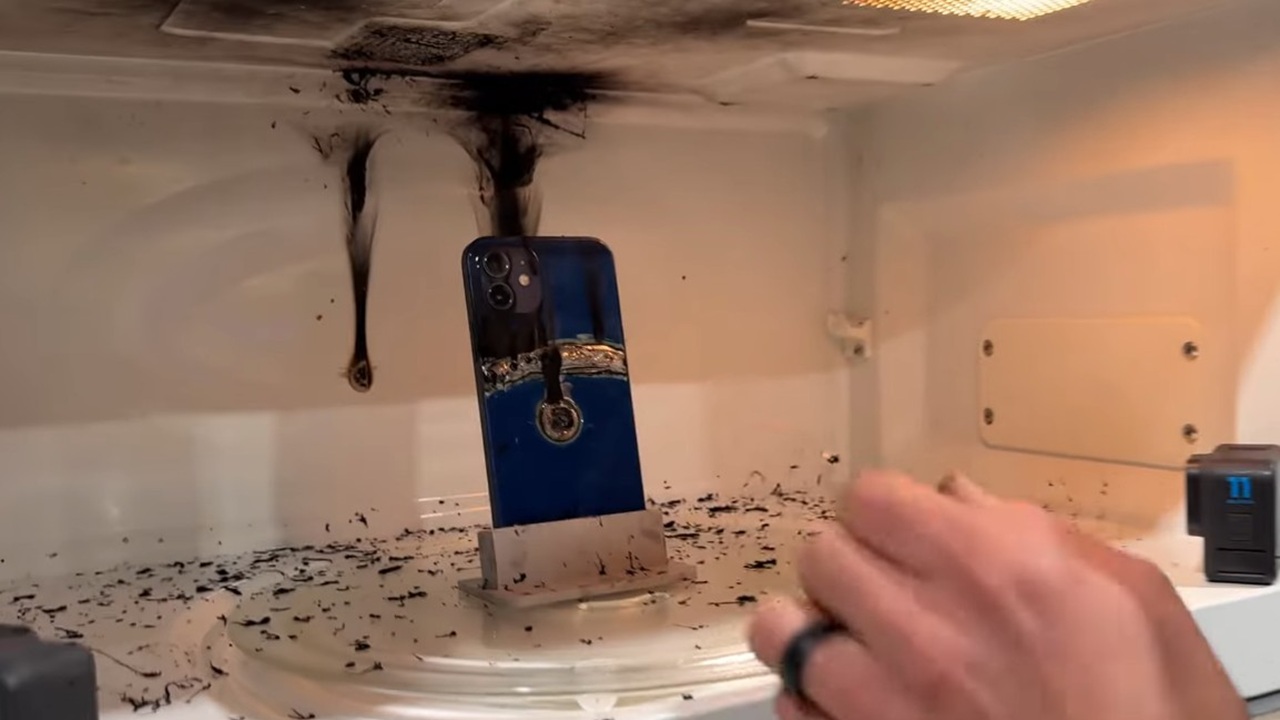
One of the first tests uses an iPhone as a target. After a few seconds of exposure to the beam, the casing suffers severe deformations, metal parts begin to melt, and the device heats up quickly. In a second application, the phone practically fuses into a single metallic piece.
A microwave oven, however, presents different behavior. Despite the marks caused by intense heating, the equipment resists more than expected, requiring several shots to suffer significant damage.
During another experiment, an egg surprises the participants. Even after about 15 seconds of directly receiving the laser beam, it remains practically intact. The presenter attributes this behavior to the high reflectivity of the white shell, which would disperse much of the incident energy.
Fruits like bell pepper, eggplant, and coconut are also used in the tests. Some show only superficial heating, while others begin to char or catch fire slowly, depending on the color and the ability to absorb light.
Wood, glass, and metallic containers present different results
In darker materials, the effects become much more evident.
A block of wood quickly begins to char, forming a deep groove caused by the concentration of laser energy.
The robot also fires at metallic containers and glass packaging. The cans are pierced in a few seconds, while the glass containers require much more time to suffer damage, highlighting the difficulty of the beam in interacting with transparent materials.
At a certain point, the laser passes through a piece of glass and begins to burn the surface located behind it, demonstrating that a significant portion of the energy can pass through the material before being absorbed.
Project also performs automatic welding
Besides the cutting function, the robot also demonstrates the ability to perform small welding operations.
Using custom-made metal pieces, the system automatically executes weld beads on steel supports. The result is presented as a first attempt to automate this type of process using the robotic arm.
According to the project creator, several structural parts of the equipment were manufactured by companies specialized in metal cutting and machining before being manually assembled.
Laser can melt rocks and produce glass
One of the most curious stages of the video occurs when the group tries to use the laser to fuse different mineral materials.
First, special sand intended for glass manufacturing is subjected to the concentrated beam. After a few seconds, the surface begins to glow intensely, indicating extremely high temperatures.
Next, small volcanic rocks are also exposed to the laser. The heat is sufficient to partially melt the material, forming a glowing mass similar to lava. After cooling, several stones remain bonded by the melted material.
The presenter describes this stage as one of the most impressive demonstrations of the experiment.
Lithium battery catches fire during experiment
Not all tests go as planned.
When directing the laser at a lithium battery removed from a model aircraft, the component quickly ignites, releasing smoke and forcing the team to halt the experiment to control the situation.
The participants comment that the smoke likely contained toxic substances, reinforcing the risk associated with heating this type of battery.
Experiment tests energy transmission using laser
Another objective of the project was to demonstrate a concept known as energy transmission by light beams.
For this, a small solar panel was positioned in front of the robot while a multimeter monitored its electrical voltage.
The presenter explains that companies and startups are already researching similar technologies to transmit energy without cables, including to keep drones charged during flight using high-power lasers.
However, during the experiment, the high concentration of energy ended up piercing the photovoltaic panel before an efficient measurement could be made.
According to him, photovoltaic cells specially developed for this type of application have a much higher efficiency than a conventional solar panel used only for demonstration.
Tree is cut using only concentrated light
In the closing of the video, the team performs one of the most impactful demonstrations.
During the night and following a safety protocol described by the creator, the robot directs the beam at the trunk of a small tree.
After a few seconds of continuous exposure, the wood begins to char until the trunk completely gives way, causing the tree to fall.
According to the project leader, the system only releases the shot when the software confirms that the robotic arm is exactly in the programmed position, reducing the risk of activations outside the authorized area.
In the end, the experiment reinforces both the enormous potential and the risks involved in the use of high-power lasers, showing applications ranging from material cutting and welding to research involving remote energy transmission, always requiring strict safety procedures.