Portuguese
  Spanish


The Chinese automaker announced the exchange at the launch of the Aracruz factory, which is expected to generate around 9,000 direct jobs. GWM will send part of the workforce and Senai teachers to China, and Chinese technicians will come to Espírito Santo to assist in local training.
GWM plans to take part of the workforce that will work at its new factory in Aracruz, on the northern coast of Espírito Santo, to closely observe the industry’s technology in China before the start of operations. The unit, focused on the brand’s line of electric and hybrid cars, is expected to generate around 9,000 direct jobs, and the exchange idea was announced on June 30, during the official launch of the project, on the land where the plant will be built.
According to Ricardo Bastos, director of institutional relations at GWM in Brazil, the intention is for these professionals to deepen their Chinese knowledge, which currently leads the global electrification sector, to later apply this knowledge at the Aracruz plant. According to information released by the Gazeta portal, the strategy was detailed by the automaker’s global product director, Xiangjun Meng, who highlighted the importance of having people prepared to deal with the brand’s innovations and is responsible for the company’s product development.
GWM’s Exchange with China
The central idea of GWM is to send workers from Espírito Santo to China so they can closely observe the technology used in the factories of the Asian country, a world leader in electric vehicle production.
-
Viral Message Claiming Government Will Deposit Money for Registering CPF as Pix Key Debunked

-
Embraer Acquires Full Control of Mexican Aircraft Interiors Manufacturer EAI to Reduce Supplier Dependence and Protect Margins Amid Global Aviation Competition

-
Controversial Amazon Highway BR-319 to Receive $1.3 Billion for Road Upgrades and $570 Million for Territorial Governance in Brazil

-
Four Sanitation PPPs to Inject $4 Billion into 477 Brazilian Municipalities, Setting 2026 as a Record Year for the Sector


The proposal is for these professionals to bring the acquired knowledge to the Aracruz plant, also qualifying the Espírito Santo market with techniques that are currently concentrated abroad.
The announcement was made on June 30, at the groundbreaking ceremony of the factory, and detailed by GWM’s global product director, Xiangjun Meng.
He highlighted the importance of having people prepared to deal with the brand’s innovations, in a project that is expected to generate around 9,000 direct jobs on the electric and hybrid car assembly line.
Why China is the Training Destination
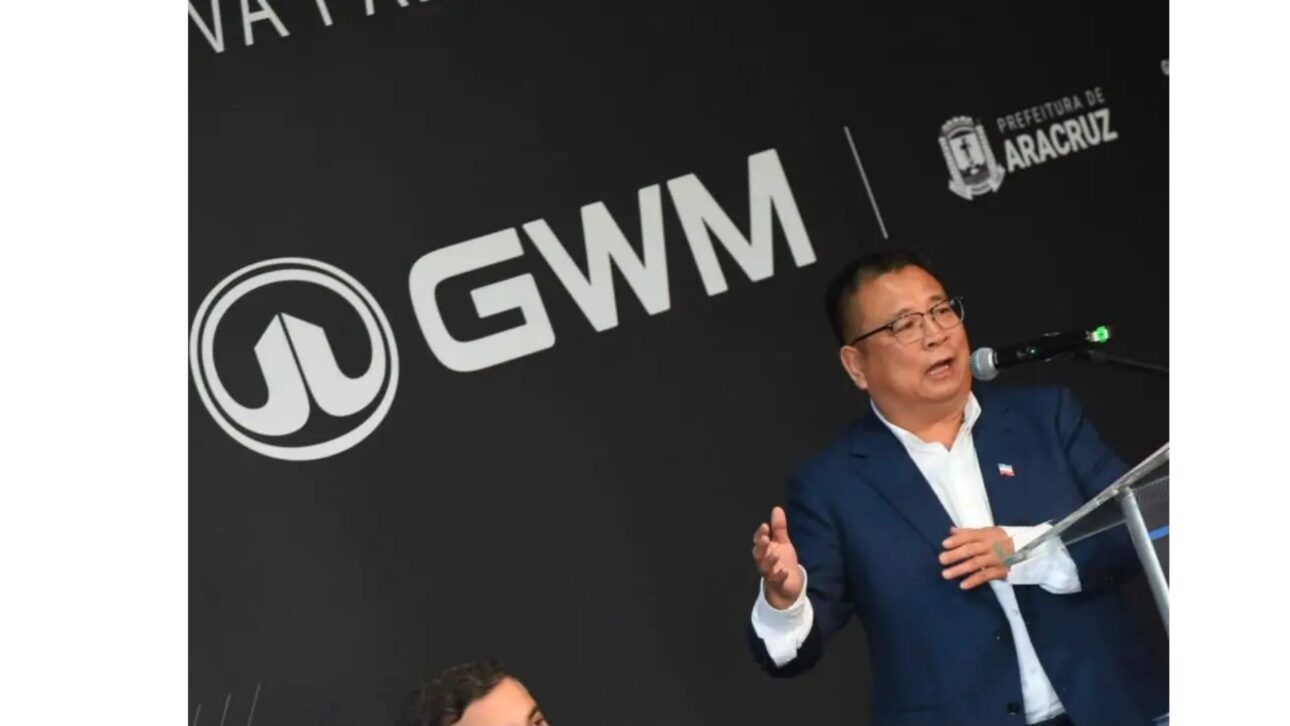
image: Carlos Alberto Silva
According to Ricardo Bastos, the choice of China is explained because the country currently leads the global electrification sector, concentrating the technology that GWM wants to bring to Espírito Santo.
The idea is for the workers to deepen this knowledge at the source to later apply it at the Aracruz factory, reducing the distance between the Espírito Santo operation and the Asian headquarters.
The Aracruz plant will be a multi-energy unit, expected to manufacture electric, hybrid, and possibly combustion vehicles, depending on market demand.
This flexibility reinforces the need for a workforce trained in different technologies, and this is what GWM seeks by bringing Espírito Santo professionals closer to the Chinese experience.
A factory that demands more than brute force
Bastos explains that the new factory, pointed out by GWM as the most technological in the country, will not only require brute force but also intellectual skills, responding to the profile of the modern automotive industry.
As the most severe stages of production, such as stamping, painting, and welding, are highly automated, the human role shifts to quality control, programming, and electronic systems.
Even though the technology is advanced, the demand for people remains high to monitor the factory systems, according to the GWM director.
This new work profile helps explain why the company invests in exchange programs, as professionals will need to master systems and processes that are new to much of the Brazilian market.
The training network with Senai, Ifes, and Ufes
To support the project, the government of Espírito Santo and GWM have already mobilized an education and training network, with a training plan involving Senai, Ifes, and Ufes.
The proposal is also to send Senai teachers to China to learn the automaker’s technologies, while Chinese technicians will come to Espírito Santo to assist in local training.
Paulo Baraona, president of the Federation of Industries of Espírito Santo (Findes), highlights that the qualification of the workforce for GWM will be a highly specialized process.
He emphasizes that, although the state already deals with large industries, the high-tech automotive sector requires a new level of training, and the expectation is that Senai will adopt customized courses, with classes prepared in a curriculum that matches the factory’s demand.
The investment and the possible battery factory
The investment for the construction of the GWM complex is around R$ 5.20 billion, equivalent to about US$ 1 billion, but it may be revised upwards.
The forecast is that the complex will also house a battery factory for electric cars, similar to what the company already does in China.
With the possible battery factory, the Aracruz plant would approach the vertical model that GWM operates in the Asian country, where the production of the vehicle and its main component are in the same complex.
This structure, combined with the exchange of workers and teachers, indicates the automaker’s intention to transfer not only the assembly line to Espírito Santo but also part of the Chinese technological knowledge.
GWM plans to send workers from Espírito Santo and Senai teachers to China to learn electric car technology before opening the Aracruz factory in Espírito Santo, which is expected to generate about 9,000 direct jobs.
Announced on June 30, at the launch of the project, the strategy includes the arrival of Chinese technicians to the State, a training network with Senai, Ifes, and Ufes, and customized courses aimed at the plant’s demand, pointed out by the company as the most technological in the country.
With investment around R$ 5.20 billion, equivalent to about US$ 1 billion, and the forecast of a battery factory, the multi-energy unit is expected to produce electric, hybrid, and possibly combustion vehicles, according to market demand.
And you, what do you think of GWM’s plan to take workers from Espírito Santo to China before opening the Aracruz factory? Do you believe the exchange will qualify the workforce of Espírito Santo for electric cars? Share your opinion and exchange ideas with other readers about industry and electric mobility.