Portuguese
  Spanish


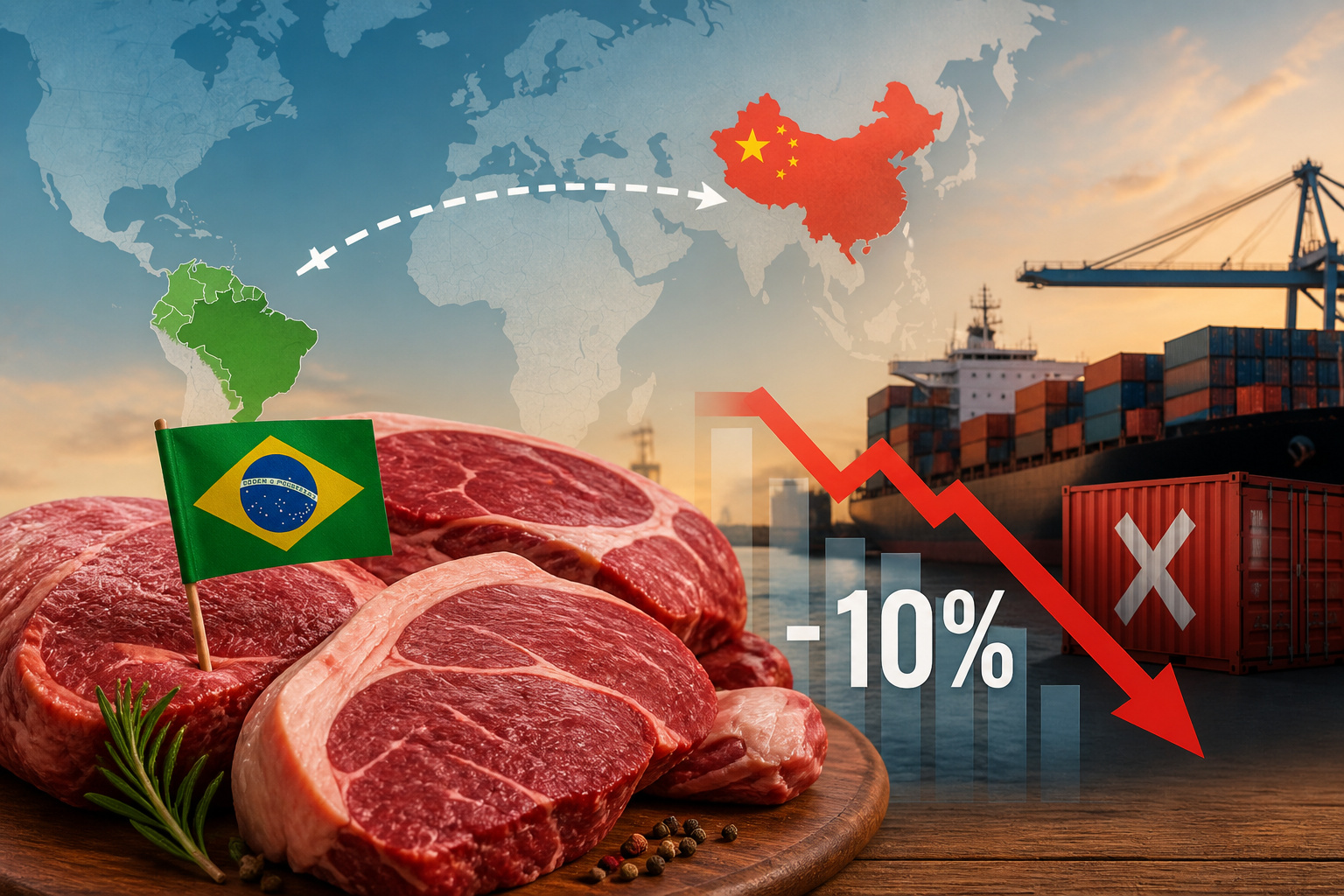

The global animal protein market faces a new scenario of uncertainties after China imposed tariff restrictions that could directly affect Brazilian beef exports. According to projections from the Brazilian Beef Exporters Association (Abiec), Brazil could see a drop of approximately 10% in the sector’s exports in 2026.
This move worries producers, slaughterhouses, and investors, mainly because China currently represents the main destination for Brazilian beef. Furthermore, the Asian country plays a strategic role in the recent growth of national agribusiness exports.
The importance of China for Brazil’s beef exports
China has consolidated its position in recent years as the largest buyer of Brazilian beef. The growth in Chinese demand boosted the Brazilian livestock sector and helped the country strengthen its position as the world’s largest exporter of the protein.
-
Brazilian Civil Servant Earns $2,800 Monthly but Seeks Legal Help as Bank Loans Consume Nearly 80% of Income

-
Brazilian Pet Industry Giant with $6 Billion Valuation Targets 24 Million Customers, Launches Franchise Model with Six Revenue Streams and $7.80 Subscription Plan for National Expansion

-
Daughter of a Mechanic, Roberta Pirolla Turns Passion for Cars into a Million-Dollar Vehicle Wrapping Business Set to Grow 75% in a Male-Dominated Industry

-
At 30, Thyago Plácido turned Innova into a solar energy operation serving central Brazil with over 300 projects completed.


Furthermore, the Chinese market absorbs significant volumes of national production. This means that any change in the Asian country’s trade policies generates an immediate impact on Brazilian agribusiness.
According to Abiec, the new tariff restrictions imposed by China could significantly reduce the exported volume in 2026. As a consequence, the sector already projects a more challenging scenario for the coming years.
What motivated China’s restrictions
The restrictions imposed by China involve new tariff barriers that make the entry of Brazilian beef into the country more expensive. This type of measure is usually used to protect domestic markets or reorganize trade policies.
Furthermore, geopolitical, economic, and strategic factors also influence such decisions. In many cases, large importers use tariffs as a commercial negotiation tool.
In this context, Brazil faces the challenge of maintaining competitiveness in a market highly dependent on Chinese demand.
The impact of the drop in exports
According to Abiec’s projections, the approximately 10% reduction in exports could generate significant impacts throughout the entire beef production chain.
Firstly, the decrease in external sales tends to increase supply in the domestic market. As a result, the sector may face price pressure.
Furthermore, slaughterhouses and producers may find it difficult to quickly redirect volumes intended for China. This is because few markets have the capacity to absorb such high quantities.
Another important point involves the financial impact. The reduction in exports could affect revenues, investments, and job creation in the sector.
Brazil’s role in the global beef market
Brazil holds a prominent position in the international animal protein trade. Currently, the country is the world’s largest exporter of beef.
This leading role has been built over decades, with the expansion of livestock farming, increased productivity, and the opening of new markets.
Furthermore, the Brazilian sector has become competitive due to the availability of production areas, economies of scale, and market diversification.
However, the strong dependence on China highlights a significant strategic challenge for national agribusiness.
The challenges of redirecting exports
One of the main problems highlighted by the sector involves the difficulty of finding new buyers to replace Chinese demand.
Although Brazil exports to several countries, few have the capacity to absorb volumes equivalent to those of China.
Furthermore, international markets have specific sanitary, regulatory, and commercial requirements. This makes a rapid reallocation of production difficult.
In this scenario, slaughterhouses and exporters may face increased competition and pressure for lower prices.
The impact on the domestic market
With the reduction in exports, part of the production intended for the external market may remain in Brazil. As a consequence, there is a possibility of an increase in the domestic supply of beef.
Initially, this could lead to lower prices for consumers. However, the scenario also worries producers, who may face a drop in profitability.
Furthermore, oversupply could affect future investments in the livestock sector.
In this context, the balance between the domestic market and exports becomes even more important.

The influence of international trade relations
The case reinforces how Brazilian agribusiness depends on international trade relations. Decisions made by major importers can quickly alter the sector’s dynamics.
Moreover, trade disputes and tariff changes are part of the current global scenario. Countries seek to protect economic interests and strengthen their strategic positions.
Therefore, experts advocate that Brazil expand market diversification to reduce excessive dependence on a single buyer.
The role of market diversification
The diversification of destinations for Brazilian beef is considered a fundamental strategy to increase the sector’s security.
By expanding trade agreements and opening new markets, Brazil reduces risks associated with specific restrictions.
Furthermore, new trade partners can generate growth opportunities in regions such as the Middle East, Southeast Asia, and Africa.
In this regard, strengthening diplomatic and commercial relations becomes essential for the future of Brazilian exports.
The economic impact on agribusiness
Cattle farming holds great economic importance in Brazil. The sector moves billions of reais, generates jobs, and directly influences the Gross Domestic Product (GDP) of agribusiness.
Therefore, any retraction in exports tends to have repercussions in different areas of the economy.
Furthermore, slaughterhouses, rural producers, transport companies, and industries linked to the sector may feel the effects of the slowdown.
In this scenario, maintaining international competitiveness will be a strategic challenge for the country.
What experts expect for 2026
According to sector analysts, export behavior will depend on several factors in the coming months.
Among them are possible trade negotiations with China, the opening of new markets, and global demand behavior.
Furthermore, the international economic scenario will also influence the consumption of animal protein.
If restrictions remain, the sector may face a period of adaptation and commercial reorganization.
The importance of competitiveness in the global market
Even in the face of challenges, Brazil remains one of the most competitive countries in the beef sector.
Large-scale production capacity, combined with export experience, keeps the country in a strategic position in the international market.
Furthermore, advancements in technology, traceability, and sustainability can further strengthen the image of Brazilian meat abroad.
In this regard, investing in innovation and efficiency will be fundamental to facing new commercial challenges.
What this scenario represents for the future of the sector
The restrictions imposed by China show how the global food market is increasingly connected to economic, political, and strategic factors.
At the same time, the episode reinforces the importance of planning and diversification to reduce vulnerabilities.
Brazil remains a world leader in beef exports, but will need to adapt its strategies in the face of new trade barriers.
Finally, the current scenario highlights that competitiveness, commercial diplomacy, and innovation will continue to be decisive factors for the future of Brazilian agribusiness.