






 Portuguese
  Spanish


The fourth intervention at Central Beach of Balneário Piçarras reignited the debate on beach widening works in Santa Catarina, after new records of erosion and scarps in the newly widened area.
The advance of the sea over the Central Beach of Balneário Piçarras, on the North Coast of Santa Catarina, has once again put the effectiveness of sand strip widening works in the state up for debate.
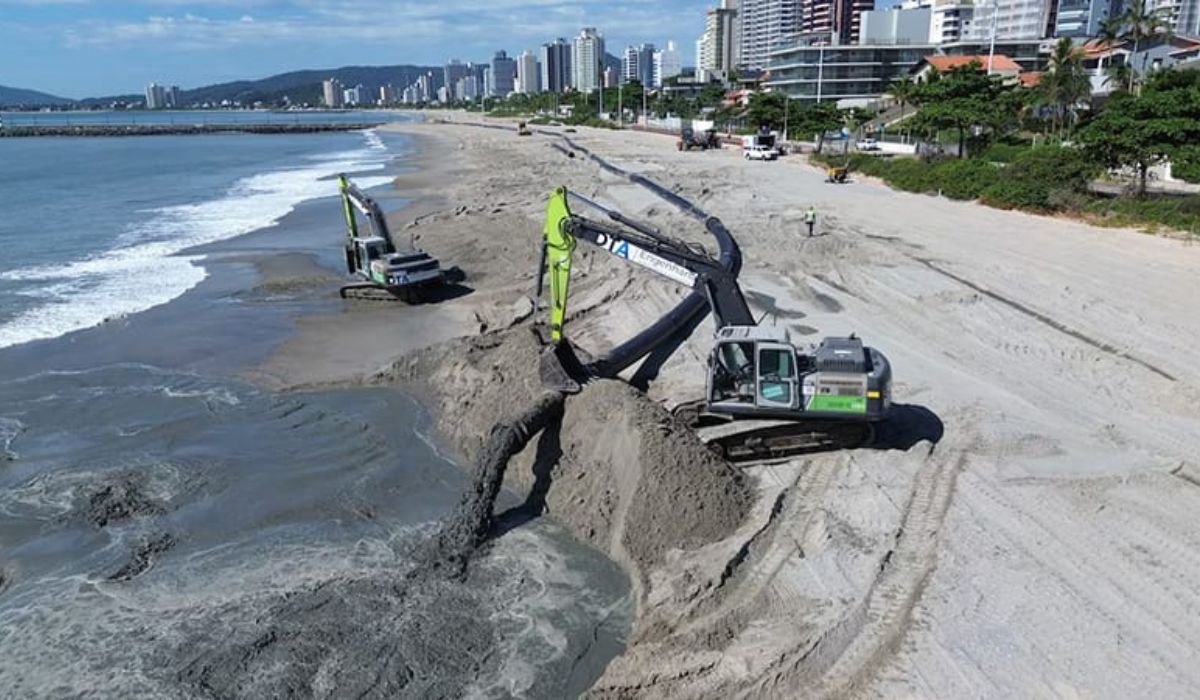
The most recent intervention began on January 23, 2026, was completed on April 16, and received more than 493 thousand cubic meters of sand, with an investment exceeding R$ 53 million.
Less than two months later, records made at the beginning of June showed a retreat of the widened strip and the formation of scarps in sections of the newly intervened area.
-
Over 70 Experts Join Global Project to Monitor Giant Asteroid Apophis, Visible to the Naked Eye During 2029 Earth Approach; Introducing Asteroids2029 Initiative

-
Japanese Manufacturer Dominates Global Bicycle Gear and Brake Market, Supplying 70% of Mid to High-End Bikes, Including Tour de France Winners

-
German Startup Raises €8 Million to Build Robot for 24/7 Harvesting of Tomatoes, Cucumbers, and Peppers Without Human Labor
-
The Pharmaceutical Glass Invented by a German Chemist in 1884 Was Crucial for 75% of Global COVID Vaccine Projects


The work was carried out between the Piçarras River jetty and the region after the Getúlio Vargas Avenue jetty.
According to information released at the conclusion of the work, the project reached 2.43 kilometers in length and expanded the average width of the sand strip by about 30 meters.
The sand used was taken from an underwater deposit located approximately 10.5 kilometers from the coast, near Ponta da Vigia, in Penha.
The 2026 intervention was the fourth nourishment carried out at Central Beach in 27 years.
The previous stages occurred in 1998, 2008, and 2012, according to the history cited by publications on the case.
Before the new work, the beach had already received about 2.1 million cubic meters of sediments.
This year, the addition was another 493 thousand cubic meters, a number that expanded the technical debate on the durability and maintenance of this type of coastal intervention.
Sea advance at Central Beach after the nourishment
The scarps appeared in areas of the widened sand strip during periods of high tide.
The Balneário Piçarras City Hall reported that the phenomenon is related to coastal dynamics and higher energy sea events, more frequent in the autumn and winter months.
In a note reproduced by ND Mais, the administration stated that “the formation of erosive scarps observed at the site is associated with the action of high energy events, a common process in the autumn and winter months.”
According to the municipality, this behavior may occur after artificial beach nourishment works, when the coastal profile goes through a phase of reorganization.
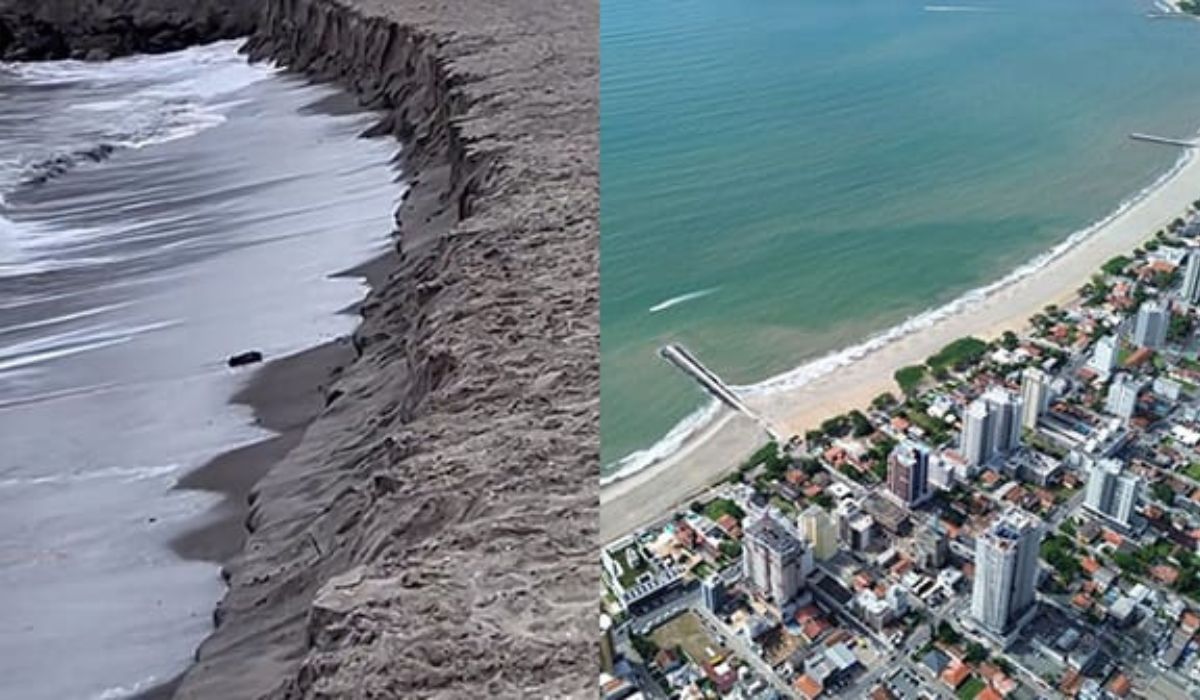
The city hall also informed that the recording of the scarps, in isolation, would not indicate instability or compromise of the work, but would require continuous technical monitoring.
Even with this assessment, the municipal administration advised bathers and visitors to avoid the base and the upper edge of the scarps, due to the risk of sand detachment.
The recommendation shows that the area has come to require specific safety attention after the records of erosion in the widened strip.
Cost of the nourishment of Piçarras beach
The history of interventions in Piçarras shows that sand replenishment was not a one-off measure.
The Central Beach received similar works on four occasions since the end of the 1990s.
The most recent stage was presented by the public authorities as an action to expand the beach’s usage area, reinforce coastal protection, and improve the municipality’s tourist structure.
The bid launched in 2025 initially provided for an investment of R$ 38.2 million to place 379,166.76 cubic meters of sand along approximately 2 kilometers of shoreline.
Later, the scope was expanded by approximately 430 meters to the north, with a new investment of about R$ 9.57 million.
With the addendum, the amount allocated for sand placement reached R$ 47,849,999.98, according to a publication by Jornal do Comércio, and the total investment exceeded R$ 50 million.
The city hall reported that the resources came from the Beach Maintenance Fund, Fumpra, and the municipality’s own resources.
The official justification included the expansion of the area available for bathers, protection against erosion caused by storm surges, and the strengthening of tourism activity.
The repetition of the works, however, is cited by researchers and environmentalists as a point that requires long-term monitoring and evaluation.
The central question involves the ability of this type of intervention to contain erosive processes without requiring new sand replenishments and new infusions of public resources over the years.
UFSC Alerts on Landfills in Sandy Beaches
Researchers from the Federal University of Santa Catarina had already pointed out risks associated with dredging and landfills on sandy beaches.
In 2023, the Ecoando Sustainability program published a technical note on nourishment in the Santa Catarina coast, with analysis of works and licenses conducted by the Santa Catarina Environmental Institute.
The document discussed the topic in the context of coastal erosion and climate change.
The 2023 note stated that the impact assessment of these works should not be treated merely as a localized issue.
For the group, it is “erroneous” to think that beach dredging and landfill generate effects restricted to the directly influenced area, as nearby beaches can also undergo changes related to sediment displacement and other environmental impacts.
In 2025, another technical note from the same program was more direct in evaluating the results of similar works in Santa Catarina.
According to researchers from the UFSC, beach landfill projects in the state “do not comply with their own licensed projects.”
The document also stated that, “after the landfill, the beaches show deterioration in bathing conditions and increased risk of drowning.”
The university’s analysis considered data from beaches such as Canasvieiras, Ingleses, Jurerê, and Balneário Camboriú.
According to the text, between 2020 and 2024, four beaches in Santa Catarina received works licensed by the IMA: Canasvieiras, Ingleses, and Jurerê, in Florianópolis, as well as Balneário Camboriú.
Bathing Conditions and Safety on Widened Beaches
The 2025 technical note also pointed out an increase in the number of rescues on filled beaches.
According to the researchers, all the analyzed beaches recorded a significant increase in occurrences after the interventions.
In Balneário Camboriú, for example, there were 374 rescues in the three years prior to the landfill and 821 in the three years after.
In Ingleses, the number rose from 69 in the year before the artificial nourishment to 185 in the following year.
Bathing conditions also appear among the points evaluated by the UFSC.
Based on IMA data, the researchers reported that all the reclaimed beaches analyzed had a significant increase in the number of samples unsuitable for swimming during or after the works.
The evaluation considered the summer period, from November to March.
This data does not allow us to conclude that the same effects will occur in Piçarras in the same proportion.
Even so, they serve as a technical reference for the debate on artificial nourishment works on the Santa Catarina coast.
In the case of Praia Central, the June records expanded the discussion on public cost, swimmer safety, environmental licensing, and the need for continuous monitoring.


Beach Widening Works on the Santa Catarina Coast
Santa Catarina is home to some of the most well-known beach widening works in the country.
Balneário Camboriú, Canasvieiras, Ingleses, and Jurerê appear in UFSC’s technical analyses as examples used to assess effects following landfills and artificial nourishment.
In Piçarras, the fourth intervention in less than three decades has become part of this same set of cases observed by researchers and public managers.
The debate involves the purpose and durability of the works.
Municipalities often defend widening as a way to expand the leisure area, protect urban structures, and reduce damage associated with storm surges.
Researchers, on the other hand, advocate for more comprehensive environmental studies, effective monitoring, and a review of licensing rules for interventions that move large volumes of sediments.
UFSC proposes that works with more than 100,000 cubic meters of material be considered large-scale and require an Environmental Impact Study and Environmental Impact Report, the EIA/Rima.
The change would depend on an amendment to Resolution 98/2017 of the State Environmental Council.

In the case of Piçarras, the work moved a volume almost five times greater than this limit suggested by the researchers.
The city hall states that the technical monitoring was already planned in the environmental plan of the intervention and should continue in the coming years.
With the records of erosion in June, information remains open such as the volume of sand effectively lost, the cost of maintaining the widened strip, and the measures planned in case new storms hit the area.





