Portuguese
  Spanish


The German Schott, founded in 1884 by Otto Schott, created borosilicate glass that became the standard for vaccine vials, ampoules, and syringes, and single-handedly equipped most of the world’s COVID vaccines
Every time you get a vaccine or an injectable medication, the dose comes stored in a glass vial that seems ordinary. But it’s not. This pharmaceutical glass is a special material, created over a century ago by a German chemist, and much of it comes from a single company that almost no one outside the industry knows.
This company was founded in 1884 and dominates the manufacture of glass that protects medicines worldwide. During the COVID-19 pandemic, about 75% of approved or developing vaccine projects used vials made with glass from this German manufacturer, an invisible detail on which humanity depended to immunize en masse.
How pharmaceutical glass became a silent monopoly
The reason for such concentration is technical. Storing medicine is not like storing juice: the glass needs to be chemically inert, meaning it cannot react with the liquid, release particles, or alter the formula. A common vial could contaminate the dose and put lives at risk.
-
Dinosaur Bone Found in 1985 on James Ross Island Identified as First Confirmed Titanosaur Fossil from Antarctica, Shedding Light on a Once-Green Continent

-
Scientists Develop System to Turn Seawater into Drinking Water Using Only Sunlight, No Electricity Needed
-
Brazilians Spend Over 52 Years Online, Leading Global Internet Usage Rankings Ahead of Mexico and South Korea

-
German Printing Machine Manufacturer Dominates Over 40% of Global Offset Press Market


Making such glass, on an industrial scale and with absolute purity, is extremely difficult, and that’s why few companies in the world can do it. The German company accumulated more than a century of knowledge in this specific niche and became an almost mandatory supplier to the pharmaceutical industry. Pharmaceutical glass is one of those products that no one notices, but without which modern medicine simply wouldn’t function.
A glass that neither reacts nor breaks with the medicine

The secret lies in the composition. The material used is the same durable glass as ovenware, but in an ultra-pure version for medical use. It withstands sudden temperature changes, resists aggressive chemicals, and does not release substances into the content.
This is essential because many medicines are frozen, heated, or stored for years, and the bottle needs to withstand all of this without failing. A micro defect in the glass could crack the ampoule or ruin the entire dose, which is why quality control is obsessive. This type of glass became a global standard precisely because it combines strength, neutrality, and transparency in one material.
The visionary chemist and the invention of 1884
The story begins with a visionary chemist. According to Schott, the company was founded in 1884, in the German city of Jena, when that chemist joined forces with physicist Ernst Abbe and optician Carl Zeiss to set up a small glass laboratory, legendary names in optics and materials science.
It was in this laboratory that the chemist himself developed borosilicate glass, revolutionizing not only pharmacy but also optics and laboratories. That late 19th-century invention continues to be the basis of medicine bottles to this day, more than 140 years later. Few industrial discoveries have had such a long lifespan and such a silent impact on the health of billions of people.
75% of COVID vaccine projects in just one bottle
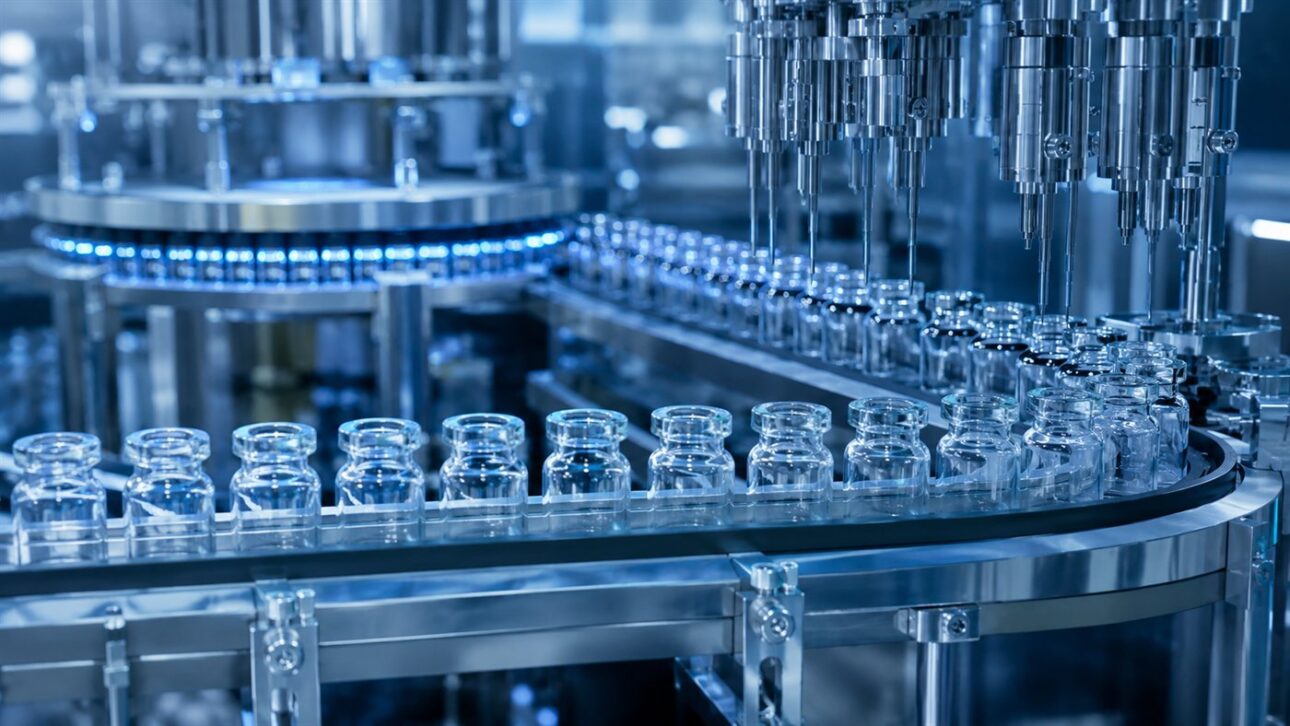
The pandemic shed light on this hidden giant. When the world rushed to produce billions of vaccine doses in record time, an unexpected bottleneck emerged: it wasn’t enough to have the vaccine, safe glass vials were needed to package it. And a large part of this glass came from the same source.
According to Schott, the manufacturer’s containers, including glass vials, were used in 75% of all COVID vaccine projects approved or in development. Global immunization practically depended on the ability of a glass industry to meet the demand. It was a brutal reminder of how the world’s health relies on the invisible links of the production chain.
Billions of vials per year coming out of factories
The scale of the sector is impressive. The same statement from the manufacturer claims that its glass formulation is used in billions of vials per year to keep even the most sensitive medicines stable. It’s an ocean of vials, ampoules, syringes, and cartridges continuously coming out of factories.
Each of these containers needs to be born perfect, without any flaw that could compromise the dose. Producing tens of billions of identical and flawless medical pieces per year is an industrial feat that rivals chip manufacturing, although almost no one values it. The medicine bottle is simple in appearance and high technology inside.
Why medicine needs a special glass
Many people wonder why not use plastic, which is cheaper and unbreakable. The answer is that plastic can react with certain medications, allow gases to pass through, and not withstand high-temperature sterilization as well as glass. For many sensitive medicines, glass is still irreplaceable.
Glass is also transparent, which allows for dose inspection, and it is chemically stable for decades. When it comes to storing something that will enter a person’s vein, the margin of error is zero, and this special glass offers the security that few materials guarantee. That’s why, even in the plastic era, the glass bottle continues to reign in the pharmacy.
The German manufacturer is also in Brazil
The company’s reach extends to the country. The company maintains operations in Brazil, serving the pharmaceutical industry and other sectors that depend on high-precision technical glass. This means that part of the chain that packages medicines consumed by Brazilians goes through structures installed on national soil.
Having a nearby supply is strategic for a sector as sensitive as health, where delays and failures are costly. The local presence reinforces how this invisible glass is a silent part of the healthcare infrastructure of an entire country. From the health center to the hospital, the bottle that holds the dose likely carries the heritage of a 19th-century German invention.
Why a glass bottle is a key piece of health
In the end, the story of this German company shows how global health balances on details that no one sees. A vaccine only reaches someone’s arm if there is a safe bottle to transport it, and this bottle depends on pharmaceutical glass dominated by very few companies in the world.
It’s another case of a hidden giant sustaining modern life behind the scenes. Next time you get an injection and see that little glass bottle, it’s worth remembering the technology of more than a century hidden there. Did you imagine that a simple bottle could be so decisive for the planet’s health?