





 Portuguese
  English
  Spanish
  5 min of reading
  0 comments



Jeff Bezos May Be Losing His Position As The Biggest Threat To Elon Musk In The Space Race. Discover Who May Take This Place And What Is Behind This Change
The growing rivalry between the key players in the space industry, Elon Musk and Jeff Bezos, has dominated the spotlight in recent years. However, as another player advances in its aerospace ambitions, Jeff Bezos may no longer be seen as the main threat to Musk’s space dominance.
In a recently published article, Bloomberg highlighted that China is strategically positioning itself to be a worthy competitor, investing in aerospace startups and state-owned companies aiming to create reusable rockets that can deliver satellites to Earth orbit more frequently and at a reduced cost.
The Awakening of China’s Competition – Has Jeff Bezos Fallen Behind?
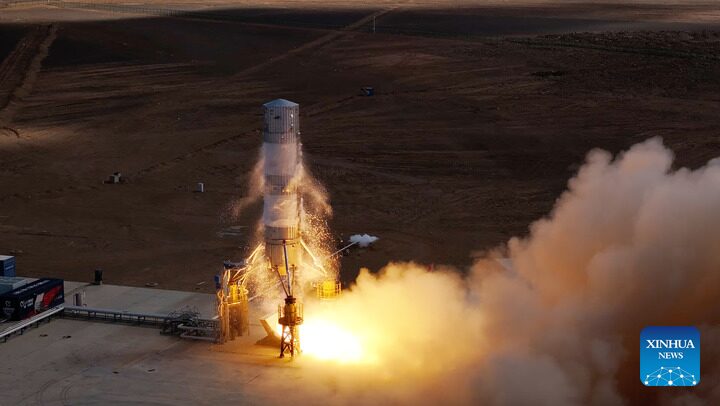
The advancement of China in reusable rockets is being led by companies such as LandSpace Technology Corp. and Deep Blue Aerospace Technology Co., both playing a crucial role in transforming the country into a competitive space power.
-
With workers dying from heat at construction sites worldwide, a company has created a vest that cools the body by up to 15°C for 8 hours and is already used by Formula 1 drivers and workers in Brazil.

-
YouTube launches “Ask the Studio” in Brazil, an AI that promises to interact with creators, explain channel metrics, reveal audience patterns, and even suggest ideas for upcoming videos.

-
Young Brazilians transform electric skateboards seized by the Federal Revenue into low-cost motorized wheelchairs, which can benefit schools, hospitals, and health centers.
-
Substitute for the traditional pot? Model with 9 safety devices, timer up to 24 hours, 1000W of power, and automatic functions is changing the routine of those who avoid cooking under pressure.




Recently, the Zhuque-3 rocket from LandSpace completed a successful vertical takeoff and landing test, demonstrating significant progress in the development of reuse technology. For Huo Liang, CEO of Deep Blue, Musk’s SpaceX is still the main model to follow, but he emphasizes that China is close to achieving equally remarkable advances.
This scenario is reinforced by the success of SpaceX in making rocket reuse an industry standard. Since 2017, Elon Musk’s company has reused the boosters of its rockets, allowing it to reduce launch costs and increase mission frequency.
This model has also been crucial for the growth of the Starlink project, with over 6,000 satellites already launched. Reuse not only provides an economic advantage to SpaceX but also consolidates its leadership in the commercial launch market, something Beijing aims to replicate.
Challenges for Blue Origin and Jeff Bezos’s Race
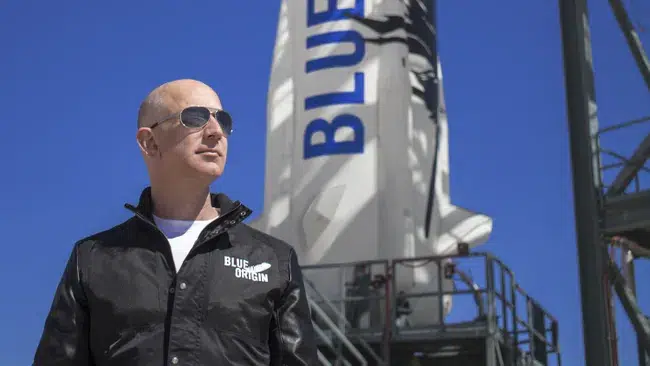
Jeff Bezos’s company, Blue Origin, has been seeking to rival SpaceX, but progress has been slower. While SpaceX already conducts frequent commercial launches with the Falcon 9, Bezos’s company still faces challenges in solidifying the development of the New Glenn, a rocket designed to directly compete with Musk in the orbital launch market.
The New Glenn, promised to conduct at least 25 reusable flights, is set to debut in November, four years behind the initial schedule.
Although Jeff Bezos’s Blue Origin has made progress with the New Shepard, which conducts suborbital flights carrying passengers to space for a few minutes, the company is still far from the routine of orbital launches that SpaceX already dominates. This puts Jeff Bezos in a less competitive position, while China emerges as a new potential rival capable of challenging Musk.
China’s Ambitions In Space
China’s strategy extends beyond commercial competition. For the Chinese government, the conquest of space has symbolic and strategic value, reflecting national pride and the country’s security.
President Xi Jinping views a robust commercial space industry as essential for the country’s development and its global standing.
Reusable rockets are fundamental for Beijing to compete with the US and SpaceX in providing space services around the world, as well as building a network of orbital satellites for its own projects, such as a lunar base and an orbital solar power station.
The quest for reusable rockets has already led China to conduct important tests. State-owned companies like China Aerospace Science and Technology Corp. (CASC) and China Aerospace Science and Industry Corp. (CASIC) have carried out similar experiments, notably a test in the Gobi Desert in June of this year.
The country plans to conduct commercial flights of reusable rockets by 2025, aiming to reduce costs and increase launch frequency, which would allow the construction of a solid space infrastructure.
The Race For Dominance In Reusable Rockets
Although Chinese startups are making significant advancements, the transition to a routine of launches with reusable rockets may take time.
The process involves numerous cycles of testing and development of technologies, as evidenced by recent setbacks. In a test conducted in June, a rocket from Beijing Tianbing Technology Co. collided with a mountain, demonstrating that while progress is significant, there is still a long way to go to catch up with SpaceX.
Competition with SpaceX is also not restricted to China. European and Japanese companies are facing similar challenges. ArianeGroup, a joint venture between Airbus and Safran, and Mitsubishi Heavy Industries are developing their own strategies for reusable rockets. However, these initiatives are still in early stages, with the CEO of Mitsubishi Heavy stating that the company is not developing anything concrete at the moment.
The Role Of SpaceX In The Global Landscape
SpaceX’s advantage in rocket reuse has been crucial for its dominance. The ability to launch satellites frequently and at a relatively low cost has allowed the company to capture a considerable share of the global market, practically monopolizing space launch services.
Starlink, SpaceX’s global internet network, is playing a crucial role in conflict zones like Ukraine, as well as providing connectivity to underserved regions around the world.
The presence of Starlink is also seen as a strategic threat by China. Beijing recognizes the importance of directly competing with Musk, both in developing reusable rockets and in creating its own satellite networks.
Peter Garretson, a defense studies expert, emphasizes that China needs these technologies to achieve its ambitious space and economic projects, such as building a research base on the Moon.
State Funding And The Future Of Competition
One of China’s major advantages is massive state support for its space program. In 2023, the Chinese government invested about US$ 14 billion in its space program, a large portion directed to state-owned companies.
Additionally, private Chinese companies are heavily subsidized by government funds, allowing them access to crucial technologies and infrastructure for developing reusable rockets.
Deep Blue, for instance, raised US$ 141 million from local investors in July, while its rival Orienspace secured about US$ 82 million earlier this year. These resources are essential for Chinese startups to continue their advancements and potentially rival SpaceX.
However, the path for China to form a “national champion” capable of defeating Elon Musk remains uncertain.
While Jeff Bezos and his Blue Origin continue to be a significant threat to Elon Musk’s SpaceX, the true challenger may come from China.
With a government willing to invest massively in the development of reusable rockets and startups eager to imitate — and surpass — SpaceX’s achievements, Beijing is positioned to redefine the space industry in the coming decades.
The world is watching to see if China’s aerospace ambitions will manage to confront and, perhaps, overcome the challenge posed by Musk.





Be the first to react!