






 Portuguese
  Spanish
  5 min of reading
  0 comments


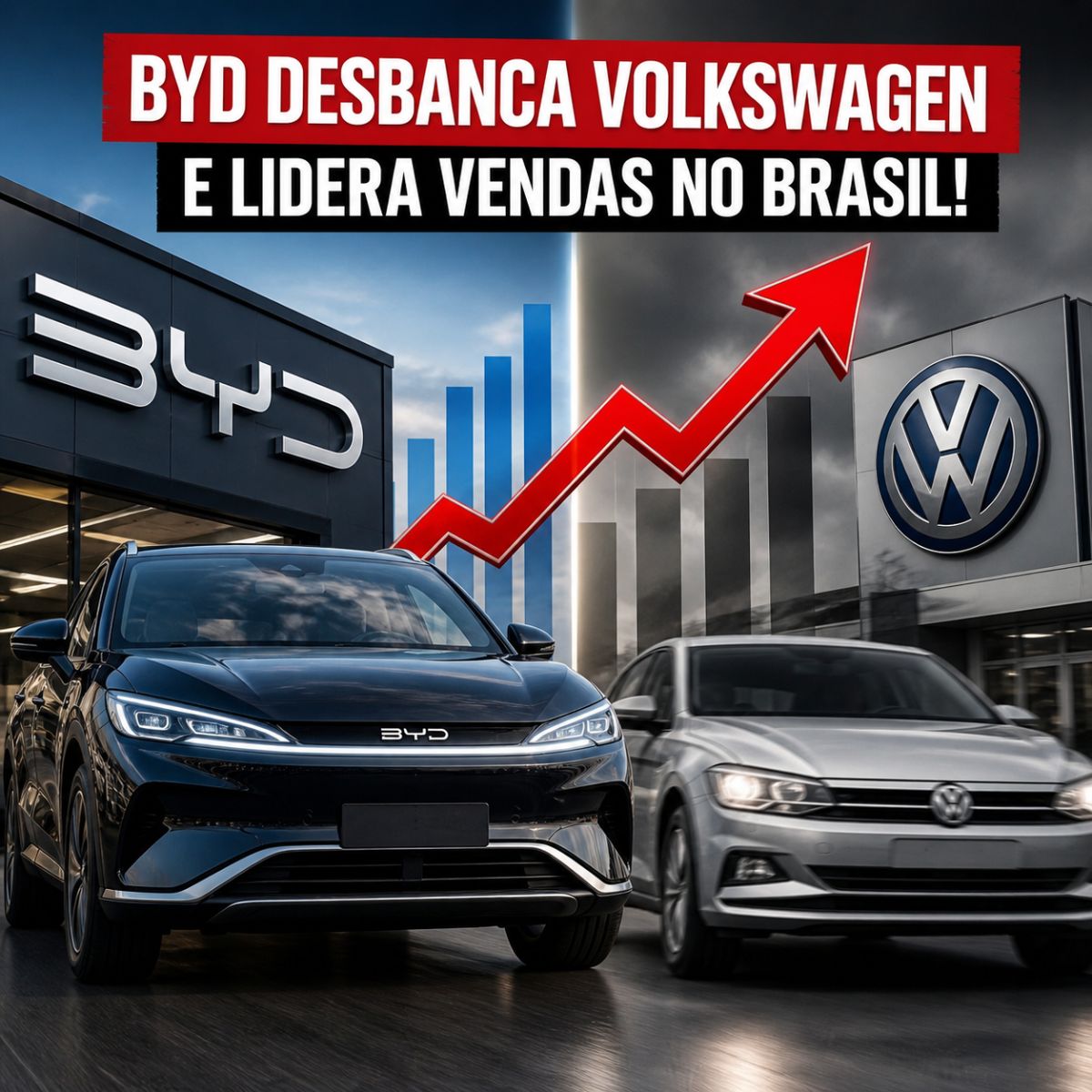
BYD was the best-selling car brand in Brazilian retail in April 2026, with 14.9 thousand vehicles sold in dealership showrooms, narrowly surpassing Volkswagen (14.8 thousand). The Dolphin Mini has led the model ranking for three months with 5.9 thousand units, and the Song family reached 4.1 thousand cars. Including direct sales to rental companies, BYD renewed its monthly record with 18.5 thousand vehicles. Anfavea warns of impacts of R$ 103 billion on the auto parts chain if Chinese imports continue at the current pace.
BYD has just achieved the position of the best-selling brand in Brazilian retail in April, and the feat is even more impressive when remembering that the Chinese automaker set foot in Brazil only four years ago. There were 14.9 thousand vehicles sold in dealership showrooms, a number that narrowly surpassed Volkswagen’s 14.8 thousand, which came in second. The Dolphin Mini, an electric car that has led the model ranking for three months, accounted for 5.9 thousand units alone, while the hybrids of the Song family reached 4.1 thousand.
The leadership in retail is yet another milestone of the Chinese invasion in the automotive market that is keeping traditional automakers awake at night. When including direct sales, closed with clients such as rental companies, BYD ranked fifth behind Fiat, Volkswagen, General Motors, and Hyundai, but still renewed its best monthly number in Brazil with 18.5 thousand cars sold in April. Anfavea, the association of automakers established in the country for decades, urged the government to impose barriers to slow down imports and pointed out potential impacts of R$ 103 billion on the auto parts chain.
What it means for BYD to lead Brazilian retail
According to information released by infomoney, leadership in retail is the channel that best measures the common consumer’s preference because it excludes volume sales to rental companies and corporate fleets that distort the overall ranking. When BYD sells more cars than Volkswagen in dealerships, the message is that Brazilians entering a showroom to choose their next car are preferring the Chinese brand over the German one that dominated the national market for decades.
-
The invisible danger inside the house: plugging too many devices into the same outlet and spreading extensions throughout the rooms can overload the electrical network, silently heat wires, and turn a common habit into one of the leading causes of house fires.

-
Goodbye traditional laundry: Roborock launches washer and dryer with super hydrolysis, microbubbles, 99.99% sterilization, low-temperature drying, automatic detergent, app control, and cycles to remove stains, odors, mites, and bacteria from clothes.

-
It is now possible to generate energy without batteries: new flexible material transforms body heat into electricity and paves the way for more efficient, autonomous, and comfortable wearable devices, with the potential to revolutionize personal electronics in the coming years.
-
Leaving the charger plugged in without a phone consumes energy or is it a myth? Experts call the phenomenon “phantom consumption” and warn that dozens of devices on standby can add up on the bill over the year.


The achievement comes four years after the official arrival of BYD in Brazil, a speed of conquest unprecedented in the national automotive sector. Automakers like Fiat, Volkswagen, and GM took decades to build the presence that BYD is achieving in months, supported by a combination of aggressive prices, electric and hybrid technology that traditional competitors were slow to offer, and a portfolio ranging from popular cars to high-end SUVs.
The models that drove sales in April
The Dolphin Mini is the phenomenon anchoring the leadership. With 5.9 thousand units sold in April, BYD’s entry-level electric car has led the model ranking for three consecutive months and proves that the Brazilian consumer is willing to consider an electric as a first car, not just as a second luxury vehicle. The competitive price and significantly lower operational cost compared to a combustion car are the factors explaining the demand.
The Song family, composed of plug-in hybrid SUVs, complemented the performance with 4.1 thousand units. The Song Pro and Song Plus models cater to an audience that wants the efficiency of the electric engine without giving up the safety of the combustion engine for long trips, positioning BYD in a market segment that traditional automakers dominated until recently. The diversification between pure electric and hybrids allows the brand to cater to very different consumer profiles with a single strategy.
The reaction of traditional automakers and the request for barriers
The automakers established in Brazil for decades are not watching passively. Anfavea pointed out at the beginning of the year potential impacts of R$ 103 billion on the auto parts chain and R$ 26 billion on government revenues if public policies encourage the replacement of national products with imports. The argument is that BYD and other Chinese brands import vehicles fully or partially assembled, generating jobs in China instead of Brazil.
The political clash revolved around import quotas for hybrid and electric vehicles, with traditional automakers asking the government for limits to curb the influx of Chinese cars. BYD responds that it democratizes technology and expands the market: “Having an electric car seemed like a distant dream for most of the population until very recently, and today this option is already real for hundreds of thousands of people,” says BYD’s senior vice president in Brazil, Alexandre Baldy.
The Camaçari factory and the nationalization strategy
BYD does not rely solely on importation. The brand brought partially assembled cars from China for production completion at the Camaçari factory in Bahia, a strategy that reduces logistical costs and allows part of the vehicles to be classified as national production. The Bahia plant is BYD’s response to criticisms that the brand generates jobs only in China and does not contribute to the Brazilian production chain.
The Camaçari operation is an intermediate step. BYD’s goal is to progressively increase the national content of the vehicles, incorporating auto parts manufactured in Brazil and reducing dependence on imported components. For traditional automakers, however, the Bahia factory is insufficient because most of the added value, including batteries, electric motors, and electronic systems, continues to be produced in China, where BYD has vertical integration that no Western competitor can replicate.
The goal to be number one by 2030 and what’s at stake
BYD does not hide its ambition: the goal is to become the number one brand in Brazil by 2030, including all sales channels. If the growth rate of April continues, this objective could be achieved much sooner, as the gap between the Chinese brand and the overall leaders narrows each month while the portfolio expands with new models.
For the Brazilian consumer, the competition is positive because it pressures prices down and accelerates the offering of technology that was previously exclusive to luxury cars. For the national industry, the challenge is to adapt to a market where Chinese efficiency redefines what is possible in terms of cost, technology, and speed of launch. The question remains whether Brazil will be able to absorb BYD as part of the national production chain or witness the replacement of an industry built over decades by imports that arrive cheaper and more modern.
Would you buy a BYD or prefer to stick with the traditional brands you already know, and do you think the government should protect the national industry or let the consumer choose freely? Tell us in the comments if you’ve ever driven a Chinese electric or hybrid car and what you thought.





Be the first to react!