






 Portuguese
  Spanish


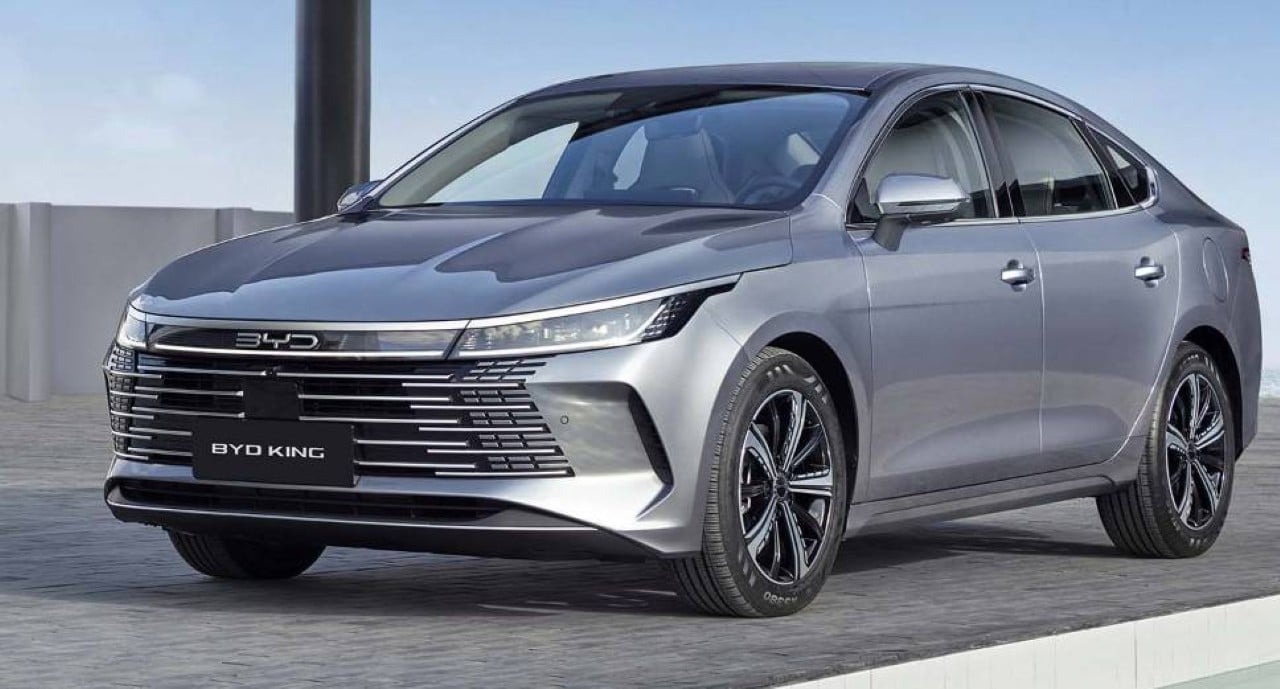


BYD Hybrid Sedan Surpasses Corolla in Fuel Efficiency, Delivers 235 HP and Promises Up to 1,200 KM of Range with a Full Tank
The new 2026 line of the BYD King GS 2026 arrives in Brazil reinforcing the Chinese brand’s strategy of offering more for less — and now with a powerful asset: fuel consumption.
According to BYD, the plug-in hybrid sedan can travel up to 44.2 km/l in the city and 36.7 km/l on the highway.
These figures are significantly higher than those of its direct competitor, the conventional Toyota Corolla hybrid.
-
End of an era in Brazil: beloved sedan by Brazilians is discontinued despite having a 2.0 engine with 151 hp, CVT transmission, 466-liter trunk, and up to 650 km of range.

-
New Law Proposal in Brazil Could Heavily Penalize Drivers: Dangerous Overtaking May Become a Serious Offense with Fines Increased Tenfold and a 12-Month License Suspension; Update on 2026 Progress

-
Electric Revolution: Watts W125 Motorcycle Offers 160 km Range, 90 km/h Speed, and Affordable Price Starting at $3,000
-
General Motors Replaces Over a Thousand Workers with 50 Cobots at Electric Vehicle Plant, UAW Union Criticizes Move Amid Industry’s Automation Push


Even after the reduction of the combustion engine power — from 110 hp to 98 hp, to comply with Proconve L8 — the hybrid system maintained a combined performance of 235 hp.
The electric motor continues to deliver 197 hp and 33.1 kgfm of torque, which ensures immediate power and quick accelerations, even with less contribution from the gasoline engine.
Range of Up to 1,200 KM and Urban Use Without Consuming Fuel
With the 18.3 kWh Blade battery, the King GS can travel up to 78 km in 100% electric mode. When this range is added to the full tank capacity, the sedan can cover about 1,200 km without refueling.
This makes it ideal for daily urban use practically without consuming fuel, leaving the combustion engine as support only for longer trips.
In addition to being efficient, the model offers a six-year warranty with no mileage limit for the plug-in hybrid system, low-voltage systems, and chassis, and eight years for the electric battery.
BYD’s proposal is to provide not only fuel savings but also lower maintenance costs in the long term.
Features Enhance Cost-Effectiveness Against Japanese Rival
The advantage in fuel efficiency is not the only argument for the King GS. Even priced at R$ 175,990 — about R$ 14,000 less than the entry-level hybrid Corolla — it comes with an extensive list of features.
It includes an 8.8-inch digital display, a 12.8-inch rotating multimedia center with integrated GPS, wireless mirroring, an induction charger, and four USB ports (two type A and two type C), in addition to a 12V outlet.
The front seats have electric adjustments and black synthetic leather upholstery, and the cabin received rubberized materials, textured plastics, and chrome details.
The raised console concentrates the controls for the transmission and the dual-zone air conditioning. Ambient LED lighting and the sound system with eight speakers complete the package.
Standard Safety and Generous Cabin Space
In terms of safety, the King GS 2026 now comes with a Level II ADAS system, featuring adaptive cruise control, blind-spot detection, lane-keeping assist, frontal collision warning, and emergency braking.
There are also six airbags, traction and stability controls, hill-start assist, automatic headlights, and a 360° camera.
The sedan measures 4.78 meters in length, 1.83 meters in width, and 2.71 meters in wheelbase, offering more interior space than the Corolla. It only falls short in the trunk space: 450 liters, compared to 470 liters of the Japanese competitor.
Fuel Consumption as a New Competitive Differentiator
By combining 235 hp performance, a complete package of features, a sophisticated interior, and a competitive price with much higher fuel efficiency than its rival, the King GS 2026 aims to establish itself as the new standard of efficiency in the medium sedan segment.
BYD’s strategy is clear: to turn low fuel consumption into a weapon to secure its position as the most advantageous model in the category.





Queria entender como é feito esse cálculo para obter 44 km/l?
Andam 32 quilômetros na bateria, depois andam 12 quilômetros na gasolina. Usando um 1 litro de gasolina para esses 12 km, somam os 32 só da bateria e voila 44km/l. Uma farsa.
Você tem que usar gás e bateria em harmonia aí sim ela fará aquela kilometragem dita.
Não é farsa nao, faz isso mesmo.