





 Portuguese
  English
  Spanish
  4 min of reading
  1 comment


Chinese Success in Aviation: The COMAC C919 Challenges Airbus and Boeing, Aiming to Lead the International Market
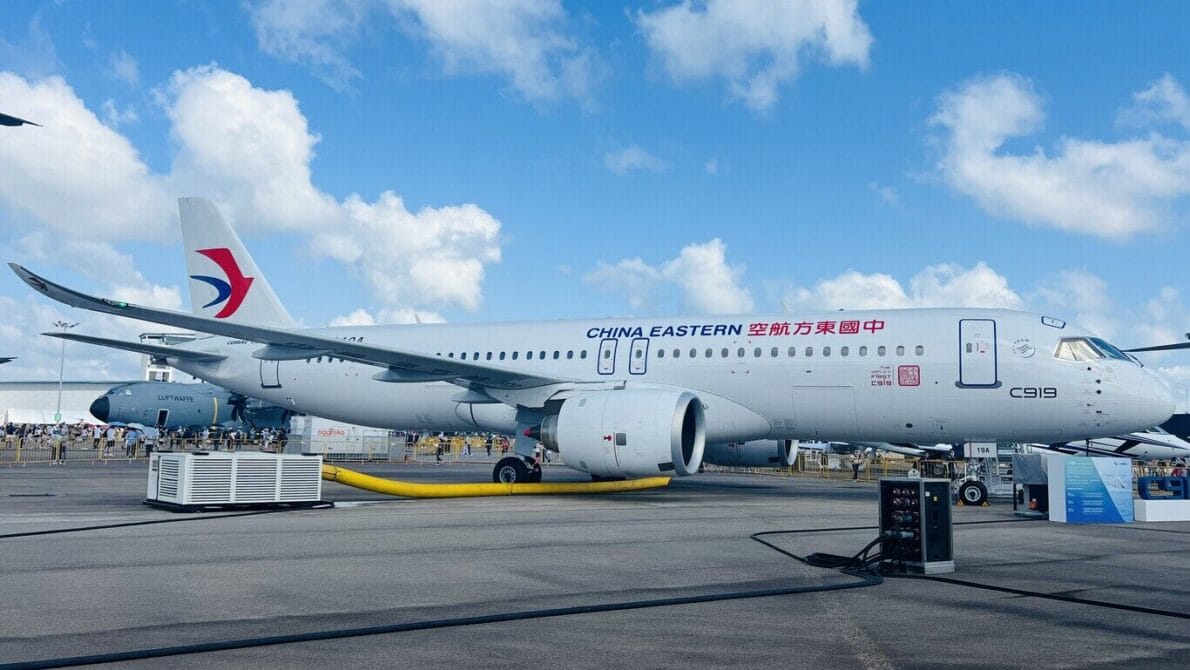
After a tumultuous manufacturing process, China has unveiled its brand-new C919. This is a narrow-body commercial airplane (single aisle) that completed its inaugural flight between Shanghai and Beijing, culminating over a decade of work. It is an aircraft designed to meet international standards, thus China aims to enter a market dominated by giants like Boeing and Airbus.
Market Acceptance and the Development of the C939
And the move is going so well, at least in its home territory, that not only are airlines ordering the C919 by the dozen, but China is also already working on a second generation: the wide-body C939.
A Major Achievement
The C919 was manufactured by the Commercial Aviation Corporation of China, or COMAC. It is a state-owned enterprise that, as proudly stated on its website, is the “first jet passenger aircraft independently developed by China, complying with intellectual property rights and international airworthiness standards.” It’s important to specify “jet” because the same company already had the ARJ21, a “small” turbofan model for regional flights.
-
Bangladesh tested a house that seems to have hidden buoys, stays firm on the ground on dry days, and floats during floods without turning into a houseboat.

-
While regular houses face the hurricane head-on, a company in the United States sells round houses that deflect wind pressure, withstand 130 mph, and reach 190 mph with reinforcements.
-
The material that still causes surprise in Brazil has become walls in the USA, accelerated houses in Minnesota, and reduced heating costs by 70%.
-
The John Deere forestry truck carries 19 tons of wood per trip, uses traction power to overcome mud, slopes, and narrow trails, and becomes the hidden link between the felled tree and the pulp industry.




As for the airplane, it was designed to compete with Airbus’s A320 and Boeing 737, measuring 38.9 meters in length, 11.95 meters in height, and able to carry between 158 and 192 passengers, depending on the seating configuration. Its range varies from 4,075 kilometers to 5,555 kilometers.
Made in China (With Western Parts)
However, “made in China” is relative, as the problem the company faces is that many of the key parts and components are Western. The engines, for instance, are French. The flight control system, weather radar, and instrument panel, among other components, are American. There are also British and German systems, although part of the fuselage and construction itself were carried out in China.
Success
COMAC’s production was estimated at 150 aircraft per year over five years, but the company announced that it had received more than 1,200 orders for the C919. Some pointed out that most were “letters of intent” from domestic customers, but one year later, it seems that the aircraft has indeed been a success. Air China is one of the latest to place an order for 100 units (around 11 billion dollars in total), and COMAC has embarked on expanding its facilities to fulfill the orders.
Last May, it was reported about the company’s intentions, with confirmation from the China Aviation Planning and Design Institute Group, that COMAC had won the bidding for the second phase of its construction project for the C919. It will be in the same Shanghai where COMAC is headquartered, and it will consist of an area of 330,000 square meters. AVIC-CAPDI indicated that this project “will meet the future batch production needs of the large passenger aircraft C919, improving its production efficiency and providing strong support for commercial operations and competition in the large domestic aircraft production market.”
China’s Unbridled Ambition
The C919 is a source of pride for China, as the country will seek certification from the European Union Aviation Safety Agency and is already marketing the model in Southeast Asia. However, the plans go beyond that. As we can read in the South China Morning Post, the Asian giant aims to capture a share of the international market to compete with the two dominant companies.
With the second assembly line, they will be able to build each unit more quickly and are already seeking to surpass the United States in the 2030s or 2040s. These are extremely ambitious plans, but the intent is not to compete with a single model, but with three.
C939 and C929 Wide-Body
After the success in developing this model, China and Russia have started the path to create the C929, a wide-body aircraft (with two aisles). However, with Russia’s invasion of Ukraine, the Russians have gradually distanced themselves from the project, and thus international sanctions came into play. Sources from SCMP indicate that this was viewed in China as a blow, but not something that would halt the project.
“Russia’s exit has some impact, but we can manage it. The work on the C929 is ongoing and progressing smoothly, taking advantage of the experience and system coordination we already have for the design and development of the C919. The time required for its construction and development may be similar,” this source notes. However, it will not be the only wide-body aircraft from COMAC, as they are also working on a C939 to compete with the largest from Airbus and Boeing. The issue is that we don’t have details on either.
Plans to Make It More ‘Made in China’
It is remarkable the effort China is making to achieve its ‘domestic’ line of commercial aircraft, and a good question is whether the West will impose sanctions like those affecting the automotive industry. In Beijing, this is a top-level objective, and the idea is to invest more in essential local technologies to become self-sufficient, starting with components like landing gear or engines.
Images and video: Ken Chen, S5A-0043








_China_Eastern_Airlines_Comac_C919-100ER_B-919A_@_Singapore_Airshow_2024-02-25_(2).jpg)
E, a China não quer ficar pra trás, despeja pelo mundo afora suas centenas de modelos de carros de suas dezenas de indústrias de automóveis, aos poucos vai dominando esse setor. Agora começa com a indústria de aviões, ataca as gigantes do setor. Em pouquíssimo tempo já dominará essa tecnologia e serão os “maiores “. Tudo é questão de tempo pra atingir o domínio total, que é seu grande objetivo. Quem viver, verá