Portuguese


The TOP Discovery documentary enters the plants that crush concrete, grind wood, and separate metal with magnets to return demolition debris as raw material for new construction
The debris that comes from a demolition seems like the end of the line, but in California, it’s just the beginning of another. According to the TOP Discovery channel, in a documentary published in July 2026, the United States generates hundreds of millions of tons of construction and demolition waste per year, and the state of California requires projects to divert at least 65% of this non-hazardous material from landfills.
The destination of this volume surprises those who imagine it all buried. Much of the debris does not remain as waste: broken concrete becomes road base, old asphalt becomes new pavement, wood becomes chips or biomass, steel becomes scrap, and gypsum can return as gypsum material, as TOP Discovery shows. It’s an entire industrial chain hidden behind every demolished building. In the United States, the generation of construction and demolition waste is estimated at more than 600 million tons per year, more than double the common household waste, which gives an idea of what would be going to the landfill without the diversion goal.
The separation of construction waste begins at demolition
Everything depends on early separation. According to the TOP Discovery channel on YouTube, the process begins at the demolition site, where excavators equipped with hydraulic breakers, grabs, pulverizers, and shears dismantle the building into material streams: concrete slabs on one side, asphalt on another, steel beams, rebar, copper pipes, and aluminum frames removed separately.
-
Man Builds Entire House by Hand from Abandoned Pallets Found in Brazilian Forest, Complete with Round Door and Matching Doghouse

-
Japan Constructs World’s Deepest Sea Wall in the Pacific, Sinking Massive Concrete Structures for Three Decades

-
Pair Transforms Sunken Pontoon Bought for $4,000 on Facebook into 8,800-Pound Solar-Powered Tiny Home on Water
-
In Flood-Stricken South Sudan, Displaced Families Use Sand-Filled Plastic Bottles to Build Cooler, More Durable Homes



The golden rule appears quickly. The cleaner the separation at the site, the more value the recycling plant can recover later, because clean loads move quickly and mixed loads require much more machinery and manual sorting, as TOP Discovery explains. Roll-off trucks take the material to the yard, where each load is weighed on the scale and has type, origin, and destination recorded, as many California projects need to document recycling and landfill diversion.
Concrete becomes road base with the magnet pulling the rebar
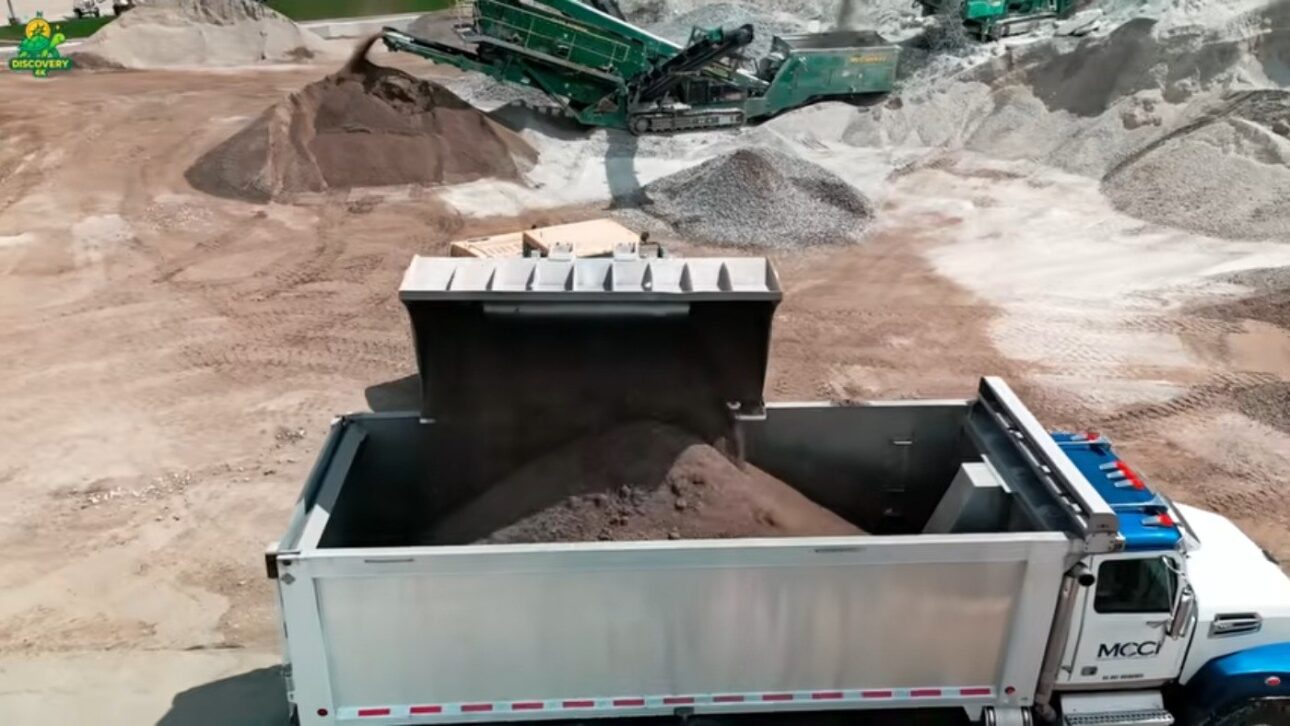
Concrete is the heaviest material in the yard and the one with the clearest route. According to TOP Discovery, slabs, foundations, sidewalks, and bridge pieces arrive in huge blocks, often with rebar still inside, and a loader feeds them into a primary crusher that closes its jaws with enough force to break the block into smaller stone.
Steel does not escape along the way. While the crushed concrete runs on the conveyor, suspended magnets pull rebar, wire, mesh, nails, and steel fragments, which fall into containers and leave the plant as scrap, as detailed by TOP Discovery. The material goes to vibrating screens that return what was too large to the crusher and direct the rest turned into recycled aggregate, which becomes road base, trench backfill, drainage stone, or structural fill for new construction.
Old asphalt becomes new asphalt: RAP
The old track doesn’t die, it is reborn. According to TOP Discovery, pavement removed from highways, streets, parking lots, and airport runways arrives in pieces, goes through crushers and screens, and becomes what is called RAP, an acronym for recycled asphalt pavement.
The cycle closes at the asphalt plant. Plants mix RAP with new aggregate and asphalt binder to produce new pavement, meaning old roads can become part of new roads, as TOP Discovery summarizes. It is one of the most direct examples of circular economy in infrastructure: the same material cycles, is scraped, crushed, and returns to the ground as pavement, cycle after cycle.
Ground wood, recovered gypsum, and the mixed waste line
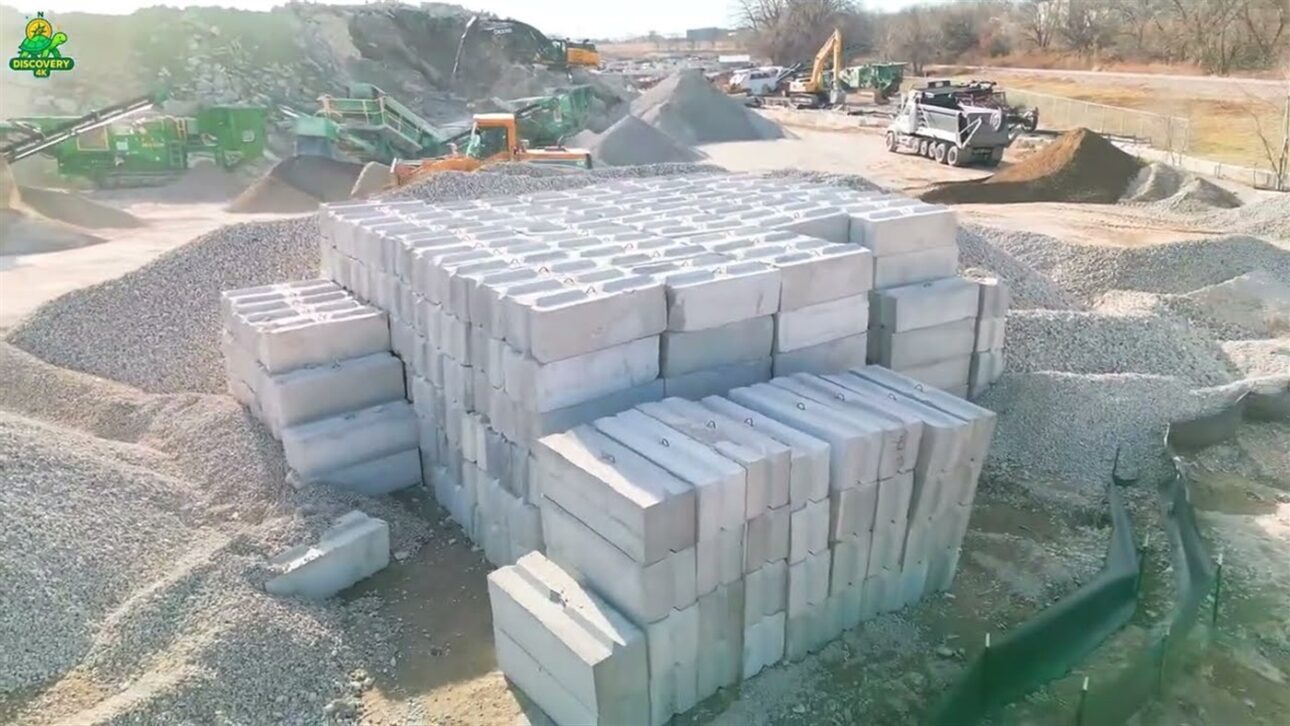
Each material has its machine. According to TOP Discovery, clean wood, pallets, and plywood are separated from painted or treated wood and go to a horizontal grinder, where rotating hammers reduce boards to chips, magnets remove nails and screws, and screens classify the pieces, which become mulch, biomass, compost, or animal bedding.
The most difficult case is the mixture. The mixed residue, which arrives with wood, plastic, plaster, cardboard, metal, insulation, and rubble in the same truck, enters a sorting line with conveyors, workers, screens, magnets, and air separators that pull the light, drop the heavy, and recover the usable, as shown by TOP Discovery. Even the plaster from drywall panels has its own route when it arrives clean: it is crushed, the covering paper is removed, and the recovered plaster returns for agricultural or industrial uses, which only works if the separation at the site has been well done.
What becomes what at the end of the line
The plant is not just one process, there are several production lines side by side. According to TOP Discovery, concrete becomes aggregate, asphalt becomes RAP, wood becomes chips, metal becomes scrap, and cardboard becomes fiber raw material, each requiring the right machine, the right size, and the right quality to become a product again.
The final destination is reuse in construction. Recycled concrete goes under roads, driveways, building platforms, and utility trenches; reclaimed asphalt returns to the hot mix; chips cover landscaping or become biomass energy; and recovered steel becomes new steel, as TOP Discovery concludes. The same rubble that entered the plant as construction waste exits on the other side as construction material, ready for the next site.
What Brazil is already doing with the rubble


The California standard has a direct parallel in Brazilian law. In Brazil, CONAMA Resolution 307, from 2002, and the National Solid Waste Policy, from 2010, require municipalities and construction companies to properly dispose of construction waste, known as RCC, which can represent more than half of the urban waste mass in many Brazilian cities.
The technology shown in the video is already in use here. Recycling plants for rubble scattered across Brazilian capitals and medium-sized cities crush concrete and masonry to become recycled aggregate, used in pavement base and concrete artifacts, exactly the same chain as the documentary, a notable parallel for the construction sector in the country. The difference between California and Brazil is not in engineering, but in the scale and enforcement of the landfill diversion target.
The video covers the demolition site, the scale, the crushers, the magnets, the sorting line, and the piles of aggregate, asphalt, and chips ready for reuse.
The Californian chain proves that rubble is not the end, it’s raw material waiting for the right machine. Tell us in the comments: would you build with recycled rubble aggregate in your construction?