Portuguese
  Spanish


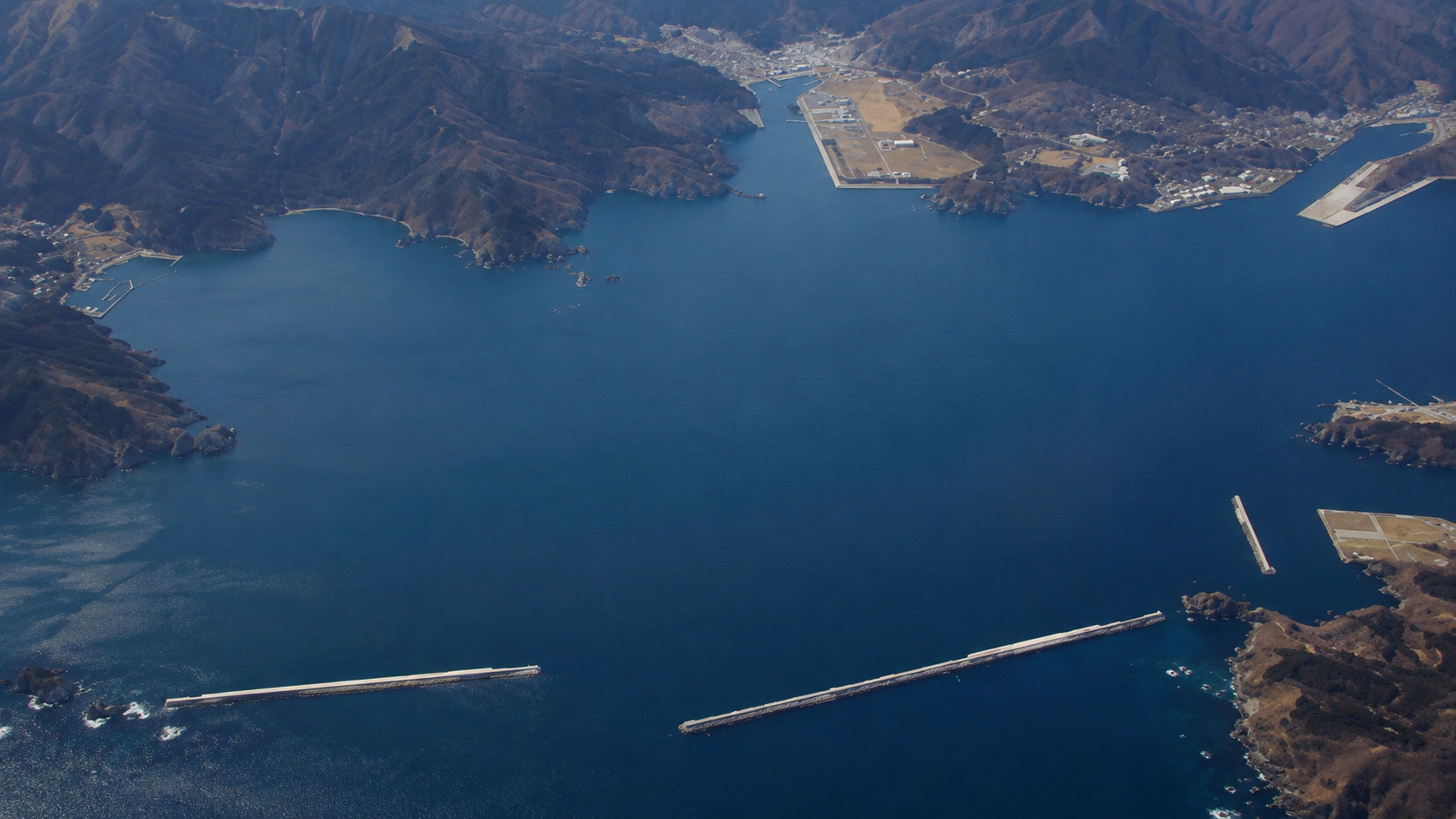

Japan built in Kamaishi the world’s deepest sea barrier, installed at 63 meters depth to reduce the impact of tsunamis.
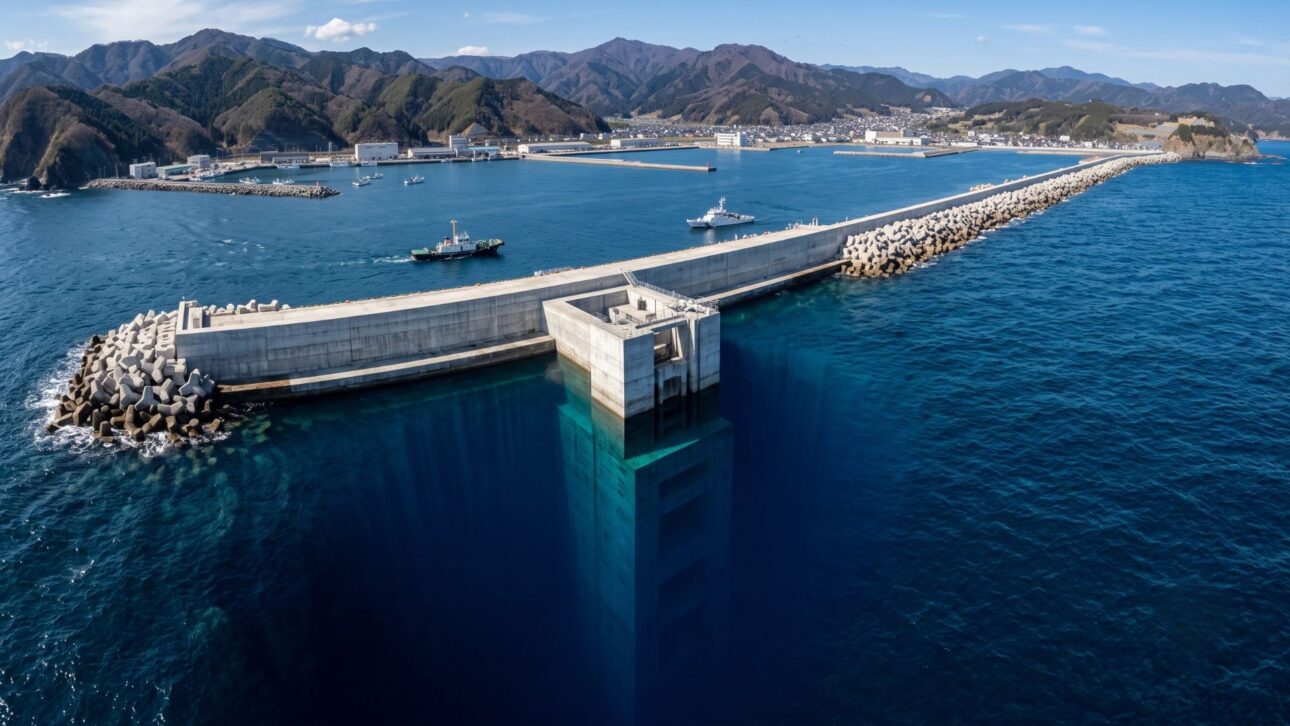
To protect Kamaishi, a port and industrial city in the province of Iwate, Japan executed one of the most daring maritime works ever completed on the planet. The country decided to install at the seabed the Kamaishi Bay Breakwater, a structure completed in 2009 and recognized as the deepest in the world, installed in waters reaching 63 meters.
The work began in 1978, took about 31 years, and required a total investment of approximately ¥120 billion, equivalent to US$ 1.5 billion according to the value cited by the World Bank. The goal was to reduce the energy of tsunamis before the waves advanced into the bay and reached the urban and port area of Kamaishi.
Japan took more than three decades to complete in Kamaishi a breakwater designed to reduce the force of tsunamis
The decision to build the structure did not arise by chance. The northeast coast of Japan has a severe history of disasters, including the tsunamis of 1896, 1933, and 1960, events that shaped Japanese coastal protection policy throughout the 20th century.
-
Pair Transforms Sunken Pontoon Bought for $4,000 on Facebook into 8,800-Pound Solar-Powered Tiny Home on Water

-
In Flood-Stricken South Sudan, Displaced Families Use Sand-Filled Plastic Bottles to Build Cooler, More Durable Homes

-
Mother Who Called Herself a ‘Pinterest Failure’ Learned Wood Furniture Restoration from Videos, Now Earns Around $15,900 Monthly

-
Denmark Constructs World’s Largest Immersed Tunnel to Connect with Germany, Sinking 217-Meter Concrete Sections in the Baltic Sea

In this context, Kamaishi became a strategic point. The city had consolidated industrial and port importance, and protecting the bay entrance became a central piece to reduce human, urban, and economic damages in future extreme events.
Kamaishi Breakwater was installed at 63 meters depth and reached almost 2 kilometers in length in the Pacific
When the work was completed in March 2009, it was already considered a milestone in maritime engineering. The project reached 63 meters depth at its maximum point and a total length of about 1,950 meters, earning it recognition as the deepest breakwater in the world.
More than half of the structure was deployed in sections with depths greater than 50 meters, which ruled out more conventional solutions. Because of this, engineers adopted a composite breakwater system, with a rubble mound base and large concrete caissons supported on the seabed.


The design also needed to respond to a high technical demand environment. The extreme depth increased costs, made execution difficult, and required specific solutions for structural stability, wave energy dissipation, and resistance to earthquake and tsunami-related loads.
Kamaishi underwater structure was created to dissipate wave energy before the tsunami entered the bay
The function of the system was never to completely block a large-scale tsunami. The logic of the work was to reduce the force, decrease the height of the waves entering the bay, and gain time for the evacuation of the population and emergency response.
This principle became even clearer after the disaster of March 11, 2011. According to the World Bank, even destroyed by the Tohoku earthquake tsunami, the breakwater managed to reduce the wave’s force and height by about 40%, as well as delay its arrival by approximately six minutes.
In an event of this scale, extra minutes make a real difference. The case of Kamaishi showed that even when the structure cannot prevent flooding, it can still mitigate the hydraulic impact and extend the escape window for the coastal population.
The 2011 tsunami destroyed parts of the breakwater, but transformed Kamaishi into a global reference on the limits and effectiveness of coastal engineering
The magnitude 9.0 earthquake and the 2011 tsunami placed the work in the most extreme situation in its history. The event exceeded the conditions considered in the original design and caused severe damage to the system, with destruction and displacement of structural elements of the breakwater.
Even so, Kamaishi remained at the center of the international technical debate. The case has come to be used as an example of two simultaneous realities: the engineering capacity to reduce damage in coastal disasters and, at the same time, the limits of any physical work when an event exceeds the design scenario.
Billion-dollar underwater project helped redefine how Japan thinks about coastal protection against tsunamis
After 2011, Japan reinforced the idea that structural measures alone are not enough. The World Bank notes that the disaster exposed the limitation of strategies overly reliant on dikes and breakwaters, leading the country to strengthen combined approaches, with infrastructure, evacuation, land-use planning, and alert systems.
Even so, the Kamaishi breakwater remains a global reference. Few projects have managed to combine record depth, port scale, decades of construction, and a real performance test against one of the largest tsunamis ever recorded in the modern era.