Portuguese
  Spanish


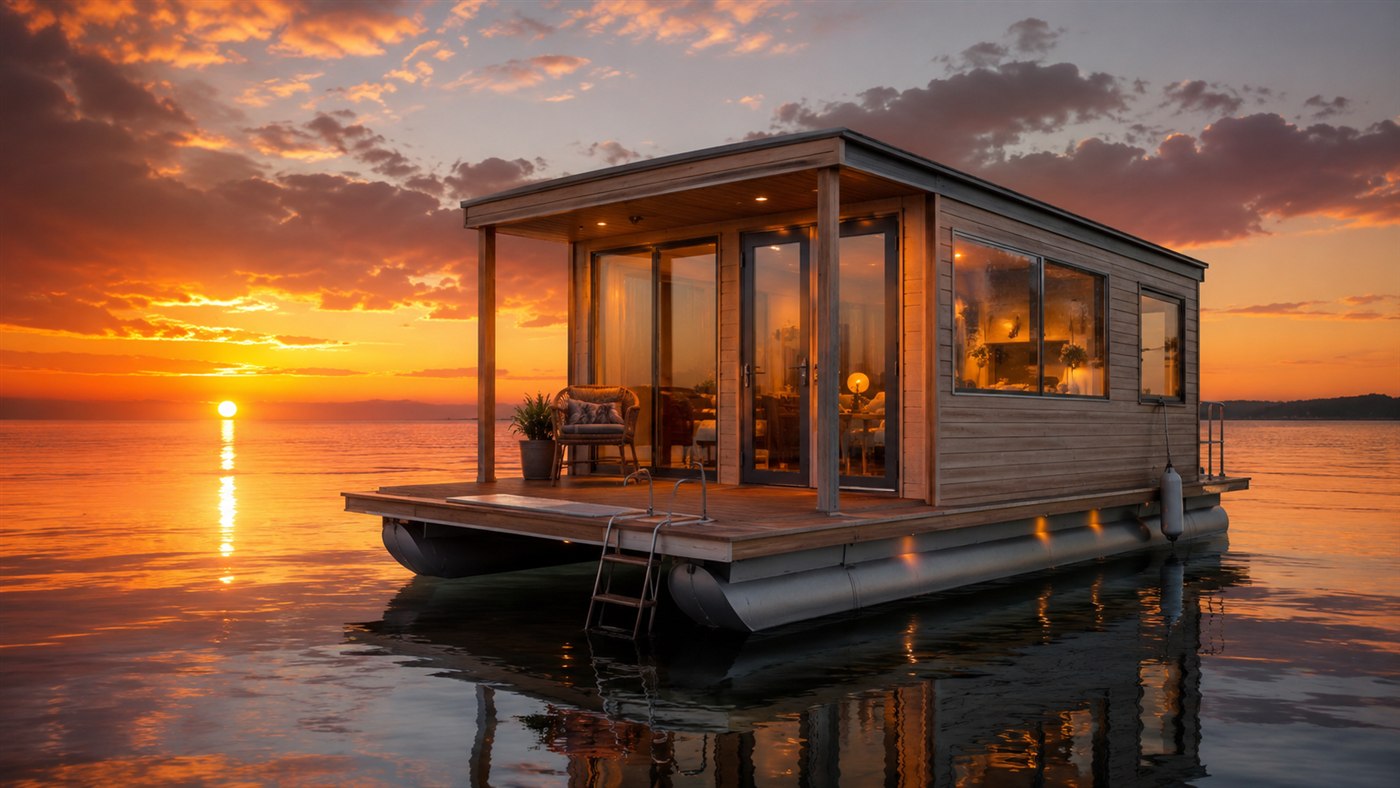

The Salvage to Scenic record shows the battle against the weight that almost crushed the floats, the reinforcements welded on the trailer, the rubber roof, and the six extra floats that doubled the buoyancy to reach 21,000 pounds
Buying a sunken boat for $4,000 seemed like a bargain, until the weight of the project became the villain of the story. According to the Salvage to Scenic channel, in a record published in March 2026, a duo bought a 24-foot pontoon that had sunk in a river, paid $4,000 on Facebook, and spent 14 months transforming the hull into a floating tiny home launched at sea.
The guiding thread of the entire project is a balance sheet. The boat and the engine already weighed about 1,000 pounds, leaving only 4,000 pounds to build the entire house without sinking the floats, a limit that the project far exceeded until reaching 8,800 pounds, equivalent to three Toyota Corollas, as Salvage to Scenic accounts. Each window, each cabinet, and each layer of material pushed the pontoon boat further down into the water.
The risky purchase and the trailer that bent like pasta
Every garage project starts with a bargain and a scare. According to Salvage to Scenic, the pontoon had sunk when holes appeared in the floats, but the seller assured that the holes were professionally repaired, and the almost new engine justified the purchase for $4,000.
-
In Flood-Stricken South Sudan, Displaced Families Use Sand-Filled Plastic Bottles to Build Cooler, More Durable Homes

-
Mother Who Called Herself a ‘Pinterest Failure’ Learned Wood Furniture Restoration from Videos, Now Earns Around $15,900 Monthly

-
Denmark Constructs World’s Largest Immersed Tunnel to Connect with Germany, Sinking 217-Meter Concrete Sections in the Baltic Sea
-
Low-Cost Concrete Panel House Goes Viral: Investor Reveals Prefabricated Kit Structure for Around $1,500, Assembled in 30 Days, with Plans for Rental and Resale Income



The first problem appeared during transport. The old trailer could only handle 2,000 pounds, against the estimated 5,000 pounds of the final set, so the duo bought another trailer rated at 7,000 pounds for $1,000, as Salvage to Scenic recounts. Even so, with the weight increasing, this trailer began to bend like pasta, and the solution was to weld trusses made from the old trailer underneath, stiffening the structure to prevent it from giving way.
The war against the weight that crushed the floats

The weight was not just a towing problem, it was a flotation issue. According to Salvage to Scenic, the rotten floor was completely replaced with a new one, twice as thick and with a layer of plastic underneath to block water, and two extra floaters were added to the originals, raising the flotation from 6,000 to 10,000 pounds.
The golden rule was not to sink the pontoons. With the water able to rise at most to half of the floaters, the set needed to stay below 5,000 pounds, but the structure exceeded 3,000 pounds still in the wall phase and already began to crush the pontoons, as Salvage to Scenic shows. The solution was to lift the boat with jacks and support all the weight on the trailer crossbeams, not on the floaters, an engineering patch that saved the project.
600 W of solar and the systems of a true tiny home
Inside, the boat became a complete home. According to Salvage to Scenic, the roof gained 600 watts of solar panels to charge the onboard battery bank, which began to power the house without ever needing to be plugged in again, in addition to a solar exhaust fan on the roof to remove moisture from the walls.
The finish was home-like, not an improvised boat. The construction received thermal insulation in the walls and ceiling, a waterproof rubber roof covered by nautical foam flooring, sliding glass doors at the front, a kitchen with cabinets made with the help of a professional carpenter, and a dining table that turns into a bed with electric actuators, as Salvage to Scenic details. Even a hot shower was included, with a gas tankless water heater, and the windows got automatic blinds to darken the bedroom.
The 6 floaters that doubled flotation to 21,000 pounds
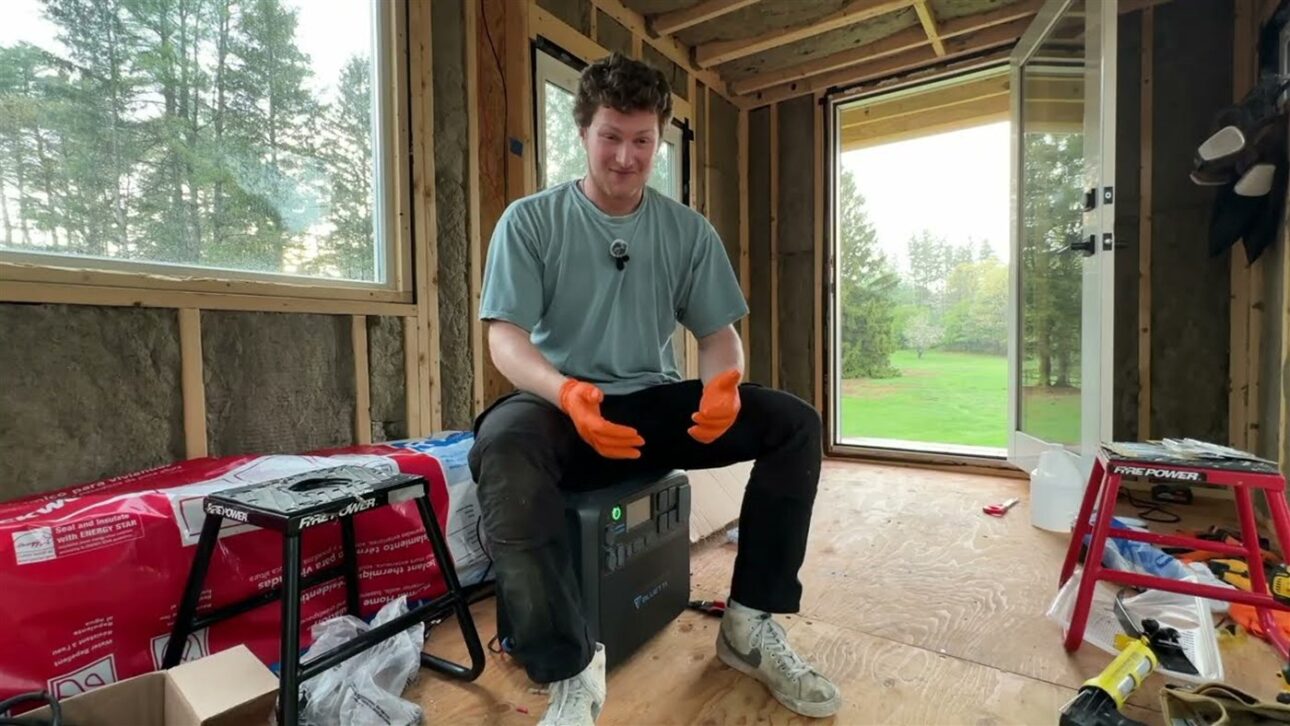
With the boat weighing almost twice as much as expected, floating became the final challenge. According to Salvage to Scenic, at 8,800 pounds the hull would sit too low in the water, and any wind or wave could flip it, which required flotation reinforcement before launch.
The stability calculation was completed with ease. Six foam core floaters were added, capable of adding up to 11,000 pounds of buoyancy, bringing the total theoretical flotation to about 21,000 pounds, equivalent to seven Toyota Corollas, as the Salvage to Scenic channel on YouTube explains. The floaters were attached by square aluminum tube beams, the most critical piece of the project, because a failure there could capsize the entire boat. Since the set was 12 feet wide, the floaters were made removable to fit on the road.
The 7-mile journey and the launch at sea
The project would only be worthwhile if it reached the water. According to Salvage to Scenic, the trailer axle, valued at 7,000 pounds, was replaced with a stronger one with electric brakes, and the houseboat undertook a 7-mile journey to the marina, with the chimney at 13.5 feet high, the legal limit for vehicles on the roads.
The final moment crowned the 14 months. After nearly scraping wires and branches and being stopped once by the police to check the height, the houseboat arrived at the Essex marina in Massachusetts and went down the ramp to float for the first time, with a rudder motor of double the power and a smooth pitch propeller to push the heavy hull, as Salvage to Scenic shows. The boat floated, proving that the buoyancy math worked despite the overweight.
What the project says to Brazil


The idea has a direct translation in Brazilian nautical culture. In Brazil, marinas and inland reservoirs are full of houseboats and adapted floaters, and the reuse of old hulls is a common practice among those who want to live or spend seasons on the water without paying for property.
The onboard engineering is the same that advances on solid ground. The combination of solar panels, battery banks, thermal insulation, and compact water and gas systems is identical to what enables tiny homes and off-grid sites in Brazil, showing that the house on floaters is just a variation of the same autonomous living concept, a notable parallel for the Brazilian reader. From the American pontoon to the Minas Gerais reservoir, the challenge is the same: balancing weight, buoyancy, and energy to live off the grid.
The video covers the purchase of the pontoon, the floor replacement, the battle against weight, the trailer reinforcements, the internal systems, the floaters, and the launch at the marina.
The pontoon boat transformed into a tiny home proves that homemade ingenuity can overcome even a sunken hull, as long as the weight calculation works. Tell us in the comments: would you live in a floating tiny home made from a $4,000 pontoon?