Portuguese
  Spanish


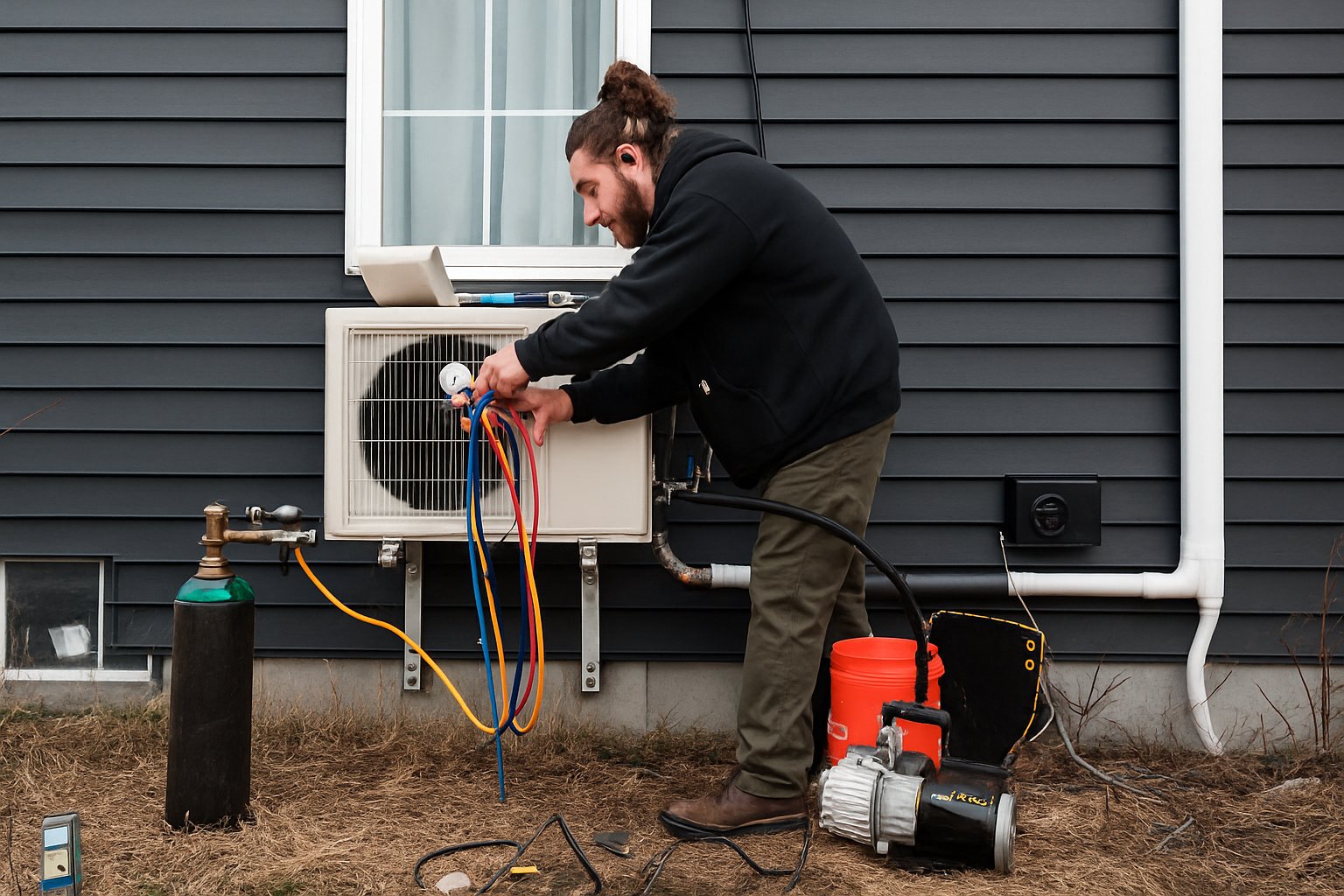

Discover How the Solar-Powered House in Canada Integrates Solar Energy, Heat Pump, and Thermal Battery for Efficiency and Low Cost.
Currently, the world is experiencing a moment of deep energy transformation. Thus, the search for sustainable and efficient solutions drives researchers and companies to develop technologies that reduce costs and decrease carbon emissions.
In this context, Canada stands out with an innovative initiative: the creation of a solar-powered house that integrates heat pump and thermal battery, allowing the achievement of a net energy consumption of zero.
This project is the result of a partnership between Western University in Ontario and Magnus Homes, supported by engineers specialized in clean energy.
-
More than 1,000 residents of a remote island in Kiribati now have clean water and electricity with solar systems operated by the community itself.

-
Island in Brazil Innovates by Installing 184 Solar Panels on Urban Lagoon to Generate Clean Energy
-
Japanese Island of 417 Residents to Test Living Half the Year Solely on Solar Power, Reducing Dependence on Diesel Brought by Ship
-
Brazilian Fishermen Use Solar Power to Produce Nearly One Ton of Ice Daily, Preventing Fish Spoilage Before Reaching Market



Historically, the residential sector accounts for a large portion of energy consumption and greenhouse gas emissions.
Since the Industrial Revolution, homes have relied on fossil fuels such as coal, oil, and natural gas. However, this model has significantly contributed to global warming and environmental degradation.
Fortunately, the advancement of solar technologies and heat pumps has opened new possibilities, allowing homes to reduce their environmental footprint and become more efficient.
Indeed, the house located in Komoka, west of London, operates as a true living laboratory, where researchers monitor real-time energy consumption.
Additionally, the solar panels capture energy from the sun and supply the house’s electrical systems, while the heat pump efficiently provides heating and hot water.
The central innovation lies in the thermal battery, which stores generated heat and enables the conversion of each unit of electricity into up to three units of heat, achieving efficiency of 300% or more.
This system utilizes phase change materials, such as salt or wax, maximizing resources and reducing waste.
Academic Leadership and Economic Viability
Professor Joshua Pearce and PhD candidate Shafquat Rana lead the project, while Jaime Crncich, president of Magnus Homes, brings the practical vision of construction.
Thus, the proposal goes beyond testing new technologies: it seeks to prove that a solar-powered house can be economically viable and environmentally sustainable.
Pearce emphasizes that, in Canada, solar energy costs are already lower than traditional grid electricity costs, which makes this solution a real alternative for families and businesses.
Furthermore, preliminary results show significant benefits.
The residence recorded a 45% reduction in electricity bills and a 55% decrease in carbon emissions.
Consequently, solar self-consumption increased by 60%, thanks to the thermal battery.
These numbers demonstrate that the combination of solar energy, heat pumps, and thermal storage can transform residential consumption, making homes more efficient and self-sufficient.
Historically, heating systems have evolved significantly.
Initially, homes depended on fireplaces and stoves. Later, centralized gas and electricity systems emerged.
Over time, photovoltaic solar energy revolutionized the sector, allowing for clean and local electricity generation.
Therefore, the Canadian house represents a step forward in this journey, integrating modern technologies in a practical and functional way.
Moreover, the project emphasizes that the energy transition should be accessible to everyone.
The adoption of integrated solutions, such as solar energy combined with heat pumps and thermal batteries, enables families to reduce costs and increase energy independence.
This encourages conscious consumption and strengthens the global movement for efficiency and sustainability.
Scalable Design and Comparisons with Conventional Residences
The design of the residence is scalable and adaptable, meaning it can be installed in existing homes with minimal modifications.
Thus, the solution is replicable in different contexts, allowing more families to adopt the solar-powered house model without building from scratch.
Optimized installation and operation practices make the system up to four times more efficient than traditional methods.
To measure the real impact, researchers monitor a similar residence without a thermal battery or solar panels, comparing the results.
In this way, the study demonstrates that the technology reduces costs, cuts emissions, and increases the comfort and autonomy of residents.
Additionally, smart sensors and a mobile app enable real-time monitoring and adjustment of energy use, ensuring greater control and efficiency.
The system also adopts preventive maintenance, detecting failures before they occur.
As a result, there is an increase in the durability of equipment and a reduction in operational costs, proving that the technology is reliable and sustainable in the long term.
Global Impact and Future of Electrified Houses
The electrification of residences is now a global sustainability strategy.
Countries that invest in solar-powered homes reduce emissions, decrease dependence on fossil fuels, and boost innovation in clean energy.
The Canadian case demonstrates that integrated solutions can adapt to different climates and energy realities.
Pearce emphasizes that the decarbonization of homes represents a concrete opportunity for sustainable growth.
The combination of solar energy, heat pumps, and thermal storage contributes to the fight against climate change and transforms the residential sector into a motor of energy efficiency.
Rana adds that the aim is to expand the solution to other regions, showing that it is possible to reconcile comfort, savings, and sustainability.
Moreover, the model inspires public policies to encourage residential electrification, strengthening the clean technology market.
Governments can create subsidies, credit lines, and educational programs to facilitate the adoption of solar-powered homes and accelerate the energy transition.
Technological Innovation Applied to Daily Life
The relevance of the project lies in bringing technological innovation to everyday life.
By integrating solar energy, heat pumps, and thermal batteries into a common residence, the Canadian team shows that cutting-edge technology can be within everyone’s reach.
Homes of different sizes and profiles can benefit from this integration, making the energy transition an accessible reality.
In summary, the creation of the solar-powered house in Canada proves that it is possible to reduce emissions, save energy, and maintain comfort simultaneously.
The project combines historical learning, technological innovation, and future vision, offering a replicable and scalable model for residences worldwide.
As the planet seeks alternatives to face the climate crisis, initiatives like this show that domestic innovation is key to a cleaner, more efficient, and accessible energy future.
The Canadian experience highlights that the energy transition is also an economic and social opportunity, in addition to being environmental.
Electrified, smart, and integrated homes are the path to reduce environmental impacts, promote efficiency, and inspire sustainable public policies.
Finally, it is clear that the combination of solar energy, heat pumps, and thermal storage will be increasingly essential in the construction of modern, comfortable, and environmentally responsible homes.