






 Portuguese
  Spanish
  5 min of reading
  0 comments


In Southwest China, Families Live Inside a Cave at Over 1,800 Meters Above Sea Level, with Electricity and Subsistence Agriculture, Maintaining Traditions Amid Isolation and Resettlement Attempts.
In Southwest China, in the province of Guizhou, a group of 18 families permanently lives inside a large limestone cave in a hard-to-reach area known as Zhongdong, in Ziyun County.
The location can only be accessed by a narrow mountain trail, and the daily routine is based on subsistence agriculture and the raising of small livestock.
There is electricity for lighting and basic equipment, but geographic isolation remains the main characteristic of the community, according to reports from Chinese and international press.
-
Neymar’s Family Sells 300,000 Bottles of Wine Before Launch, Aims for $20 Million Revenue in First Year

-
Cambridge Introduces 25m² Modular Homes to Bridge the Gap from Shelters to Permanent Housing
-
Facing high costs and limited expertise in Brazil, couple builds 27 m² tiny home on wheels for $36,000 using online resources.

-
Tired of High Rent in Portland, Newlyweds Buy 37m² Tiny House with 36 Cabinets, King-Size Bed, and Loft Office, Paving Way to Financial Freedom



Location and Structure of the Cavity
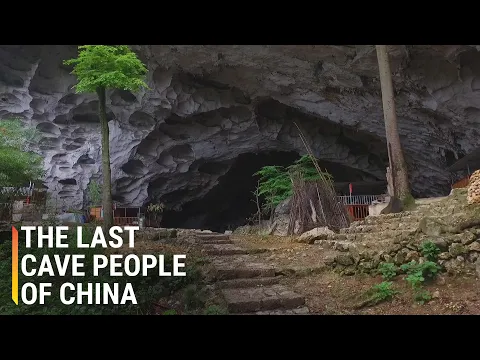
The cave where the residents of Zhongdong live is about 230 meters long, 115 meters wide, and over 50 meters high, according to measurements cited by outlets such as China Daily.
The shelter is approximately 1,800 meters above sea level and has an opening facing a valley, forming a space that, according to local geologists, provides natural protection against strong winds and heavy rains.

The houses were built without roofs, with lightweight wooden and masonry walls, utilizing the rocky ceiling of the cave.
The internal space has been divided over time to accommodate homes, storage areas, and pens, according to field records from researchers and journalists who visited the area.
Restricted Access and Pedestrian Movement
The access to the community is only via a steep mountain trail, which limits the transport of goods and the disposal of agricultural production.
The journey to the nearest villages can take several hours on foot, according to accounts from residents collected by international agencies such as Reuters.
Daily movement is part of local life.
Before the reorganization of education in Ziyun, children from the cave walked long distances to attend school.
A primary school once operated inside the cavity but was closed in the early 2010s, according to information from China Daily.
Since then, students have been traveling to institutions outside the valley, which requires long trips and periods in boarding schools.
Energy and Basic Supply
The community has electricity, resulting from local rural electrification projects.
The supply enables the use of lighting and some household appliances, but cooking and heating still depend on firewood.
According to Chinese reports, electricity has brought improvements to daily life, especially for children’s studies and food storage.
Water is obtained from natural springs and the drainage of the rocks inside the cave.
Residents use improvised reservoirs to store water during dry periods.
This practice is common in isolated communities in the region, according to researchers studying traditional water use in karst areas of Guizhou.
Agriculture and Livestock

Agricultural production focuses on the cultivation of corn in small strips of land on the nearby slopes.
The cereal is used both for the families’ consumption and as feed for poultry and pigs.
The manure from the animals is reused in the fields, creating a basic cycle of production and subsistence.
Small herds of cattle and goats complement the diet and can provide occasional income from the sale of animals, according to local studies on rural economy in mountainous areas.
During rainy periods, the access trail often becomes slippery, affecting the movement of people and goods.
In dry seasons, the focus shifts to maintaining crops and reserving water.
Exchanging help between families is a common practice used to compensate for labor shortages during agricultural peaks.
Historical Context and Cultural Identity
The permanent occupation of the cave has been recorded for several decades, and some families belong to the Miao Ethnicity, according to local government data.
The formation of the community occurred gradually, associated with the search for natural shelter and proximity to cultivable land.
The way of life is considered by researchers an example of adaptation to the geographical conditions of the karst terrain typical of Guizhou.

Inside the cavity, there is a spatial organization that separates dry and wet areas, preventing water that drains from the rocks from reaching the food supplies.
The residences are close to the entrance of the cave, where there is more natural light.
According to records from journalists and photographers’ visits, the arrangement of the homes follows practical criteria, aimed at space economy and ventilation.
Resettlement Attempts
The Ziyun government has promoted, at different times, resettlement programs to encourage residents of Zhongdong to move to nearby villages with access to basic services.
Some families accepted the move; others decided to remain in the cave, citing economic factors and attachment to the land, according to reports from Reuters and South China Morning Post.
The authorities justified the initiatives as part of an effort to reduce rural poverty and broaden access to infrastructure.
Experts consulted by the Chinese press state that Zhongdong’s case reflects a common dilemma in isolated rural areas of China: balancing respect for the communities’ choices with policies for development and territorial integration.
The “Last Cave Village” of China
Since the mid-2000s, Zhongdong has been mentioned in the international press as the “last cave village of China”, a term used to differentiate the location from communities living in dwellings carved into slopes, common in the north of the country.
This designation appears in outlets such as Taipei Times, Reuters, and China Daily.
The visibility has attracted one-time donations and support initiatives, but it has not changed the geographic isolation or the local productive structure.

Recent data indicates that the cave’s population has gradually decreased, with young people moving to cities in search of education and work.
According to local authorities, the number of resident families remains around 18 households, totaling about 70 to 100 people.
There is currently no specific public census of the community.
A Way of Life in Permanence
Life in Zhongdong remains organized around agricultural work and cooperation among families.
The combination of natural shelter, local resources, and community ties sustains the permanence in the area, even in the face of official incentives for resettlement.
Researchers monitoring the case point out that the decision to stay is related to the low cost of living, productive autonomy, and the cultural identity of the families.
Experts in rural development state that Zhongdong exemplifies the challenge of balancing tradition and modernization in hard-to-access areas.
In a country that has undergone intense urban transformations in recent decades, the village stands out for maintaining an almost unchanged routine, supported by family farming practices and limited natural resources.




-

-

-

-

-

-

84 people reacted to this.