






 Portuguese
  Spanish


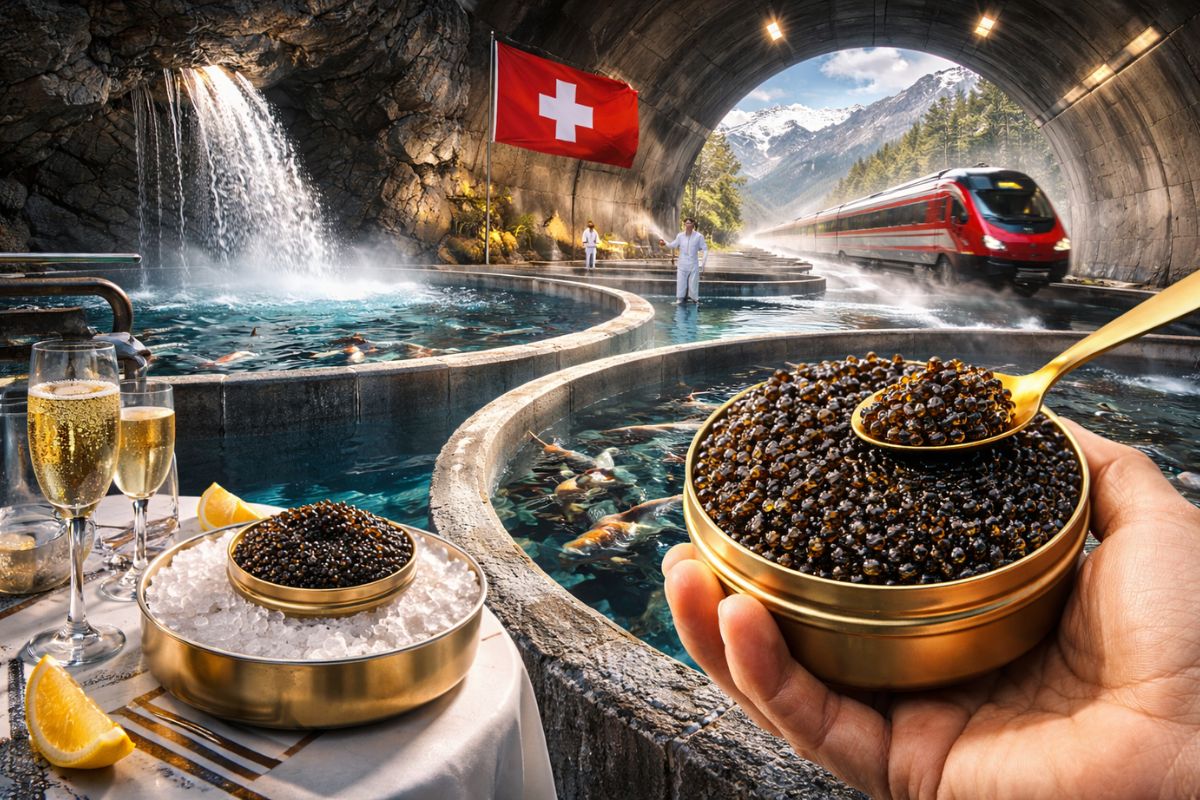

In Frutigen, An Accident in the Lötschberg Base Tunnel Turns into a Siberian Sturgeon Farm Using Geothermal Water, Producing Oona Caviar and Generating Millions a Year.
Instead of spending fortunes on mechanical cooling towers to deal with a hot water leak in the middle of the Alps, Swiss engineers decided to turn the problem into business. The geothermal water coming out of the tunnel at about 20 degrees now feeds a farm of 60,000 Siberian sturgeons, a caviar production line worth up to US$ 4,000 per kilo, and a model that generates millions a year by repurposing energy that would simply be discarded.
The result is a complex of 35,000 square meters, built above the northern portal of the tunnel in Frutigen, functioning as a parasitic organism linked to the railway. The same water that could destroy the ecosystem of the Kander River due to thermal shock is used to cool the system, accelerate the fish’s metabolism, and supply a luxury chain that exports the first caviar produced entirely within Switzerland.
The Accident of Engineering That Turned Into a Geothermal Gold Mine
The story begins as a classic problem of heavy engineering. During the construction of the 34-kilometer high-speed railway line of the Lötschberg Base Tunnel, excavating machines broke through a geothermal aquifer deep within the Alps.
-
King Charles III Discloses British Royal Family Finances, Revealing Million-Dollar Tax and How Public Funds, Historic Estates, Wind Farms, and Duchies Sustain a Billion-Dollar Monarchy

-
Brazil to Open $100 Million Military Theme Park Featuring Tank Rides and Immersive Experiences

-
Brazilian Multinational WEG to Supply 600 Motors for World’s Largest Lithium Reserve at Thacker Pass, a $2.2 Billion Project in Nevada Funded by U.S. Department of Energy

-
Brazilian Civil Servant Earns $2,800 Monthly but Seeks Legal Help as Bank Loans Consume Nearly 80% of Income


Suddenly, about 100 liters of water per second began flooding the infrastructure, equivalent to 86,000 tons of water per day, always at a constant temperature of 20 degrees Celsius.
The volume was enormous, but the main problem was the thermal energy. Dumping this hot water directly into the glacial Kander River would violate Swiss environmental laws and could sterilize the riverbed, eliminating vegetation and trout populations.
The obvious alternative would have been to build cooling towers, with a multimillion-dollar bill just to dissipate heat.
Instead, the engineers decided to channel the water into large concrete basins, build an industrial complex worth about 30 million dollars, and use gravity to their advantage.
Since the exit of the tunnel is nearly 800 meters above sea level, the geothermal water flows on its own to the facility, without relying on large pumps, ensuring a continuous and free flow 24 hours a day.
How the Water from the Tunnel Turned into a 60 Thousand Sturgeon Farm


The complex is divided into three large operational zones. Before the water sees the light of day, it passes through a capturing system inside the mountain, traverses 600 meters of insulated piping, and arrives at the farm at the exact temperature of 20 degrees.
This is the most sensitive point, as the drainage shares space with high-speed freight trains, bringing the risk of contamination from oil, chemicals, or brake dust.
In zone 2, the heart of the operation, the water enters a large internal hall with 40 channels and concrete basins.
This is not a scenic lake but a high-density protein factory where 60,000 Siberian sturgeons are raised under a continuous flow of water, oxygen at the saturation limit, and without the need for expensive mechanical aerators.
Zone 3 is the protective layer. There, a matrix of sensors at almost military level monitors the chemical composition of the water in real time.
If any trace of oil or chemicals is detected, giant steel valves automatically close, isolating the farm from the mountain and activating an internal recirculation mode.
This system allows the fish to survive for days without receiving a drop of water from the tunnel, protecting a stock worth millions of dollars from railway accidents.
Eternal Summer, Accelerated Growth, and Tasteless Mud Meat
The choice of Siberian sturgeon was not solely gastronomic but thermodynamic. In nature, this species faces long winters with water near zero degrees, enters metabolic dormancy, and can take 10 to 12 years to reach sexual maturity. In Frutigen, winter simply does not exist.
The farm uses the waste heat from the tunnel to maintain a permanent artificial summer of 20 degrees Celsius, the optimal metabolism point for this species.
This means that the fish never enter dormancy, grow continuously, and reach the egg production phase in about 6 to 8 years, shortening the investment cycle and increasing the return speed by about 40 percent compared to outdoor farms in cold climates.
Another differential lies in the water itself. Instead of shallow and stagnant ponds, prone to algae proliferation and geosmin production, the sturgeons swim in mineral water filtered for decades by the granite mass of the Alps, renewed in continuous flow.
This eliminates the muddy taste typical of farmed freshwater fish, reduces disease risk, and allows the entire operation to function without antibiotics, using fluid dynamics to keep the stock healthy.
Ultrasound, Biopsy, and Surgical Room for a US$ 4,000 Caviar
As the females approach maturity, the farm begins to operate almost like a medical center.
From the age of six, each sturgeon is captured with a net and taken to an ultrasound station. With high-resolution probes, technicians examine the abdomen to visualize ovaries and measure the diameter of the oocytes.
If the images indicate that the eggs have not yet reached the ideal size, the fish returns to the tank for another six months.
If the exam is promising, a small biopsy is performed, removing some eggs to assess color, firmness, and membrane resistance.
Only when the animal passes both the ultrasound and the biopsy does it enter the harvest queue, reducing the risk of losing a high-value fish with immature or past caviar.
When the time comes, the process is quick and silent to avoid stress. The fish are stunned in the water with an electric current, become unconscious, and are slaughtered without thrashing.
In the extraction room, ovaries that can represent up to 15 percent of the animal’s weight are removed, sifted, washed in cold water, and subjected to the malossol method, with less than 4 percent salt and no additives.
Since the processing plant is integrated into the farm, the time between the tank and the can is less than 45 minutes, preserving the freshness, texture, and characteristic pop of high-end caviar.
A System That Generates Millions a Year with Sturgeon Eggs and Meat

The final product, sold under the Oona brand, is the first caviar produced entirely on Swiss territory.
The top selection, number 103, can reach about 4,500 dollars per kilo, with an annual production between 800 kilos and 1.2 tons, representing a revenue flow of nearly 5 million dollars just from the eggs.
However, the operation does not stop at caviar. About 90 percent of the fish meat is utilized, filleted, and smoked on-site, generating approximately 20 tons of sturgeon meat per year and creating a second source of income that helps cover salaries and feed costs. This leaves most of the caviar profit practically as margin.
In practice, the farm transforms an industrial leak into a zero-waste protein circuit. Switzerland exports over 6 million dollars a year in Oona caviar and sturgeon meat from this facility, consolidating a model where an engineering accident generates millions a year by being redesigned as a luxury business based on science and energy efficiency.
Hidden Risks of Railway Caviar
Despite the technical sophistication and financial results, the system lives under permanent tension. The same railway infrastructure that offers free thermal energy is also the greatest threat of all.
A serious derailment inside the tunnel involving chemicals could contaminate the water beyond the valves and filters’ response capacity, compromising an entire stock valued in millions in minutes.
There is also the biological risk. The Siberian sturgeon is an exotic species in Western Europe. In an extreme scenario, with structural collapse or massive flooding, fish could escape into the Kander River and, further downstream, reach the Rhine, with the potential to compete with native species and even hybridize with local stocks.
Therefore, the farm needs to maintain nearly military-level biosafety standards, protecting both the external environment and the business that generates millions a year.
In 2024, the less profitable part of the project was closed. A tropical house that produced bananas and coffee using the same waste heat was deemed financially unviable and shut down. The plants exited the scene, but the sturgeons remained.
The message is clear: in extreme agriculture, only the component that sustains itself on the balance sheet survives, and here the one that pays the bill is railway caviar.
Prototype for Farms That Parasitize Infrastructure
The Tropical House Frutigen shows that the problem of intrusive groundwater in tunnels, mines, and subways can be seen as an opportunity. Large infrastructure projects around the world spend billions just to pump and discard infiltration water.
The Swiss model suggests that with engineering and risk management, it is possible to transform this water into high-value food, reducing dependence on the traditional power grid and taking advantage of energy that is currently wasted.
More than a curiosity, the system in Frutigen works as a prototype of parasitic agriculture, feeding on the energy waste of human infrastructure.
It is not a simple or risk-free path, but it opens a debate on how cities, tunnels, and industries can become involuntary hosts of new forms of food production.
And you, would you pay for Swiss caviar that comes from the water of a railway tunnel, feeds sturgeons with waste heat, and generates millions a year thanks to an engineering accident?


