Portuguese
  Spanish


Aerial Images Reveal Surprising Details of the Locomotive Ruins in Bolivia. The Exploration Drone in Uyuni Highlights the Train Cemetery as a New Icon of Industrial Tourism in a Country Close to Brazil.
One of the most surreal landscapes in Bolivia, the Uyuni train cemetery was recently mapped in detail through drone recordings. The aerial images show an impressive collection of about 100 rusty locomotives and abandoned cars, aligned in the desert, near the city of Uyuni. The recordings emphasize the scale and visual impact of the locomotive ruins in Bolivia, which have been resting under the scorching sun and salty air of the altiplano for decades. With this new aerial perspective, international interest in industrial tourism in Uyuni is growing, boosting the local sector and reigniting the debate about the conservation of this heritage.
A Little History About the Abandoned Trains in Bolivia
The emergence of the cemetery dates back to the late 19th century when Uyuni became a strategic point in the Bolivian railway system. The railway was primarily aimed at transporting minerals — especially silver — from the Potosí region to the Pacific Ocean ports.
During this expansion period, locomotives imported from England were sent to Bolivia. However, with the mining crisis in the 1940s and 1950s, the railway infrastructure was deactivated, and hundreds of cars and trains fell into disuse, being abandoned just a few kilometers from the city.
-
Retired Railway Workers in Brazil Preserve Locomotive for 52 Years, Now See It Donated by the Government

-
Railway returns to prominence in Brazil after STF approval: a R$ 25.2 billion project promises to save R$ 9 billion in freight, transport 50 million tons per year, and transform Sinop into a logistics powerhouse for agribusiness.
-
Retired trains leave European tracks and become tons of steel, aluminum, and copper in dismantling yards where recycling exceeds 90%, but batteries, composites, and electronics create a new frontier of railway waste.

-
The strategic railway of Santa Catarina will receive R$ 608 million, will undergo historic modernization, and could transform logistics between Mafra and the Port of São Francisco do Sul.


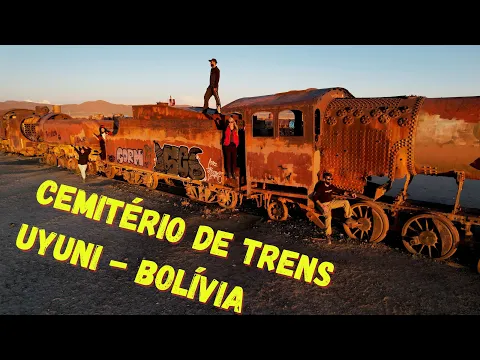

Over time, the climate’s action and abandonment transformed the site into a true Uyuni train cemetery, a scene that seems taken from a post-apocalyptic movie.
Exploration Drone in Uyuni Reveals Unseen Images
Technological advancements and the growing use of drones have provided new ways to view the world — including forgotten historical relics. In the case of the Bolivian locomotives, the use of the exploration drone in Uyuni revealed unprecedented images of the extent and condition (or deterioration) of the abandoned cars.
The images show more clearly the distribution of the trains and how time and neglect have affected the metal structure of the vehicles. Corroded, rusty, and partially dismantled, the trains now form a kind of open-air museum, a symbol of an industrial past that has faded over time.
Industrial Tourism in Uyuni Grows with the Popularity of the Images
With the viralization of the drone captures, the location gained more visibility in international travel circuits. Industrial tourism in Uyuni had already been growing due to its proximity to the Salar de Uyuni — the largest salt flat in the world — but recent videos have given new momentum to interest in the train cemetery.

Tourists visiting the region have included the site as a must-stop, whether for artistic photographs, historical exploration, or simple curiosity. The unique atmosphere of the place, combining nature, rusted iron, and silence, provides an unusual immersive experience.
Additionally, the train cemetery is often used as a backdrop for photoshoots, video recordings, and social media content, further increasing its popularity.
How to Visit the Uyuni Train Cemetery
The cemetery is about 2.5 km from the center of Uyuni. It is possible to walk there in about 30 minutes or take a taxi in just a few minutes for affordable rates. Entrance is free, and the location has no formal infrastructure — there are no ticket booths, fences, or fixed guides. The visit is self-guided.
Since the environment is open and the structures are in a state of corrosion, it is important to be extra cautious. Climbing on the locomotives may seem tempting for photos, but there are risks of cuts, falls, or injuries. The best approach is to observe carefully, always respecting the historical space.
It is recommended to visit in the early morning hours or at sunset, when the sunlight casts dramatic shadows on the metal carcasses, further highlighting the contrast between the abandoned machines and the highland sky.
Locomotive Ruins in Bolivia: Heritage at Risk
Despite its rustic beauty, the Uyuni train cemetery is at serious risk. The location lacks any type of legal protection or preservation program. Time, vandalism, and the removal of parts by locals or visitors have accelerated the degradation of this heritage.
Organizations linked to Bolivian culture and tourism have already discussed ways to protect the site, including the creation of an open-air railway museum, the delimitation of access areas, and the installation of informative signs. However, there are still no effective actions implemented.
The appreciation of this space should not be merely tourist-oriented. It is a physical and symbolic record of an era of industrial progress that marked the economic history of the country. Preserving it is also preserving the memory of an important phase in Bolivia’s and South America’s history.
Cultural and Economic Impact of the Abandoned Trains in Bolivia
The industrial tourism in Uyuni has the potential to generate positive economic impact in the region, especially in sectors such as hospitality, transportation, and food. Small businesses and local agencies are already offering customized tours that include a visit to the train cemetery.
Beyond the economic aspect, the site promotes debates about historical heritage, sustainable development, and the revaluation of neglected spaces. With proper public policies, this type of attraction can transform a degraded area into a cultural, educational, and tourist center.
Similar initiatives in European countries — such as railway museums or industrial tourism routes — show that this is a viable and interesting model, both for residents and visitors.
The Uyuni train cemetery is more than a collection of rusting cars forgotten in the desert. It is a silent testimony to an era of Bolivian industrial glory, now rediscovered through modern lenses, like those of drones.
The recently captured aerial images have transformed the way the world views this space. Now, the exploration drone in Uyuni not only revealed a greater dimension of the structures but also broadened the reach of the message the site conveys: memory, abandonment, resistance, and beauty.
For those visiting Bolivia, especially the Salar de Uyuni region, including this tour is a unique opportunity to experience living history, even if in ruins. For the country and for Latin America, it is a warning about the importance of looking back with respect — and ensuring that these stories, though rusted, do not disappear with time.