





 Portuguese
  English
  Spanish
 3 min of reading


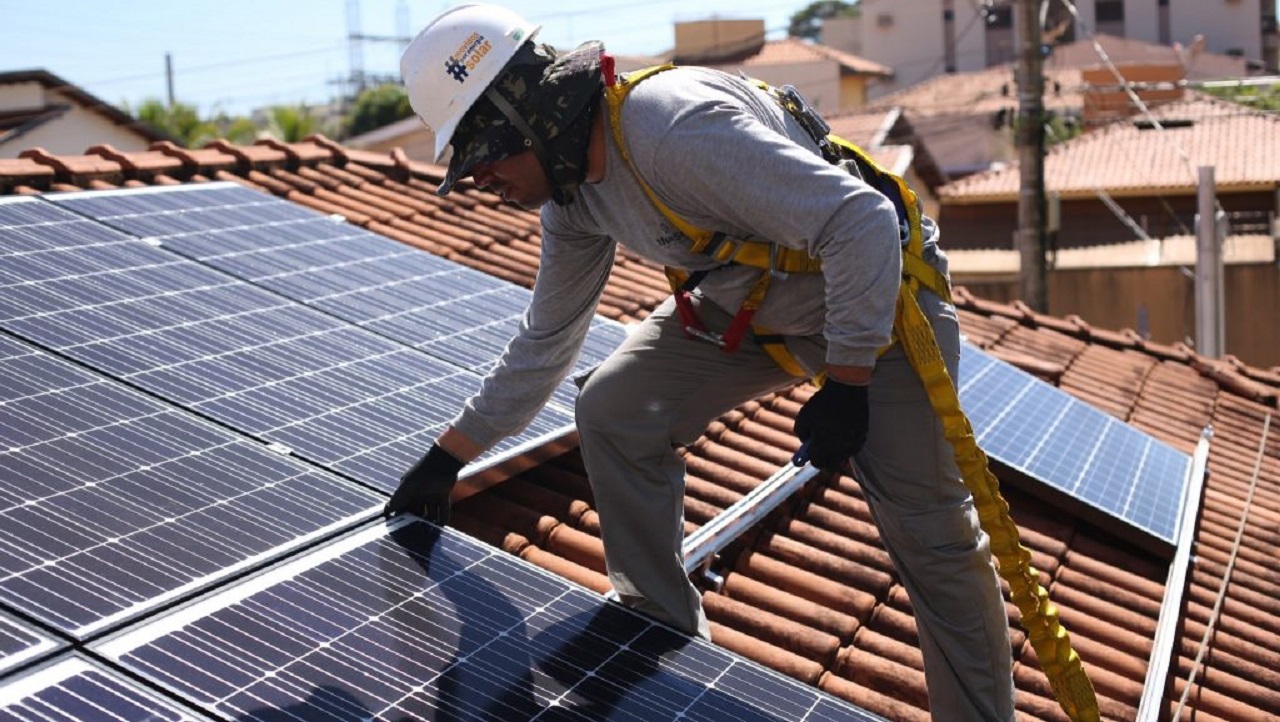
Cetam and Sedecti Are Offering Free Professional Training Course for Solar Panel Installers. The Free Course Has a Workload of 120 Hours.
The category of solar panel installers earns between R$ 1,500 and R$ 3,000 on average, but earnings can exceed R$ 5,000. This depends on many factors such as the professional’s level of knowledge, years of experience in the field, certifications, and similar. The solar panel installer can also earn in two ways: having a fixed salary while working for a solar company or as an entrepreneur in the solar energy sector.
The autonomous solar panel installer does not have a fixed income. However, for each installation completed, about 20% of the approximate profit margin is theirs, which corresponds to at least R$ 2,000.
Registrations for the Free Solar Panel Installer Course Provided by Cetam and Sedecti
Registrations for the free Cetam course in Amazonas will be conducted exclusively online, from 26th at 8 a.m. until 27th July, ending at 11:59 p.m.
-
Federal Institute offers more than 1,800 free technical course vacancies in Logistics, Electrotechnics, Mechanics, Nursing, Construction, and also options for higher education; see how to enroll and become a student at IFPE.

-
How much does it cost to install solar energy at home in 2026? This method of generating energy attracts attention for allowing a reduction in electricity expenses and an estimated financial return between four and seven years, with residential systems costing between R$ 15,000 and R$ 28,000.
-
More than 200 free and fully online courses with certificates are open for registration for people from all over Brazil, in areas such as technology, programming, management, and languages, and can be secured without fees, without a selection process, and only with a CPF and email until the end of June.

-
Take a free technical course and earn R$ 300 per month: there are 60 open slots in free technical courses to study Electrotechnics or Production Planning and Control (PPC) with support from SENAI-MS and the Bataguassu City Hall.




The public notice of the selection process is already available on this website. In total, 200 spots will be offered for the free solar panel installer course, divided among the cities of Manaus, Itacoatiara, and Parintins.
The free course will take place from August 8 to September 26 in person. The purpose of the free course is to stimulate the sustainable and economic development of the state of Amazonas, generating more jobs and income in this growing sector in the country.
Of the 200 spots available for the free solar panel installer course, 120 are allocated to the capital and the remaining 80 to Itacoatiara and Parintins. Men and women from the region can participate.
Cetam Director Discusses the Benefit of the Free Course for the State
In the city of Manaus, classes will be held at the Galileia unit, at the Estelio Dalison Vocational School and the Benjamin Constant Institute (IBC).
“The Government of Amazonas continuously updates Cetam’s course catalog, and the high demand for qualified professionals in the solar energy market in our region is being addressed through this partnership with Sedecti. The trend is for expansion and high employability,” emphasized Cetam’s president, Professor José Augusto de Melo Neto.
The solar panel installer course arose from a request from Sedecti, through the Executive Secretariat of Mining, Energy, Oil, and Gas – Semep, recognizing the great potential of Amazonas for solar energy generation.
Capacity of Amazonas in the Energy Sector
According to energy sector studies, Amazonas has a global horizontal irradiation of 4,825Wh/m², making it a very viable state for harnessing energy and generating electricity.
“Furthermore, in 2020, the Government of Amazonas created State Law No. 5,350, of December 22, 2020, concerning the State Policy for Incentives to the Use of Renewable Energy Sources and Energy Efficiency,” highlighted the Executive Secretary of Mining, Energy, Oil, and Gas of Sedecti, Marco Antônio de Oliveira Villela.
“The project of the law was formulated within Sedecti and allows for the stimulation of the use of renewable energy sources and also focuses on the interiorization of sustainable development in Amazonas, promoting training programs and human resources development, to effectively utilize solar energy systems,” Villela detailed.





Be the first to react!