Portuguese
  Spanish


BYD confirmed that it is developing humanoid robots and is considering selling them in its dealerships worldwide. The Chinese manufacturer wants to leverage the same batteries, motors, and artificial intelligence from its cars to create the machines, but there is no launch date or price yet.
Imagine entering a dealership and, instead of a car, leaving with a humanoid robot. This is the future that BYD, the largest electric car manufacturer in China, is envisioning. The company confirmed that it is developing humanoid robots and is evaluating selling them in its own network of dealerships spread around the world.
The information was provided by Li Ke, executive vice president of BYD, in a recent interview. According to the IG portal, the same batteries, electric motors, sensors, and artificial intelligence systems from the brand’s vehicles can be utilized in the humanoid robots. For now, however, there is no launch date, price, or confirmed specifications.
Why BYD wants to sell humanoid robots in dealerships
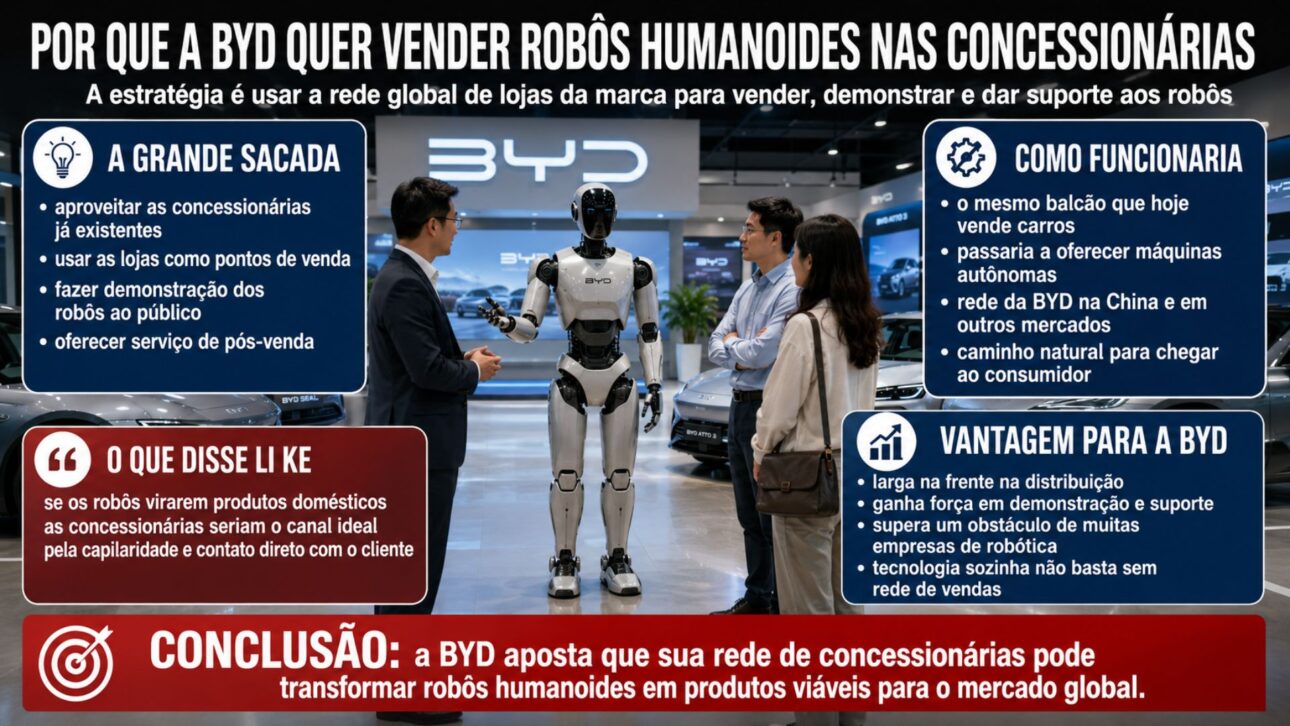
The great idea of the strategy is the sales channel. Instead of creating a structure from scratch, BYD intends to leverage its global presence, especially the brand’s dealerships, to transform them into sales points, demonstration locations, and after-sales service for the humanoid robots.
-
Experts Warn: Aging NASA Launch Facilities Could Hinder Artemis Moon Mission Progress

-
Self-Driving Harvester Now Operating in Brazil’s Vast Farmlands
-
Astronomers Discover Two Giant Exoplanets as Light as Cotton Candy, Challenging Current Scientific Models 1,110 Light-Years from Earth
-
NASA’s Plan to Dump ISS Debris in Ocean Sparks Environmental Concerns Among Scientists


It would be the same counter that today sells cars, now offering autonomous machines.
According to Li Ke, if these robots become products for domestic use in the future, the company’s vast network of dealerships, in China and other markets, would be the natural path to reach the consumer.
With this, BYD could get ahead of robotics companies that dominate the technology but still face difficulties in selling and supporting products worldwide.
Batteries, motors, and artificial intelligence: the bridge between car and robot
The bet makes sense because cars and robots share a lot of technology. According to Li Ke, the artificial intelligence used in automobiles and robotics has the same foundation, as both rely on perception, decision-making, motion control, and integration between software and hardware.
In practice, humanoid robots gather components that are already in smart vehicles, such as sensors, electric actuators, batteries, and computing platforms.
This is where BYD‘s advantage comes in. As one of the largest automakers in the world, having sold over 321,000 vehicles in April 2026 alone, the company has production scale and supply chain mastery to manufacture complex hardware at a lower cost.
The batteries, one of the company’s specialties, and the experience in automotive artificial intelligence are precisely the assets the company intends to transfer to the robots.
A project that started in 2022 and an open platform
BYD‘s interest in robots is not new. According to reports from the specialized press, the company is working on an internal humanoid robot project, codenamed Yao-Shun-Yu, initiated in 2022 within a unit dedicated to electronics and intelligence.
The idea under study is to set up an open platform, where BYD manufactures its own robots and, at the same time, accommodates products developed with partners, which would help accelerate development.
Li Ke also conducted a sector analysis to justify the company’s entry. According to her, robots made in China still lack a good brain, while those from the United States have a strong brain but weak limbs, and BYD‘s goal is to deliver balanced machines on both fronts.
The executive even commented that the company itself could be a major buyer of the robots, using the machines in its factories.
No release date and in a race with Tesla and others
Despite the enthusiasm, it is necessary to separate the plan from reality. BYD has not confirmed a release date, price, or technical specifications for the humanoid robots, which keeps the project, for now, in the realm of intentions.
The path to the dealership shelf is still long and full of technical and cost challenges.
The company is also not alone in this race. Companies like Tesla, Hyundai, and XPeng are investing in similar projects, aimed at uses in commerce, industry, and residences, and the Chinese company Chery has already put the humanoid Mornine M1 up for sale.
Most of these products, like BYD‘s, are still planned for the coming years, making the competition for the consumer’s living room a medium-term bet.
Buying a humanoid robot at the same dealership where you buy an electric car is the kind of scene that seemed distant and has now entered BYD’s plans.
Tell us in the comments if you would take home a humanoid robot from BYD and what you would use it for in your daily life.