Portuguese
  Spanish


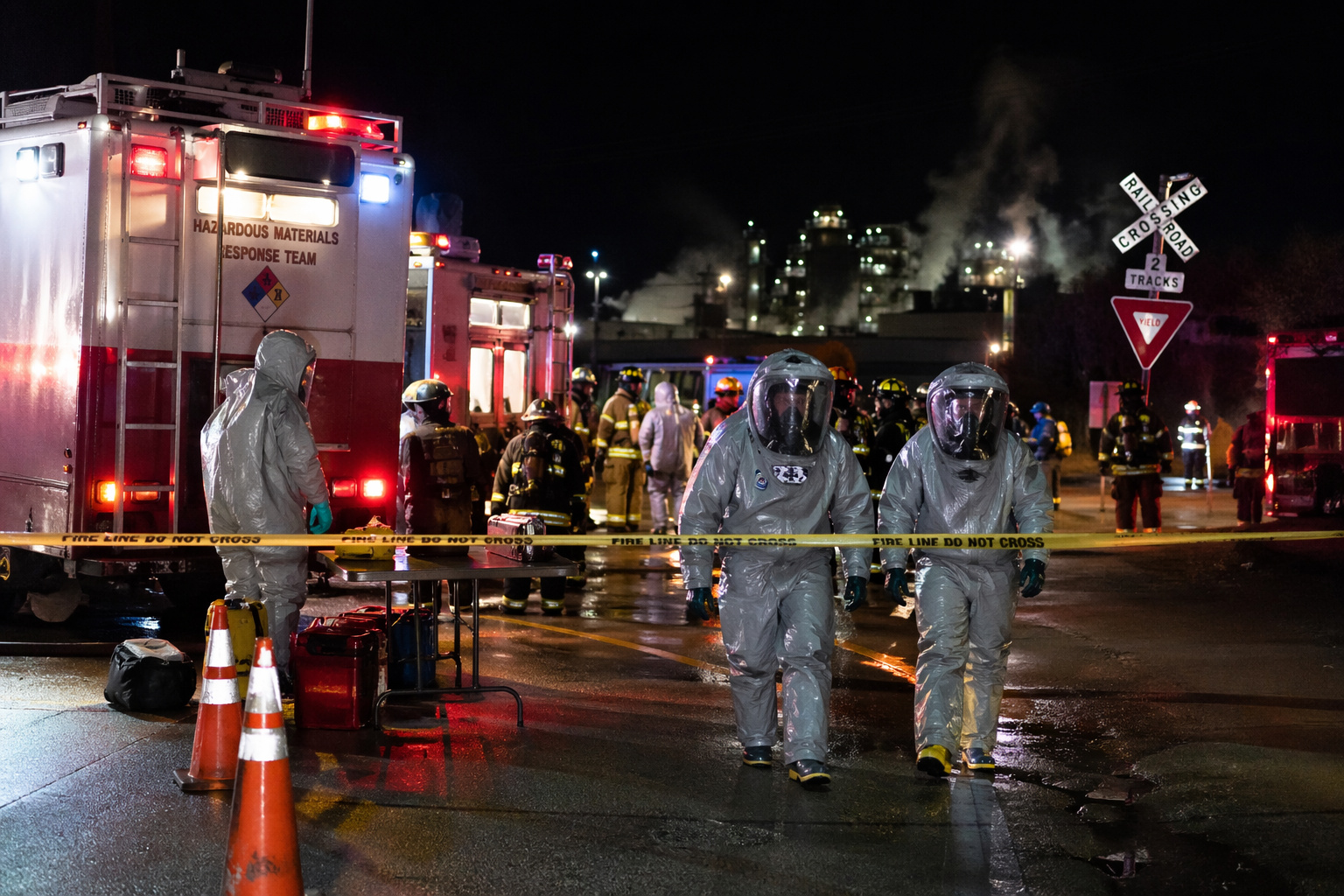

The industrial sector of the United States is facing a moment of deep mourning this week. A serious chemical accident occurred in Institute, West Virginia, last Wednesday. The leak happened suddenly at the Catalyst Refiners facility, resulting in the immediate death of two plant employees.
In addition to the confirmed fatalities, about 30 people required urgent hospital medical attention after exposure. Among the injured are seven paramedics who were attempting to carry out the initial rescue of the victims.
The company involved belongs to the Ames Goldsmith Corporation, and the incident has completely halted industrial activities in the region.
-
Qantas and Airbus Invest in Company Aiming to Convert Unsorted Household Trash into Jet Fuel

-
12-Year-Old Girl Survives Over a Day Trapped in Rubble After Devastating Venezuela Earthquake, Credits Ketchup, Cheese, and Hope
-
Brazil’s ANP Opens 86 New Oil Blocks in the Equatorial Margin, Expanding the Amazon River Mouth Frontier

-
OPEC+ Boosts Oil Supply by 188,000 Barrels per Day in July 2026, Leading to Price Drop from $112 to $89 per Barrel in Under Two Months


The critical moment when routine cleaning became fatal
According to preliminary investigations, the leak occurred during a decontamination procedure at the plant. The facility specializes in the recovery of silver from exhausted catalysts. Paradoxically, the process of cleaning industrial tanks is one of the most dangerous moments in any chemical plant, justifying local concerns.
Experts believe that an unforeseen chemical reaction occurred within the piping system during the shutdown of operations. As a result, there was an instantaneous release of a dense cloud of hydrogen sulfide ($H_2S$).
However, the gas is extremely lethal at high concentrations and causes a blockage of the workers’ reaction capacity within seconds.

The invisible dangers and the olfactory paralysis of hydrogen sulfide gas
Hydrogen sulfide is often nicknamed “rotten egg gas” due to its characteristic odor. However, the real danger lies in the fact that at elevated levels, it causes immediate olfactory paralysis. Thus, the victim stops smelling and mistakenly believes that the danger has passed.
The substance acts by blocking cellular respiration very aggressively, similar to cyanide poison. Unfortunately, workers lose consciousness before they can seek help or use oxygen masks. Therefore, exposure to $H_2S$ requires continuous electronic monitoring systems.
Rescue at risk and the impact on West Virginia paramedics
The speed of the leak was so high that it even surprised emergency teams trained for this scenario. Seven paramedics needed to be hospitalized due to what is called secondary contamination. Chemical residues on the clothing of the initial victims may have poisoned the rescuers during transport.
Currently, the condition of one of the injured is still considered critical by the local medical team. Health professionals are now monitoring for possible neurological and respiratory sequelae in all 30 survivors. In fact, the central nervous system can suffer permanent damage after deep inhalation of this type of toxic gas.
The science behind the accidental formation of toxic gas ($H_2S$)
To understand the origin of the tragedy, experts are analyzing the chemical processes of Ames Goldsmith. The company uses silver catalysts for the production of ethylene oxide, an essential component for plastics.
During the recovery of the metal, the use of strong acids is common to dissolve chemical residues. Therefore, if sulfur residues come into contact with acidic substances in a closed environment, the reaction generates the lethal gas: ($$FeS + 2HCl \rightarrow FeCl_2 + H_2S \uparrow$$)
Certainly, this mixing error or sealing failure is the central focus of the ongoing technical investigations now.

The history of industrial safety in the so-called “Chemical Valley”
The city of Institute has a tense and historical relationship with large corporations in the sector. The region is part of the industrial hub known as the Chemical Valley, where the risk of accidents is monitored by the population. The proximity of residential areas and universities makes any failure a very serious public safety risk.
In this context, the families of the deceased employees are now seeking justice and transparency in the reports. Frank Barber, the corporation’s president, issued an official statement expressing deep regret for the incident.
However, the local community demands an immediate review of all emergency plans for neighboring plants.
Federal investigations and OSHA’s role in the Catalyst Refiners case
The federal government has already assigned elite agencies to investigate the technical causes of the leak in Institute. OSHA (Occupational Safety and Health Administration) leads the analyses on compliance with labor standards. Similarly, the Chemical Safety Board sent technicians to reconstruct the events of last Wednesday.
The objective is to determine if there was negligence in the maintenance of gas sensors or failure in Personal Protective Equipment (PPE). If protocol violations are confirmed, the company could face heavy fines and criminal charges. Therefore, the authorities’ rigor aims to prevent new leaks from occurring in other plants of the group.
The need for constant vigilance in the chemical industry
This tragedy in West Virginia serves as a grim reminder that chemical risk is never zero. The balance between industrial productivity and human safety is extremely delicate and requires absolute vigilance. The lives of workers and first responders cannot be put at risk by basic operational failures.
While the community awaits the discharge of the injured, the lessons from this accident must be shared globally. Industrial safety is not just a list of rules, but a culture of daily protection. Furthermore, we wish strength to the victims’ families and that justice be served after the conclusion of all technical investigations.
Do you believe chemical industries should have stricter isolation protocols in urban areas? How can we ensure that first responders are 100% protected against invisible gases? Leave your opinion in the comments below.