Portuguese
  Spanish


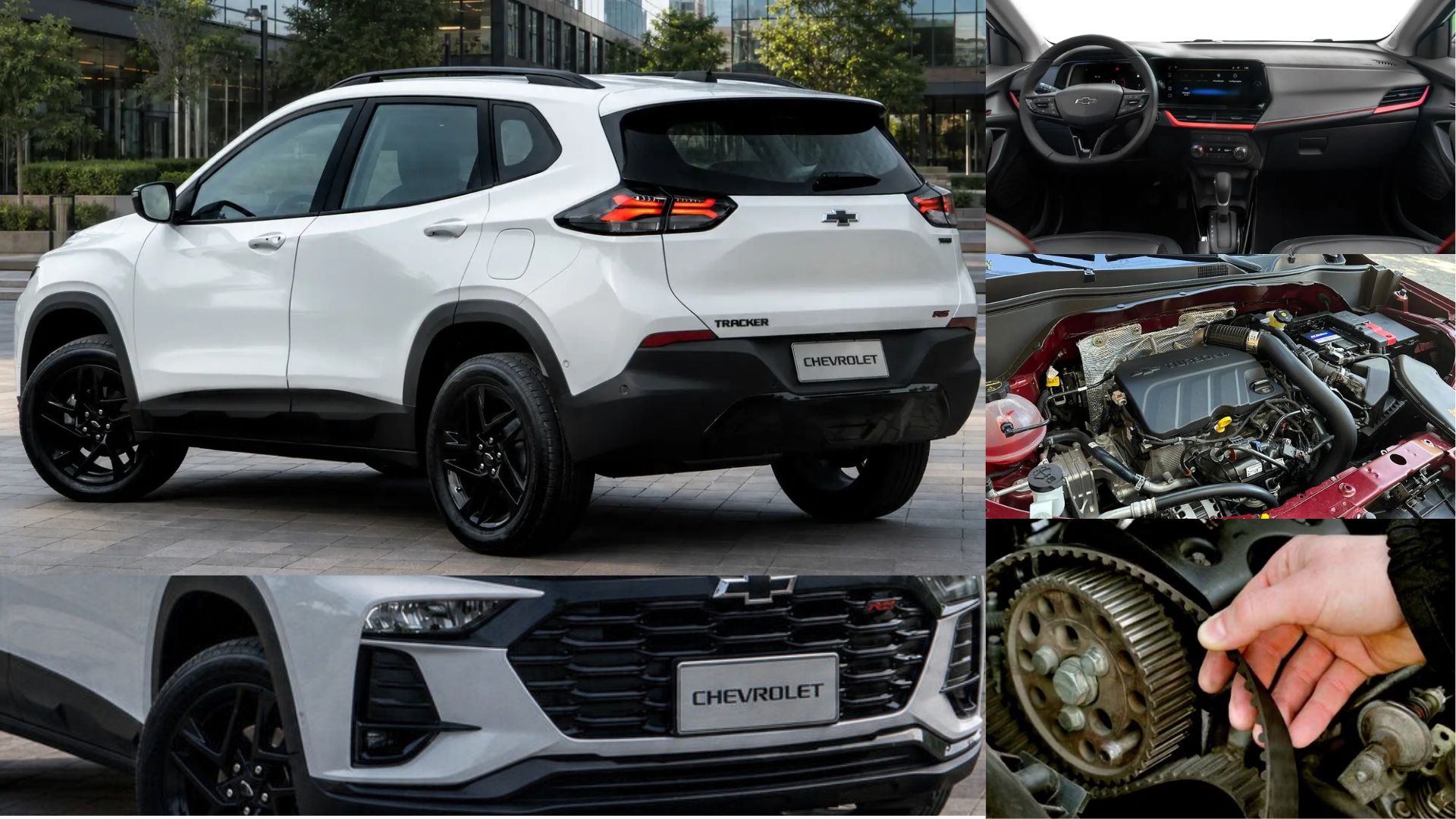

Tracker 2027 arrives with more active safety, connected services for eight years, and maintained turbo flex engines, while Chevrolet prepares a future 48-volt mild hybrid version to expand the national offer of the compact SUV.
Chevrolet launched the 2027 Tracker line with enhanced safety package, return of the Stop/Start system in 1.0 turbo versions, and expansion of connected services, without altering the known mechanical set or the oil-bathed belt of the turbo flex engines.
In the Brazilian market, the compact SUV continues to be sold in five configurations, with suggested prices starting at R$ 119,990 and a 1.2 turbo engine of up to 141 hp in the more expensive versions of the range.
Among the most relevant changes, the advancement appears in the offer of driving assistance, which now reaches more versions and places active safety features in intermediate configurations of the model.
-
Toyota Corolla Hybrid Achieves 17.5 km/l in City with Self-Charging System and Regenerative Braking, Offering a Spacious and Quiet Ride Without Needing a Plug

-
Land Rover Issues Recall for Airbag Connector Fault Affecting 250,857 Vehicles in the US, Alerting Drivers in Brazil for Official Notice

-
Brazilian Electric Motorcycle Once Promised 180 km Range and Affordable Price, Now Faces Uncertain Future Amid Delays and Manufacturer’s Bankruptcy
-
Chery Stockman 2026 Unveiled: Larger Than Toyota Hilux, Featuring Unique Plug-In Hybrid Diesel Engine, 3.5 Ton Towing Capacity, and 1,000 kg Payload to Challenge Traditional Off-Road Trucks


Starting from the LT version, the Tracker comes from the factory with front pedestrian and cyclist detection alert, low-speed automatic emergency braking, and lane-keeping assist system.
Installed in the windshield area, the new high-resolution camera supports this package and expands the capture area by 40%, allowing better reading of vehicles, pedestrians, cyclists, and different types of surfaces in risk situations.
Chevrolet Tracker 2027 gains more active safety

In the entry-level version, called Tracker 1.0 Turbo AT, the access proposal to the range was preserved, but the new active safety package was not incorporated into the standard content.
For this configuration, the main novelty is the return of Stop/Start, a system that automatically turns off and restarts the engine during traffic stops to reduce consumption and emissions in urban use.
According to GM, the feature can generate a gain of up to 0.5 km/l in urban cycle, depending on driving conditions, traffic faced, and the driver’s usage pattern.
This technology now equips the configurations with a 1.0 turbo engine, always associated with a six-speed automatic transmission, a combination that remains the mechanical base of the more accessible versions.
Just above, the LT version focuses on the greatest evolution of the 2027 line by combining new safety assistants with an 8-inch digital instrument panel, 11-inch multimedia center, and high-resolution rear camera.
The package of this configuration also includes the roof rack, trunk cover, and central console with armrest, items that enhance convenience without changing the version’s positioning.
In the LTZ, the Tracker adds blind spot alert, tire pressure monitoring, digital air conditioning, 17-inch alloy wheels, LED taillights, and seats with premium upholstery.
With this content, the configuration remains the most complete among the options equipped with the 1.0 turbo flex engine, before transitioning to versions with the 1.2 engine.
Turbo flex engines remain unchanged

Without changes to the mechanical base, the Tracker 2027 maintains the already known turbo flex engines, always combined with a six-speed automatic transmission in all configurations sold in the country.
In the 1.0 versions, the engine delivers up to about 115 hp and a maximum torque of 18.9 kgfm, while Premier and RS use the 1.2 turbo engine, with up to 141 hp and 22.9 kgfm.
The continuation of the oil-bathed belt accompanies the continuity of the mechanical architecture used in the family’s turbo engines, a point that remains one of the technical characteristics of the set.
In the previous cycle, Chevrolet had updated this component in the 2026 line, when the Tracker received adjustments to the 1.0 turbo engine to meet new efficiency and tax compliance requirements.
Among the options with the 1.2 turbo engine, Premier and RS occupy the top of the range but adopt distinct proposals for finish, equipment, and visual presentation.
Aimed at comfort and convenience, the Premier features an interior finish in black and beige tones, a panoramic electric sunroof, wireless phone charger, and Easy Park system, which assists in parking maneuvers.
With a sporty visual appeal, the RS bets on a honeycomb-style grille, darkened details, roof rack, and black mirror caps, in addition to 17-inch alloy wheels with diamond finish.
Inside, this configuration maintains its own ambiance, marked by specific upholstery and red details, without changing the mechanical set compared to the Premier.
Prices and versions of the Tracker 2027
In the table from line 2027, the Tracker 1.0 Turbo AT appears as the entry configuration, with a suggested price of R$ 119,990 in the information released about the launch.
The LT version appears for R$ 145,490, while the LTZ costs R$ 160,790 and ends the offer equipped with a 1.0 turbo flex engine.
With the 1.2 turbo engine, the Premier has a suggested price of R$ 177,990, while the RS tops the range at R$ 178,990.

These values position the Tracker among the high-volume automatic compact SUVs in the Brazilian market, in a segment contested by models that combine turbo engines, technology packages, and different levels of finish.
The entry version remains below the R$ 120,000 range, a relevant point for direct sales modalities and for consumers who follow tax benefit rules, although the application of exemptions depends on specific legislation and each purchase profile.
Free OnStar for eight years in the compact SUV
In the connectivity field, the 2027 line now offers a broader package of digital services, highlighting the extended free OnStar service in all Tracker versions.
All configurations now include eight years of free OnStar Basics plan, which includes remote diagnostics and access to the myChevrolet app for functions like vehicle location and remote door locking or unlocking.
In the more complete versions, the package also allows remote engine start for pre-climatizing the cabin, a feature aimed at improving comfort before the occupants enter.
The strategy had already appeared in the Chevrolet Sonic, the national coupe SUV launched by the brand, which inaugurated the new structure of connected services adopted by the 2027 line.
Externally, the visual update is discreet and focuses on the color palette, as the bodywork preserves the design presented in the previous restyling.
With the change, the Amber Gray replaces the Rush Gray, bringing the Tracker a metallic tone that had already been adopted in other recent Chevrolet models.
The dimensions remain unchanged, with 4.304 meters in length, 1.791 meters in width, up to 1.626 meters in height with a roof rack, and 2.570 meters in wheelbase.
In the trunk, the capacity remains at 393 liters, a volume that keeps the SUV within the family proposal expected for the compact segment.
Hybrid flex Tracker still postponed
Despite the anticipation around electrification, the hybrid flex version of the Tracker has not yet been incorporated into the 2027 lineup just launched by Chevrolet.
GM has already confirmed investment to develop hybrid flex vehicles in the country, but has not officially detailed all the models that will receive the technology within the new product cycle.
For the Tracker, the expected solution is a 48-volt mild hybrid, similar to that adopted by some competitors in the Brazilian market.
In this arrangement, an electric system assists the combustion engine at specific moments, such as starts and accelerations, but does not drive the vehicle alone as occurs in full hybrids.
In 2024, General Motors announced that Brazil will be the first market in the world to receive its hybrid flex technology, as part of a strategy aimed at combining electrification and local fuels.
The project is part of an investment cycle of R$ 7 billion in the country between 2024 and 2028, including R$ 5.5 billion allocated to operations in São Paulo, development of hybrid flex engines, and portfolio updates.