





 Portuguese
  English
  Spanish
  5 min of reading
  0 comments


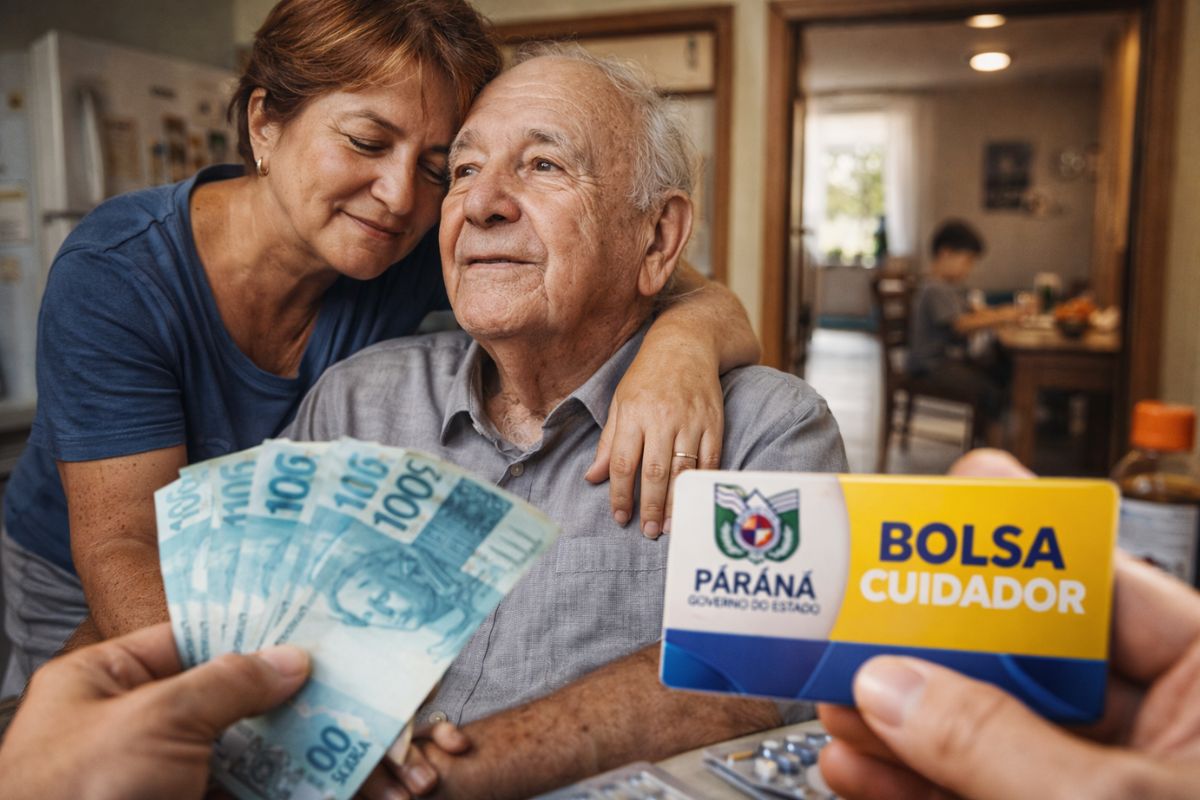
The Caregiver Grant pays R$ 810.50 per month to children and relatives who care for dependent elderly people in Paraná. The program is already operational in 20 cities, serves 141 caregivers, and offers up to 300 grants in the state, with the possibility of expansion according to demand.
The Caregiver Grant is Paraná’s response to a problem that millions of Brazilian families face in silence: how to support themselves financially when they need to leave work to care for an elderly parent in a state of dependence. The program, which is part of Paraná’s Friend of the Elderly initiative, pays R$ 810.50 per month to relatives who act as caregivers, equivalent to half a minimum wage. The benefit is already operational in 20 cities in the state and serves 141 registered caregivers, according to the Secretariat for Women, Racial Equality, and the Elderly.
The amount may seem modest, but it represents a concrete difference for low-income families who depend on every penny. Each participating municipality in the Caregiver Grant receives 15 grants, totaling 300 benefits available in Paraná, with the possibility of expansion according to demand and availability of slots. The program is still in its initial implementation phase and has been gradually rolled out since last year, meaning that many families entitled to the benefit are still unaware of its existence or how to access it.
Who can receive the Caregiver Grant in Paraná
According to information from the ndmais portal, the program is not exclusive to children. Any relative or caregiver who looks after an elderly person in a state of dependence can apply for the Caregiver Grant, provided they meet specific criteria. The caregiver must be 18 years or older, live in the same household as the elderly person, keep their registration updated in CadÚnico, and have a family income of up to one minimum wage per person. These requirements direct the benefit to those who truly need it: low-income families who have given up a source of income to care for someone.
-
The largest highway concession company in Brazil already belongs to an Italian group, and now the railway sector may be next to receive billions in investments from Italy amid the progress of the Mercosur and European Union agreement.

-
Work less and earn the same? PEC discussed by Lula and Hugo Motta affects the 6×1 schedule and reignites the debate on working hours, days off, and salary in Brazil.

-
Companies from Ceará generate billions and dominate Brazil without many people noticing, with giants born in the state such as Hapvida, Pague Menos, M. Dias Branco, and Três Corações totaling almost R$ 104 billion in revenue just in 2024.
-
A ton of old cell phones can contain up to 800 times more gold than a ton of ore extracted from a mine, according to the UN, and it is this hidden wealth in drawers that drives so-called urban mining, which can even be turned into Olympic medals.



On the elderly side, the conditions are also clear. The elderly person must prove clinical-functional fragility, be registered in CadÚnico, and not be institutionalized, meaning they cannot be in shelters or nursing homes. This last requirement reinforces the purpose of the Caregiver Grant: to keep the elderly person in a family environment, with care provided by someone they trust, rather than transferring responsibility to institutions. The benefit is paid into a bank account indicated by the recipient and has a grant limit of up to 24 months.
Which cities already participate in the Caregiver Grant
The program currently serves residents of 20 municipalities distributed across different regions of Paraná. Participating cities include Araucária, Cascavel, Cianorte, Colombo, Dois Vizinhos, Francisco Beltrão, Guarapuava, Guaratuba, Irati, Ivaiporã, Londrina, Marechal Cândido Rondon, Marialva, Palmeira, Pato Branco, Ponta Grossa, Prudentópolis, São Mateus do Sul, Toledo, and União da Vitória. The list covers both medium-sized cities with large elderly populations and smaller municipalities in the interior.
The absence of Curitiba, the capital, is noteworthy but reflects the gradual implementation logic of the Caregiver Grant. The state government chose to start with municipalities that already had a more prepared social assistance structure to operationalize the benefit, and expansion to other cities depends on the adherence of the city halls, registration capacity, and budget availability. For residents of municipalities that do not yet participate, the recommendation is to contact the local social assistance department and express interest, as recorded demand may accelerate the inclusion of the city in the program.
How to apply for the Caregiver Grant and what is the registration process
To facilitate access to the program, the government of Paraná created the Paraná Caregiver Registration, a tool that maps and identifies those who perform caregiving activities in the state. The goal is to create an official database that assists in the formulation of public policies and the expansion of the reach of the Caregiver Grant, allowing the government to know where caregivers are, how many there are, and under what conditions they work.
Those interested in applying for the Caregiver Grant should contact the municipal social assistance agencies or the city halls of participating cities. The process involves verifying eligibility criteria, updating CadÚnico, and proving the condition of fragility of the elderly person, which must be assessed by health professionals linked to the municipality. Although the procedure requires documentation, it is free and can be initiated directly at the social assistance service points in each participating city.
In what situations can the Caregiver Grant be canceled
The benefit has clear maintenance rules and can be interrupted under specific circumstances. The Caregiver Grant is canceled in cases of the elderly person’s death, formal withdrawal by the caregiver, institutionalization of the elderly in a shelter or nursing home, or proven situations of negligence in the exercise of the caregiving function. These conditions exist to ensure that public money is effectively financing quality care within the family environment.
The 24-month grant limit is also a factor that beneficiaries need to consider. After two years of receiving the Caregiver Grant, the caregiver will need to check if there is a possibility of renewal or if the program offers alternatives for continuing support. For families that depend on the benefit as an essential income supplement, this timeframe can represent uncertainty that the state government still needs to address as the program matures.
What the Caregiver Grant means for the future of elderly care in Brazil
Paraná is the first state to implement a program with these characteristics on a municipal scale, and the success or failure of the Caregiver Grant could influence similar policies in other states. With the accelerated aging of the Brazilian population, the demand for family caregivers is only expected to grow, and most of these individuals perform the role without any remuneration or formal recognition. The Paraná program places a price, albeit symbolic, on this invisible work.
If the Caregiver Grant is expanded to more municipalities and eventually serves as a model for other states, Brazil could begin to build a social protection network for family caregivers that currently does not exist at the national level. The amount of R$ 810.50 does not replace a salary, but recognizes that caring for a dependent elderly person is real work that consumes time, energy, and opportunities. For the 141 families already receiving the benefit in Paraná, this difference is already felt in their daily lives.
The Caregiver Grant pays over R$ 800 to children who care for their elderly parents in Paraná. Do you think this type of program should exist throughout Brazil? Do you care for someone in your family and would like to have this support? Leave your opinion in the comments.








Be the first to react!