






 Portuguese
  Spanish


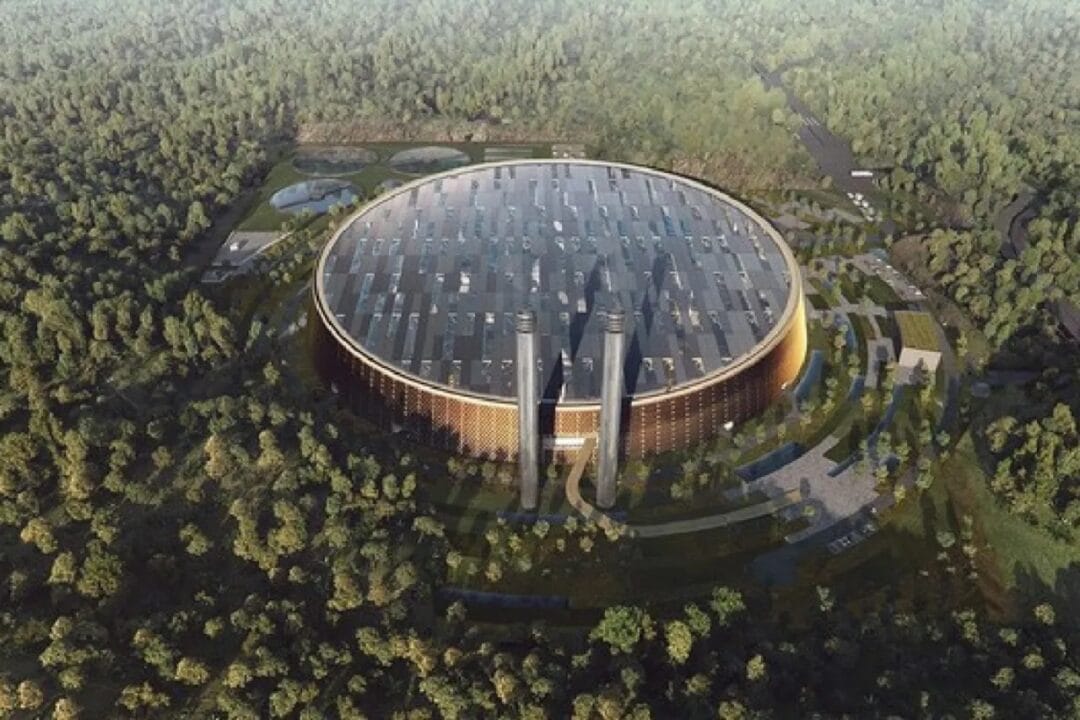

China Inaugurates Its First Waste Recycling Plant Capable of Generating Energy for Thousands of Homes and Providing Additional Services.
On last Wednesday (14), the China National Offshore Oil Corporation (CNOOC), one of China’s leading energy companies, announced the completion and delivery of all necessary modules for the world’s first integrated waste management facility. This innovative waste recycling plant is located in the city of Zhuhai, in Guangdong Province, in southern China. This pioneering project represents a significant milestone in waste management and environmental sustainability, reflecting China’s commitment to adopting eco-friendly and efficient solutions to contemporary urban and environmental challenges.
Waste Plant Can Generate Energy to Supply Up to 100,000 Homes
When the project is fully operational, the waste recycling plant will have the capacity to process up to 3,000 tons of household waste per day, generating about 480 million kWh of electricity per year. The electricity generated by the waste plant will be sufficient to supply 100,000 homes in China.
The initiative will have the capacity to reduce CO2 emissions by about 440,000 tons per year and ease the pressure on solid waste landfills in Hong Kong. The project began in September 2020, with assembly starting in October 2021.
-
ChatGPT Alerts FBI to Prevent Planned Murder of 8-Year-Old in Brazil’s Espírito Santo

-
Scientists Discover 125-Million-Year-Old “Pregnant Fossil” with Preserved Embryos and Microscopic Larvae Inside Mollusk in England

-
17-Year-Old Justin Bernstein Develops Bacteria to Produce Glass on Arctic Ice to Reflect Sunlight, Wins $50,000 U.S. Scholarship

-
The 19-Meter Rocket-Helicopter: A Private Industry Prototype That Challenged Space Race Logic




The first phase of the Integrated Waste Management Facilities in Hong Kong is located on a 16-hectare artificial island near Shek Kwu Chau, in the Hong Kong Special Administrative Region, and consists of a total of 17 key modules.
The waste plant capable of generating energy will offer a variety of services, including waste sorting and recycling, incineration for energy generation, seawater desalination, and sewage treatment.
Understand How the Structure of the Waste Recycling Plant Was Built
The delivered modules weigh approximately 50,000 tons, which is 1.2 times the total weight of the structure of the Beijing National Stadium. Composed of over 110,000 structural pieces and 270,000 pieces of equipment, connected by nearly 2 million screws, China’s waste plant features a more efficient design compared to traditional methods, being assembled with pre-constructed modules.
Yang Cheng, the facility’s deputy manager, highlighted that the modular design and innovative technology not only enhanced construction efficiency but also reduced construction time by 20%, ensuring greater accuracy in the process.
The waste incineration technique for energy generation employed in this waste recycling plant in China consists of the controlled burning of waste in a special boiler. The heat generated is then used to drive a steam turbine, resulting in energy production.
Brazil Also Has a Waste Plant
In addition to China, Brazil has also started construction of a waste recycling plant. The project, which will bring the country closer to sustainability, will be installed in the city of Palmital, about 400 km from the capital São Paulo and will initially be part of 13 other municipalities in the region.
The waste will be collected from about 150,000 homes, resulting in the production of 144 MW of energy per day, enough to supply nearly 30,000 homes.
The mayor, José Fernandes, spoke about the importance of clean energy and stated that the technology for converting solid waste into clean energy is a milestone in the pursuit of a more sustainable energy matrix. The authorization granted by CETESB for the start of construction reflects the concern for environmental preservation.
The inauguration event for the construction, held last August, was attended by Fábio Nossack, Secretary of Planning, Works, and Services, Ana Paula Marques Rodrigues, Secretary of Agriculture and Environment, local authorities, among others.


