Portuguese
  Spanish


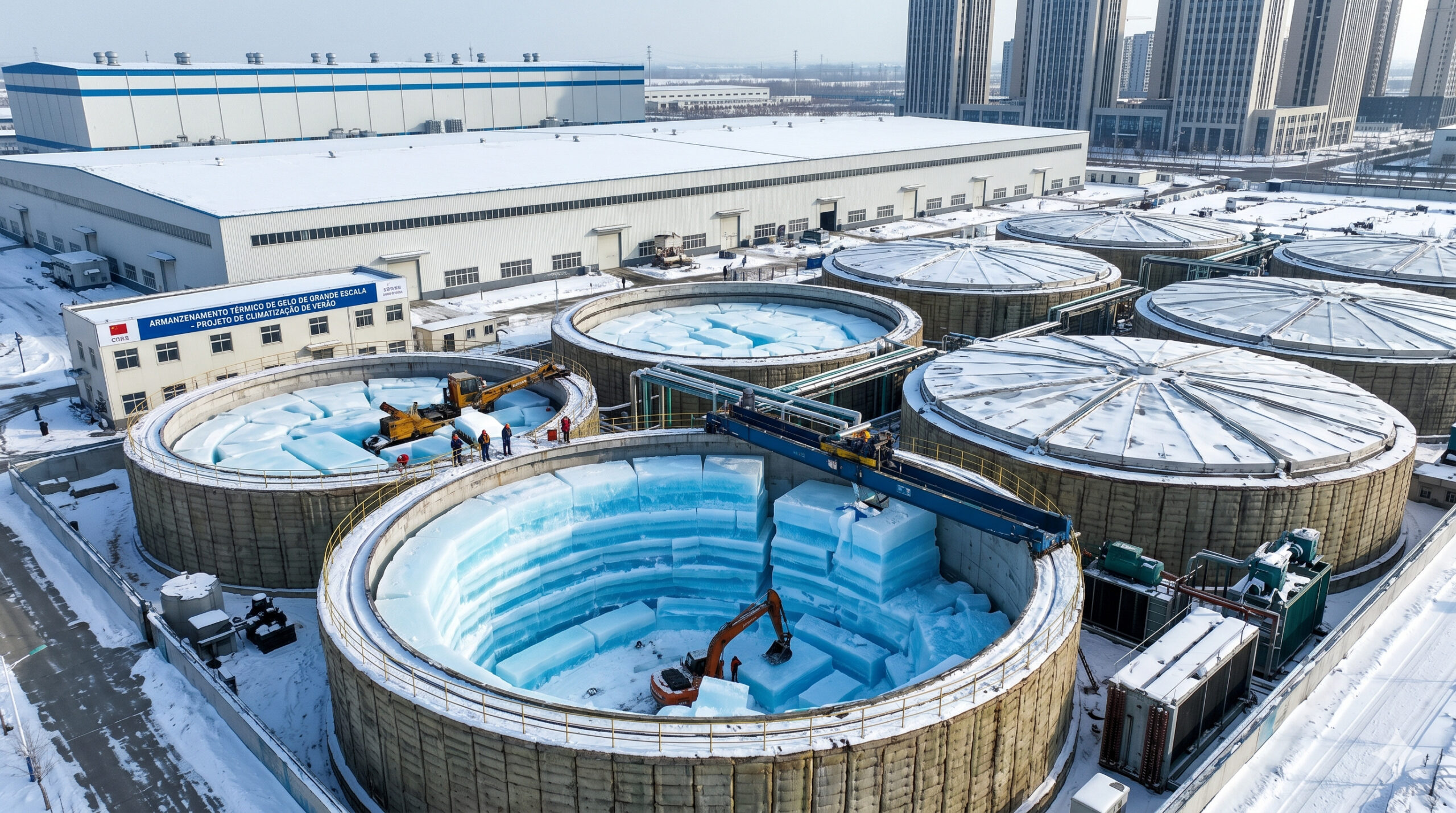

China uses stored snow as a thermal battery to cool cities and industries for months, reducing electricity consumption and eliminating compressors.
At the beginning of the 2020 decade, projects and studies on seasonal cold storage began to gain traction in the thermal engineering of China, transforming the intense cold of winter into an energy alternative for the warmer months. Instead of wasting the low temperature of the outside air, the proposal is to capture and store it in a controlled manner, generally in the form of ice or in insulated thermal systems, to reuse it later for cooling buildings and greenhouses.
A review of district cooling in China shows that this field has increasingly integrated thermal storage solutions, as the country expanded its interest in more centralized and efficient air conditioning systems. The logic is simple, although execution requires sophisticated engineering: storing winter cold with insulation and thermal load control to reduce, in summer, the dependence on conventional air conditioning systems.
System transforms snow into a long-lasting thermal battery
The fundamental principle of this type of system is the storage of energy in the form of cold, using the latent heat of fusion of water.
-
USP researcher creates thesis to attract international funds for the country’s electric energy sector

-
Trafigura receives authorization from ANEEL to trade electricity in Brazil and expands its operations in the largest energy market in Latin America.
-
Mobile solar panels promised to share space with corn crops, but the 20% to 25% shade reduced production by an average of 7.7% and opened a new dispute between energy and food.
-
More than 80 million kilometers of wires need to be replaced by 2040: the energy transition doesn’t just depend on panels and electric cars, but on a colossal race for copper, aluminum, transformers, and recycling of old cables.


When snow or ice melts, it absorbs a significant amount of heat without immediately changing its temperature. This physical process allows large volumes of ice to function as a stable thermal reservoir.
Each ton of ice can absorb approximately 334 megajoules of energy during melting, which is equivalent to about 93 kWh of thermal energy. On a scale of thousands of tons, this represents an energy capacity comparable to industrial air conditioning systems.
In practice, this means that a stockpile of snow can be used to remove heat from buildings for days or weeks, depending on the rate of use.
Mass storage requires thermal insulation and loss control
For snow to remain usable for months, systems utilize advanced insulation techniques.
The deposits are generally built with:
- thermal insulation layers
- covering with reflective materials
- ventilation control
- controlled drainage
These structures reduce heat exchange with the external environment, allowing the ice to remain solid for long periods, even during summer.
In some cases, losses of less than 20% over several months have been reported in international projects, demonstrating the technical viability of the concept.
System dispenses with compressors and reduces electricity consumption in air conditioning
One of the main differentiators of the technology is the reduction in the use of compressors, which are responsible for most of the energy consumption in traditional air conditioning systems.
In snow-based systems, cooling occurs through direct thermal exchange: the cold water resulting from melting is used to absorb heat from the environments.

This eliminates the need for refrigerant gas compression cycles, significantly reducing electricity consumption.
This feature is especially relevant in countries with high demand for air conditioning in the summer, where intensive use of air conditioning represents a significant portion of energy consumption.
Applications include factories, data centers, and urban cooling networks
In China, the technology has been applied in different contexts. Industrial facilities use stored snow to cool production processes that require constant thermal control.
Data centers, which generate large amounts of heat, can also benefit from the use of cold water from ice.
Additionally, urban district cooling systems are beginning to incorporate this type of solution as a complement to other sources. The versatility of the system allows its integration at different scales, from individual installations to complete urban networks.
Model leverages abundant and underutilized resource in winter
In regions with harsh winters, accumulated snow is often treated as a logistical problem. Local governments spend significant resources to remove, transport, and dispose of snow from the streets. Using this snow as an energy resource transforms this cost into an opportunity.
Instead of discarding the material, it is stored and reused as a source of cold, creating a more efficient cycle of resource use.
One of the most interesting characteristics of technology is its ability to operate on a seasonal scale. While conventional batteries store energy for hours or days, snow storage allows for thermal energy to be stored for months.
This type of solution is particularly relevant for balancing seasonal variations in demand. In winter, when the need for cooling is minimal, the cold is stored. In summer, when demand increases, it is released.
This temporal displacement of energy is one of the great challenges of modern energy engineering, and snow emerges as a natural solution to this problem.
Integration with hybrid systems increases energy efficiency
In many projects, snow storage does not completely replace traditional systems but acts as a complement.
During periods of lower demand, the system can operate solely with snow. During consumption peaks, it can be combined with conventional chillers. This hybrid approach allows for the optimization of energy use and reduction of operational costs.
The combination of different cooling sources creates more resilient and efficient systems, especially in complex urban environments.
Technology reduces emissions by replacing electricity with natural cold
The reduction of electrical consumption has a direct impact on greenhouse gas emissions. In countries where the energy matrix still relies on fossil fuels, decreasing the use of conventional air conditioning can represent a significant reduction in emissions.
By using stored natural cold, the system avoids additional electricity generation, contributing to sustainability goals.
Despite the advantages, the technology has limitations. The main one is the dependence on specific climatic conditions. The system is only viable in regions with a sufficiently cold winter to generate large volumes of snow.
Additionally, storage requires considerable physical space, which may limit its application in densely urbanized areas.
Engineering transforms natural phenomenon into energy infrastructure
The use of snow as a thermal battery represents a shift in how natural resources are perceived. What was once merely a byproduct of the climate is now treated as an active component of energy infrastructure.
This approach expands the concept of energy, incorporating environmental elements as part of the technical system.
The transformation of snow into a long-duration cooling system raises an important question for the future of cities. With rising global temperatures and increasing demand for climate control, solutions that utilize natural resources may gain relevance.
Could the cold of winter become one of the main ways to store energy for summer in the coming decades?