Portuguese
  Spanish


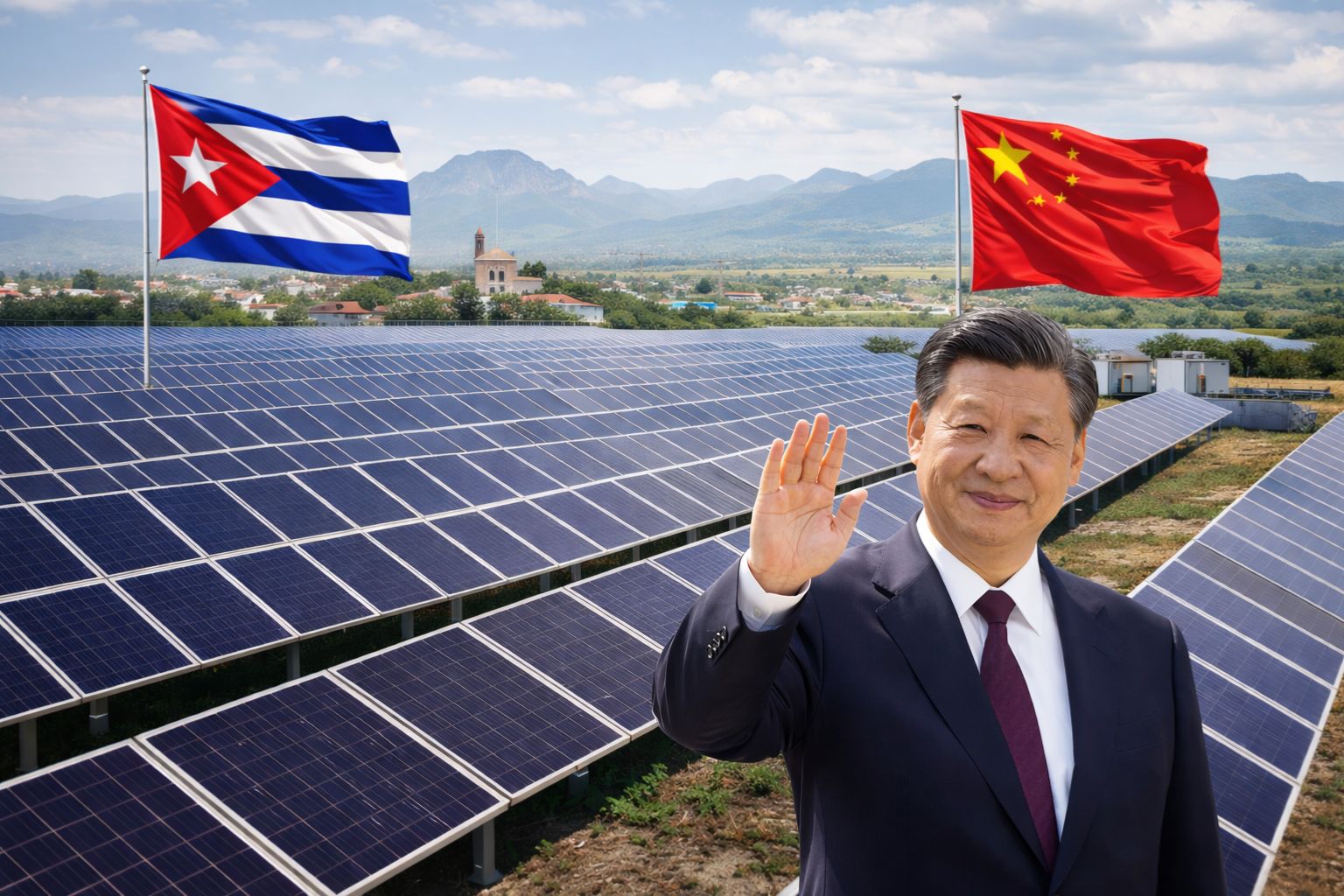

China has already built 75 of the 90 solar parks planned in Cuba, raising the island’s solar generation from 5.8% to 20% of the total in just 12 months. The Chinese investment directly responds to the American blockade that reduced oil imports by nearly 90% and caused blackouts of up to 20 hours in some Cuban regions.
The China has just made one of the fastest energy transitions ever recorded in the world, and it did so on Cuban territory. In just 12 months, Xi Jinping’s government built 75 of the 90 solar parks planned for the island, adding over 1,000 megawatts of capacity to Cuba’s electrical grid with entirely Chinese funding. The island’s solar electricity generation jumped from 5.8% to 20% of the total, a transformation that directly responds to the crisis caused by the American blockade, which reduced Cuban oil imports by nearly 90% and condemned millions of inhabitants to blackouts of up to 20 hours a day in some regions.
The speed of the project is impressive even by Chinese standards. From the beginning of 2025 until now, 49 new solar parks have been connected to the Cuban electrical grid, and some installations managed to become operational in just 35 days after the arrival of the equipment. In February 2026, Cuba generated 900 megawatts of electricity for the first time using solar panels, a milestone that confirmed that the infrastructure had reached sufficient scale to meet daytime demand. China’s plan envisions a total of 92 parks by 2028, with the capacity to generate 2,000 megawatts, equivalent to all of the island’s fossil fuel power generation capacity.
Why China decided to transform Cuba’s electrical system

According to information from the portal El Cronista, China’s decision to invest billions in solar energy in Cuba is not pure generosity. Cuba is an island strategically positioned less than 150 kilometers from the coast of the United States, and having the Caribbean nation as a technological and energy ally gives China an indirect presence in America’s backyard. The investment in solar parks circumvents the trade sanctions imposed by Washington, as solar panels are not subject to the same restrictions as fossil fuels, while simultaneously creating a technological dependency that further ties Cuba to the Chinese economic ecosystem.
-
World Cup Ball Chip Uses Technology to Detect Invisible Touches, Confirms Offside, Secures Portugal’s Victory Over Croatia

-
36-Meter Hydrogen-Powered Superyacht Arrives in Brazil to Debut German Engines and Showcase Future of Clean Navigation

-
Indian Students from Jaipur Win Top Prize at World’s Largest Science Fair with EcoFog, an Affordable Mesh to Harvest Fog Water Without Energy

-
Italy Sinks Massive 11-Story Concrete Structures in the Ligurian Sea to Create a 6.2 km Barrier, Clearing the Way for 400-Meter Ships in Genoa



The moment is also calculated. In early 2026, Donald Trump signed an executive order threatening to impose tariffs on any country that supplies oil to Cuba, a measure that reduced the island’s fuel imports by nearly 90% and triggered an unprecedented energy crisis. China responded not with oil, which would be easily traceable and subject to retaliation, but with solar technology that produces energy without relying on continuous imports. For China, each solar park installed in Cuba is an investment that weakens the effectiveness of the American blockade.
The crisis that led Cuba to accept China’s solar parks

Before China’s intervention, the electrical situation in Cuba had reached a critical point. The American blockade on oil trade cut fuel imports by nearly 90%, leaving the island’s thermoelectric plants without raw materials to operate. In some regions, blackouts lasted up to 20 hours a day, paralyzing hospitals, schools, industries, and commerce. The Cuban population faced long lines to get water, food spoiled due to lack of refrigeration, and public transport stopped due to lack of energy to operate.
Cuba’s dependence on imported oil to generate electricity was total and well-known. The island’s electrical system was built over decades based on fossil fuel-powered plants, and when external supply was cut off, there was no domestic alternative capable of meeting the demand. China’s arrival with a massive solar energy program not only alleviated the immediate crisis but also offered something Cuba had never had: the possibility of generating electricity without relying on imports that can be blocked by political decisions from other countries.
The numbers that show the scale of China’s project in Cuba
The scale of Chinese investment in Cuba is difficult to compare with any similar project in another country. Each solar park costs approximately $16 million, and the 75 already built represent an investment of over $1.2 billion in energy infrastructure installed at record speed. China’s goal is to reach 92 parks by 2028, with a combined capacity of 2,000 megawatts, enough to match all fossil fuel generation on the island.
To gauge the impact, each megawatt of solar capacity installed in Cuba represents approximately 18,000 tons of fuel that no longer need to be imported. If the target of 2,000 megawatts is achieved, the island could eliminate the need for millions of tons of oil per year for electricity generation, making the American energy blockade progressively irrelevant. In addition to the solar parks, China donated 70 tons of parts for electric generators and plans to install 10,000 photovoltaic systems in isolated homes, maternity wards, and health clinics.
What Cuba’s energy transformation means for geopolitics
Cuban President Miguel Díaz-Canel described the energy expansion as an act of “energy sovereignty,” a direct response to pressure from Washington. For Cuba, the solar transition financed by China represents the first real chance to escape an energy dependency cycle that has left it vulnerable to international sanctions for over six decades. If solar parks continue to be installed at the current pace, the island could have half of its electricity generated by the sun by the end of the decade.
For the United States, China’s presence transforming Cuba’s infrastructure raises strategic questions that go beyond energy. The installation of solar parks is the most visible face of a partnership that includes technology, equipment, and know-how that deepens Chinese influence in the Caribbean, just a few kilometers from the American coast. The irony is that the American blockade on oil, designed to economically pressure Cuba, has ended up accelerating exactly the type of technological dependency on China that Washington fears the most.
What is missing for Cuba to achieve energy independence with China’s help
Despite the advances, Cuba’s energy transition still faces significant challenges. Solar energy only generates electricity during the day, and the island still lacks large-scale storage systems that would allow it to maintain supply at night without resorting to thermoelectric plants, which depend on oil. Without batteries or another form of storage, nighttime blackouts may continue even with the expansion of solar parks.
China is aware of this problem and is likely planning to address it in the next phases of the agreement. If the 92 parks planned for 2028 are complemented with storage systems, Cuba could become the first country in Latin America to have a significant share of its electricity generated by solar energy on a national scale. For an island that just a few months ago faced 20 hours of blackout per day, the transformation is already remarkable. What remains to be seen is whether the pace of construction will be maintained and if the technology will be able to eliminate Cuba’s dependence on oil that Washington does not want it to buy.
China built 75 solar parks in Cuba in 12 months and transformed the island’s electrical system. Do you think this partnership is good for Cuba or does it create a new dependency? Did the American blockade end up pushing Cuba towards China? Leave your opinion in the comments.