






 Portuguese
  Spanish


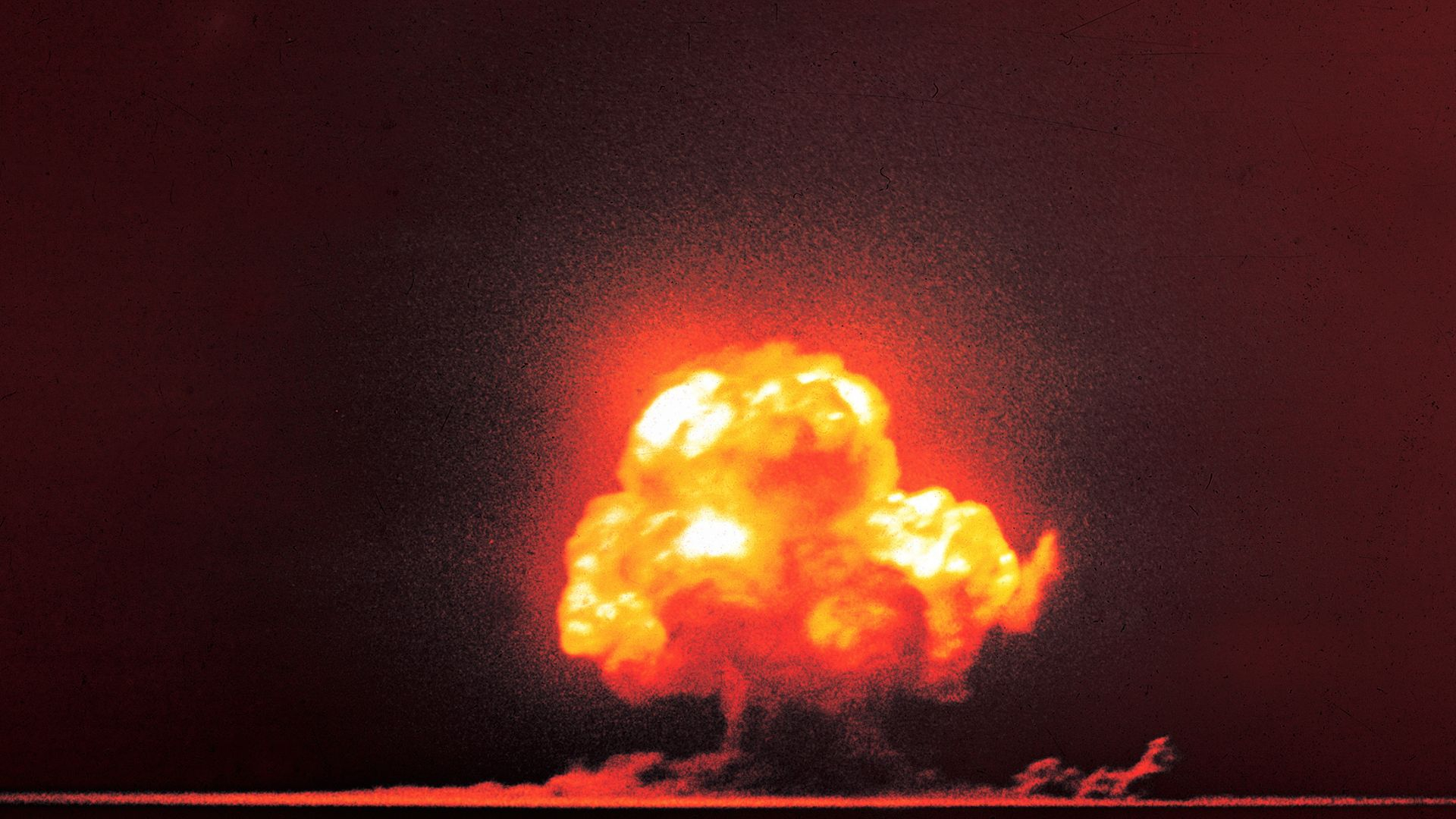


Researchers found a rare crystal in the debris of the first nuclear bomb, formed under extreme conditions of heat, pressure, and rapid cooling, revealing a structure impossible to reproduce in a conventional laboratory and expanding studies on physics, mineralogy, and nuclear forensic science.
The first nuclear bomb explosion by the United States in 1945 created a rare crystal never before reproduced in a conventional laboratory. The material was identified in trinitite glass formed after the Trinity test, conducted on July 16 in the desert.
Discovery in nuclear bomb debris
Researchers found a calcium-copper-silicon clathrate embedded in the radioactive debris of the Trinity test. The cubic crystal represents the first confirmed clathrate produced by a nuclear explosion, according to an article published by PNAS magazine on May 11.
The study was conducted by researchers from the University of Florence, responsible for the crystallographic identification of the material. The authors stated that the type I calcium-copper-silicon clathrate was previously unknown and emerged during the nuclear detonation.
-
China Develops Custom 140-Ton Electric Mining Truck with 770 kWh Swappable Battery, Deploys 290 Units in Xinjiang’s Largest Zinc Mine

-
Meta to Launch Arena, a New Prediction App Targeting 3.56 Billion Users, Competing with Polymarket and Kalshi

-
Scientist Challenges Famous Human Evolution Theory, Argues Homo Sapiens Evolved Gradually Over Thousands of Years
-
15-Year-Old American Builds Ocean Generator with PVC Pipe and 3D-Printed Propeller for $12, Wins National Prize, Presents at White House, and Makes Forbes 30 Under 30 List




Clathrates have microscopic structures formed by atomic cages that trap other atoms inside. In this case, the structure was built by silicon and copper, forming a rigid network responsible for trapping calcium atoms.
The crystal structure exhibits geometric shapes similar to dodecahedra with twelve faces. The atomic arrangement generated a stable matter considered exotic, absent in normal environmental conditions, and impossible to reproduce by conventional laboratory methods.
Extreme conditions of the Trinity test
According to the researchers, the crystal emerged during non-equilibrium conditions recorded on July 16, 1945. The environment combined millions of degrees of heat, extreme atmospheric pressure, and rapid cooling capable of freezing atoms before natural reorganization.
These conditions allowed the formation of non-equilibrium phases, characterized by materials impossible to produce in traditional laboratory synthesis. To understand the nuclear bomb debris, the team used atomic mapping combined with physical stability calculations.
The researchers stated that the combination of crystallographic characterization and first-principles calculations expands studies on materials science, condensed matter, and nuclear forensic science. The work also demonstrates how extreme environments shape crystalline structures far from equilibrium.
Rare structures and extreme physics
The new clathrate was found alongside an icosahedral quasicrystal previously identified in Trinity test materials. For the researchers, these structures function as microscopic records of physical phenomena rarely observed directly by humans.
Luca Bindi, the lead researcher of the study, stated that the crystals help scientists understand the behavior of matter during high-energy events. Among the phenomena cited are lightning, meteorite impacts, and planetary collisions observed under extreme conditions.
As clathrates emerge in very narrow energy ranges, they function as snapshots of physics and chemistry at absolute limits. The study may also aid future research on mineralogy, condensed matter, and forensic reconstruction of events involving nuclear bombs.
The authors stated that the new discoveries could bring studies on human explosions and cosmic phenomena closer together. The analysis may also reveal new atomic arrangements for future research.
Furthermore, the work could assist forensic investigations by reconstructing temperatures and pressures recorded in past or unidentified nuclear events involving residues generated by nuclear bombs during extreme tests in radioactive waste.






