Portuguese
  Spanish


The verdict was announced by NASA in early March 2026, based on observations from February, and concludes the saga of the object that topped the planetary defense list. The asteroid remains monitored and will only be visible to telescopes from Earth again in 2028.
The announcement that retired the alert came in early March 2026, when NASA, through the Center for Near-Earth Object Studies, CNEOS, at the Jet Propulsion Laboratory, recalculated the orbit of asteroid 2024 YR4 and ruled out any possibility of impact on the Moon. The review was based on two observations made by the James Webb Space Telescope on February 18 and 26, 2026, and the result, according to the agency, shows that the rock will pass about 21,200 kilometers from the lunar surface on December 22, 2032, far too distant for any collision.
The work was led by prominent researchers in American astronomy. Andy Rivkin, from the Johns Hopkins University Applied Physics Laboratory, and Julien de Wit, from the Massachusetts Institute of Technology, MIT, conducted the observations within the Webb Director’s Discretionary Time program, according to material released by NASA and the European Space Agency, ESA, because no other telescope in the world could see the object at that moment.
The roller coaster of probabilities of asteroid 2024 YR4
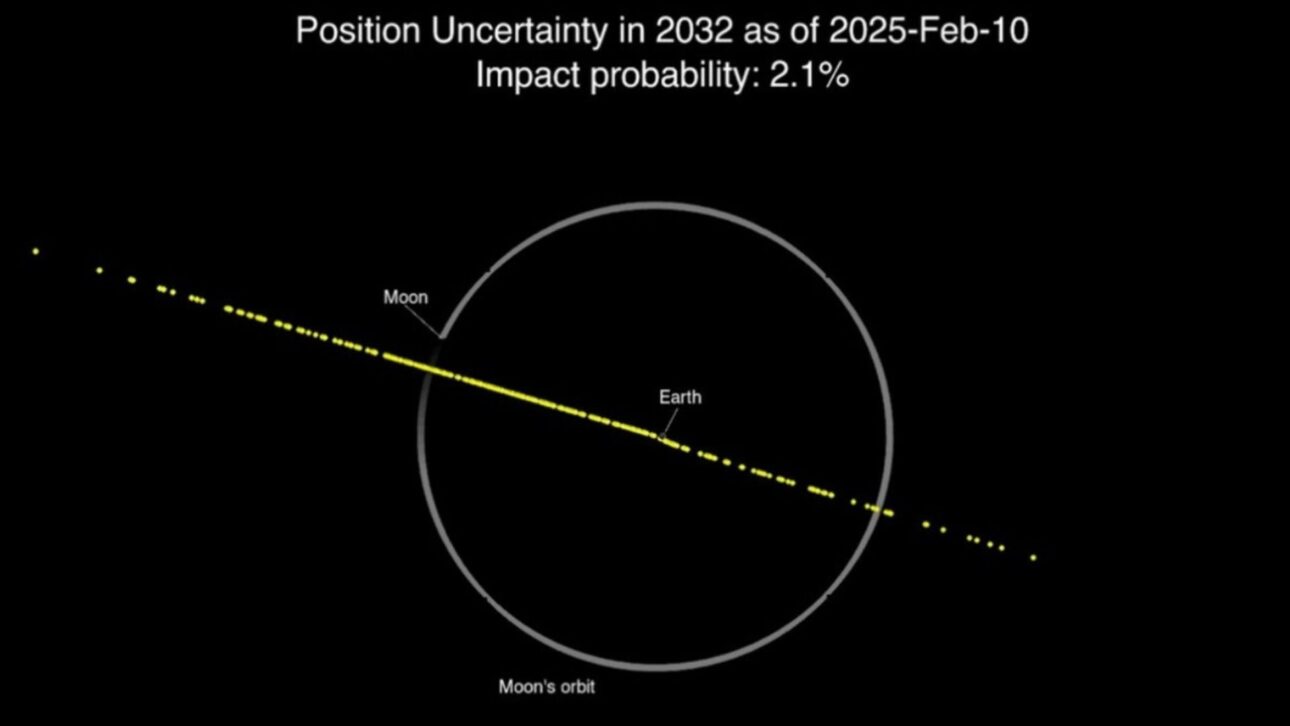
Discovered on December 27, 2024, by a telescope from the ATLAS system, funded by NASA, in Río Hurtado, Chile, asteroid 2024 YR4 had a 3.1% chance of hitting Earth in February 2025, according to CNEOS, the highest probability ever recorded for an object of that size, which led it to level 3 of the Turin Scale and to the top of the agency’s planetary defense list.
-
Geologists Find 4% of Normandy D-Day Beach Sand Still Contains Metal Fragments from WWII Explosions

-
2027 Total Solar Eclipse to Feature Unprecedented Duration, Turning Day into Night
-
China Unveils 300-Ton Hybrid-Electric Truck as the Heavy Machinery of the Future

-
Brazilian mechanic invents simple solar lamp using water and chlorine in a PET bottle, providing up to 60 watts of light during the day


The Earth quickly moved out of the crosshairs, but the Moon entered it.
With more observations, the risk to our planet dropped to practically zero, and calculations began to indicate between 4% and 4.3% probability of the rock, 53 to 67 meters in diameter, comparable to a 15-story building, hitting the natural satellite in December 2032, a scenario that remained until early 2026 and mobilized space agencies worldwide.
How the James Webb solved what no telescope could see
Since the spring of 2025 in the northern hemisphere, the asteroid was invisible to any instrument except one.
According to NASA, the James Webb was the only telescope with stability, sensitivity, and precise tracking of moving targets to relocate the object, in one of the weakest asteroid detections ever made, with the near-infrared camera NIRCam summing exposures of several hours without the rock moving a single pixel on the sensor.
The detail that killed the impact hypothesis was due to a European ruler.
The position measured by Webb was compared with the background stars cataloged by the ESA’s Gaia mission, and the asteroid appeared displaced about 22 pixels, equivalent to half an arcsecond, from the position that would still sustain some chance of collision with the Moon, according to material released by the agencies.
With the observation arc practically doubled, the orbit projection for 2032 gained the precision it lacked.
The impact that won’t happen would have created a 1-kilometer crater
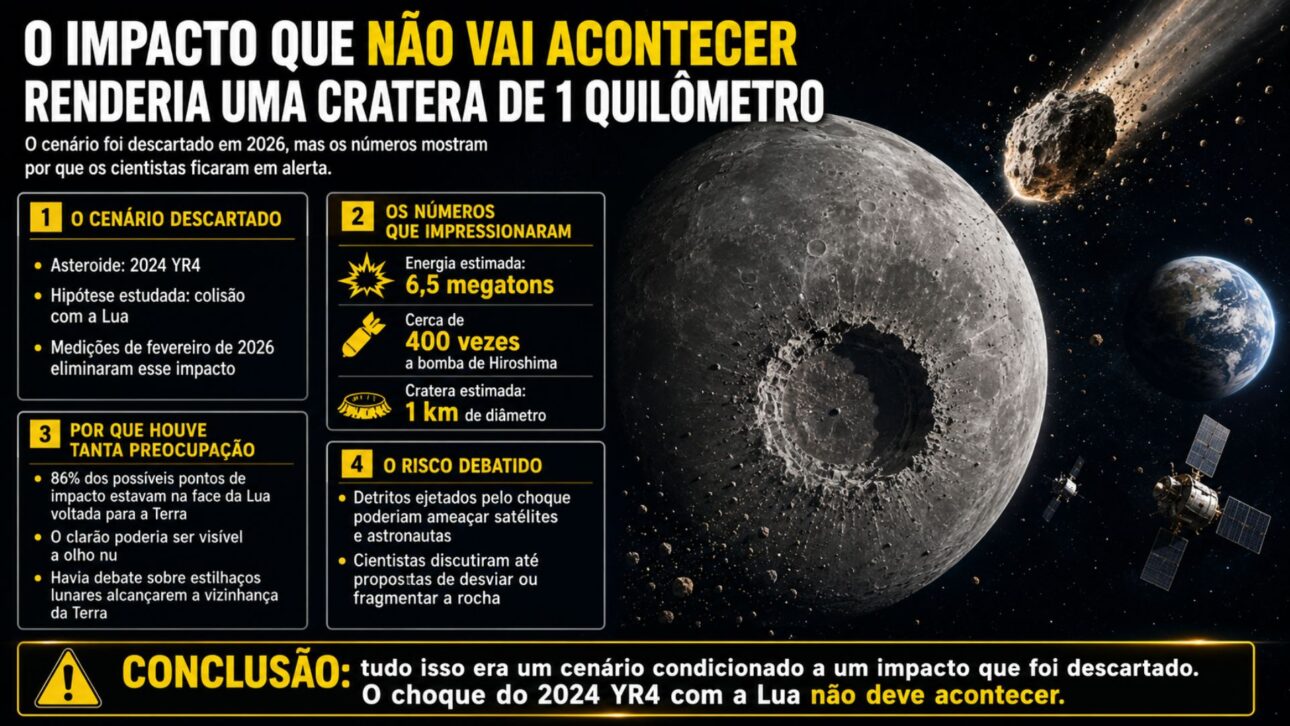
A study presented by astronomer Paul Wiegert and team, reported by Exame magazine, estimated that the collision of 2024 YR4 with the Moon would release about 6.5 megatons of energy, approximately 400 times the Hiroshima bomb, creating a crater 1 kilometer in diameter, and researcher Patrick King, from Johns Hopkins, calculated that 86% of the possible impact points were on the lunar face facing Earth, with a flash potentially visible to the naked eye.
There was also the fear of debris, which this portal closely followed.
Scientists even debated the risk of lunar debris ejected by the impact reaching Earth’s vicinity and threatening satellites and astronauts, a discussion that included even unprecedented proposals to deflect or fragment the rock.
All of this, it is worth the clear label, was a scenario conditioned to an impact that the measurements of February 2026 eliminated.
The Moon is safe and surveillance remains on duty
The message from the agencies was one of relief without demobilization.
The Moon is safe and 2024 YR4 poses no danger, but the work continues, stated the Planetary Defense team of ESA’s Space Safety Program, according to the Mexican newspaper La Jornada, highlighting that the detection and tracking of near-Earth objects continue at full pace so that no real threat catches the planet off guard.
The episode also left a valuable technical legacy.
NASA and ESA confirmed that the James Webb can visually isolate extremely faint objects against bright star fields, a technique that should be standardized for future threats, and 2024 YR4 itself will return to the range of ground-based telescopes in 2028, when new measurements can further refine the 2032 passage.
From panic to relief in 14 months of planetary defense
The trajectory of the asteroid 2024 YR4, from the record 3.1% risk for Earth to the verdict of a safe passage by the Moon, became the best recent case study of how planetary defense works: detect early, measure continuously, and let the data, not fear, have the final say.
On December 22, 2032, the building-sized rock will cross the sky at 21,200 kilometers from the Moon and continue its journey.
And you, have you followed the asteroid saga since the alerts of 2025 and do you think the billion-dollar investment in planetary defense is worth it or is the real risk of these objects exaggerated? Leave your opinion in the comments and join the conversation, always with respect for different opinions.