Portuguese
  Spanish


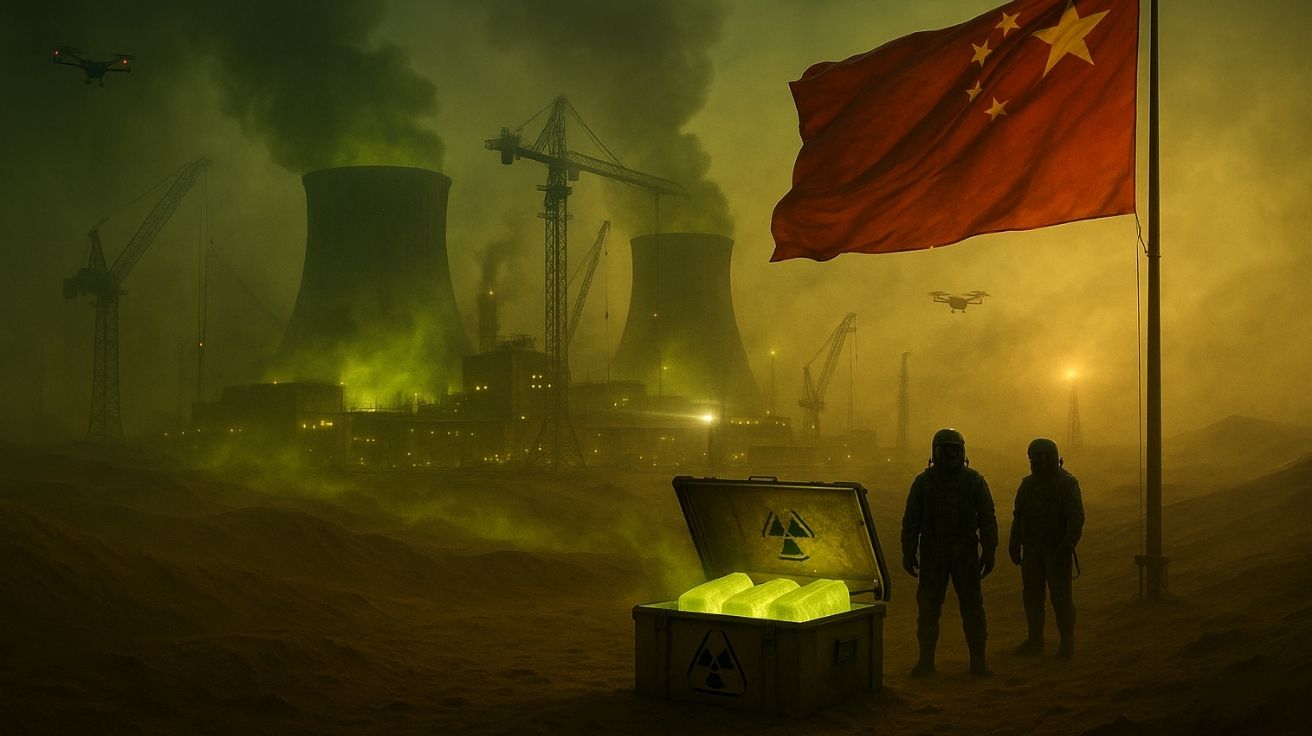


Colossal Uranium Deposit in Northern China Could Shift Global Energy Power Balance, Ensuring Self-Sufficiency for Beijing and Repositioning the Country as a Strategic Power in the International Nuclear Market
China has just revealed a discovery that may redefine global energy geopolitics. In the first half of 2025, the Chinese government officially announced the identification of a mega reserve of 30 million tons of uranium in the region of Jingchuan, in the Ordos Desert, located in the Inner Mongolia autonomous region. According to Futura Sciences and Global Times, this is one of the largest deposits ever located in the world, and the first of its kind in a region formed by aeolian sandstone.
The discovery was confirmed by the China Geological Survey, which is under the Ministry of Natural Resources, stating that the reserve “will significantly enhance the country’s energy security” and could meet China’s nuclear needs for generations. With 11 reactors under construction and 29 more planned, China is now approaching unprecedented independence in nuclear fuel production, repositioning itself as a dominant player in the sector.
A Monumental Mine Beneath the Ordos Dunes
Buried beneath layers of sand in one of the most inhospitable regions of the country, the deposit discovered in Jingchuan represents both a geological and technological achievement. The area is part of the Ordos Basin, a vast region rich in fossil and mineral resources, but until now, it had not been explored in depth for uranium.
-
Nvidia Secures Billion-Dollar Deal to Supply Up to 170,000 AI Accelerators to a 360 MW Data Center in Indonesia, Aiming to Transform Batam into an Advanced Computing Hub

-
NuScale proposes revised plan for six VOYGR SMR reactors in Poland after ending U.S. project

-
Holtec and EDF Submit Joint Proposal to Install Four SMR-300 Reactors in England with Combined Capacity of 1.3 GW
-
Brazil’s Angra 3 Nuclear Plant Reaches 66% Completion; Government Faces 2026 Deadline to Decide on $24 Billion Project’s Future


Futura Sciences points out that cutting-edge technologies such as geological LiDAR, underground sensors, and remote drilling were essential for locating the uranium beneath the sandstone. The difficulty of access and desert conditions had previously hindered any conventional exploration.
According to the official statement from the China Geological Survey, this is the first discovery of an ultralarge uranium deposit in an aeolian sandstone environment in the world, opening up new possibilities for exploration in other similar areas of China, such as the Tarim and Junggar basins.
The immediate impact of the discovery is strategic self-sufficiency: with the new deposit, China reduces its dependence on exports from countries such as Kazakhstan, Australia, and Canada, which until now dominated the natural uranium market.
According to the Nuclear Energy Agency, China’s uranium consumption is expected to explode in the coming decades, following the aggressive expansion of the Chinese nuclear fleet. Today, the country operates 56 commercial reactors and leads the world in new constructions.
With the new reserve, Beijing gains a competitive advantage in climate agreements, energy security, and future geopolitical disputes surrounding critical resources.
Global Impact and Redesign of the Uranium Market
China’s entry as a massive uranium producer could directly affect international prices and destabilize the position of traditional leaders such as Kazakhstan (Kazatomprom), Canada, and Namibia.
According to the Global Times, the Chinese discovery comes at a time of realignment in the sector: Russian state-owned enterprises like Rosatom have already started transferring positions in deposits to Chinese holdings, anticipating the new scenario of Asian power concentration.
In addition to technical dominance, China gains a diplomatic trump card. Control over uranium means bargaining power, both in negotiations over climate change and in defining future clean energy trade routes.
With the increasing international pressure for carbon reduction, uranium, as controversial as it may be, remains a critical pillar of low-emission energy. And China has already positioned itself as a global leader in solar and wind energy.
Now, with a solid foundation in internally supplied nuclear energy, Beijing can offer hybrid clean technology packages to developing countries, creating new trade and diplomatic ties with emerging economies.
Experts warn that China’s advancement could accelerate the development of alternative nuclear supply chains, weakening Western regulatory influence in markets like Africa, Central Asia, and South America.