Portuguese
  Spanish


China has completed a superfactory in Shaoxing, Zhejiang province, for the mass production of Lijian-2 rockets, with the capacity to deliver up to 12 units per year of the vehicle, which completed its inaugural flight on March 30, 2026, marking the transition of China’s commercial space sector from testing to industrial-scale production.
China has taken a concrete step in the industrialization of space access. The superfactory completed in Shaoxing, Zhejiang province, is dedicated to the mass production of Lijian-2 rockets, a liquid-propellant vehicle that successfully completed its inaugural flight on March 30, 2026.
The facility integrates final assembly, testing, and processing of essential components such as tanks, valves, interstage sections, and conduits. When fully operational, it will have an annual production capacity of 12 rockets, a volume that transforms the manufacturing of launch vehicles from a craft activity into an industrial line, according to the China Media Group.
The completion of the superfactory signals a phase change. The country is moving from the technological validation stage to large-scale industrialized production of rockets designed to meet the growing demand for commercial launches.
-
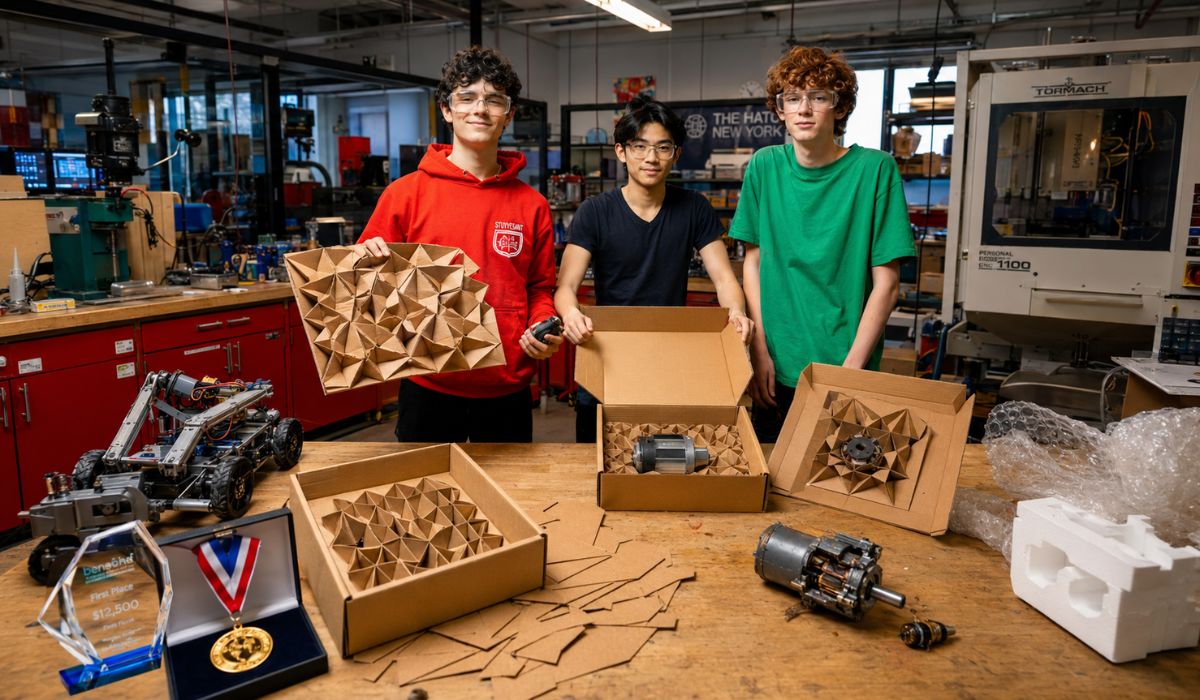
Three teenagers transform cut cardboard into Japanese origami-style packaging that promises to retire styrofoam and bubble wrap, win a $12,500 prize, and target giants like Amazon, FedEx, and Home Depot after a robot motor arrived broken.

-
The large jar blender has a rival: Oster Ultra Power bets on 1,000 W, six stainless steel blades, and two portable cups with leak-proof lids.

-
Tesla injected an additional $250 million into the German factory, doubled the battery cell target, and opened its own production line for startups.

-
No more TV stuck on the wall: Samsung The Freestyle+, the new projector with over 400 lumens projects on walls, floors, and ceilings, bringing cinema to any corner of the house.



The Lijian-2 is China’s first launch vehicle to adopt the Common Booster Core (CBC) configuration. In this modular architecture, the first stage and the side boosters are structurally and functionally identical.
With a height of 53 meters, a takeoff weight of 625 tons, and 753 tons of thrust, the rocket transports up to 8 tons to a 500 km sun-synchronous orbit or 12 tons to a 200 km low Earth orbit. On its inaugural flight, it precisely placed the Qingzhou prototype cargo spacecraft and two satellites into their predefined orbits.
What the rocket superfactory in Shaoxing produces and how it is organized

The facility goes beyond a final assembly line. It concentrates the production of critical components that, in previous models, were manufactured in separate units.
Tanks, pipeline valves, interstage sections, and conduits are produced in the same complex where assembly and testing take place. This configuration reduces logistics between suppliers, accelerates the production cycle, and allows for centralized quality control.
The capacity of 12 rockets per year means one vehicle per month on average. A pace unthinkable in the Chinese space industry a decade ago.
The choice of Shaoxing follows industrial and logistical logic. Zhejiang is one of China’s most industrialized provinces, with a supply chain for advanced materials, precision metallurgy, and electronics that the space industry demands.
The coastal location facilitates the transport of finished rockets to launch centers, including the Dongfeng pilot zone, from where the Lijian-2 lifted off in March. The concentration of production in a single complex is a strategy pioneered by SpaceX in Hawthorne, California, and which China is now replicating on a scale adapted to its emerging commercial sector.
Why modular architecture enables mass production of rockets
The CBC configuration has a direct consequence on manufacturing. When the first stage and side boosters are identical, the factory produces a single type of module in large quantities instead of manufacturing different parts for each position of the vehicle.
This reduces tools, jigs, and processes. It allows for economies of scale impossible in rockets where each component is unique.
The analogy with the automotive industry is direct. Just as automakers use the same platform for different models, the CBC architecture allows the same modules to be combined in varied configurations for missions with distinct payload and orbit requirements.
Modularity also simplifies maintenance and spare parts logistics. If a module shows a defect in quality tests, it can be replaced by an identical one without custom rework.
This agility makes the difference between meeting or delaying a commercial client’s launch schedule. The Lijian-2 was designed from the outset for mass production, not adapted later.
What is the role of Lijian-2 rockets in China’s commercial space race
The demand that justifies 12 rockets per year comes mainly from the satellite constellation market.
China plans to deploy massive low-Earth orbit communication satellite networks, similar to SpaceX’s Starlink. This project requires dozens of launches to position thousands of satellites, and the Lijian-2 is scaled for missions where multiple satellites ascend simultaneously.
The transition to industrial production is a prerequisite for competing at the pace of launches. In the constellation race, flight frequency is as important as vehicle technology, because networks need to be deployed and replenished continuously.
China’s commercial space sector has grown rapidly but faced a bottleneck in production capacity. Companies like CAS Space (developer of Lijian-2), Landspace, and iSpace compete for market share.
The Shaoxing superfactory is the infrastructure that China’s private rocket sector needed to scale. Delivering one vehicle per month allows for offering deadlines and prices that reflect scaled production, not custom manufacturing.
What industrial rocket production means for the global market
Mass-produced rockets in China add capacity at a time when demand for space access is growing faster than supply.
Constellation operators, governments, and space data companies compete for slots on the manifests of SpaceX, Arianespace, Rocket Lab, and Chinese and Indian providers. Each new source of rockets reduces queues and puts downward pressure on prices.
The production of 12 units per year does not rival SpaceX’s pace. But it represents a qualitative leap for the Chinese industry, which until 2025 did not have a mass production line for medium to large-sized vehicles.
For Brazil, which relies on foreign launchers for its satellites, the multiplication of suppliers is relevant. More companies producing rockets mean more options and better prices for those contracting launches.
The Shaoxing superfactory is a piece on a board where industrial rocket production is no longer a monopoly. In the coming decades, access to space could become as routine as intercontinental air travel.
And you, do you think mass production of rockets will make access to space cheaper? Leave your opinion in the comments.