






 Portuguese
  Spanish
  6 min of reading
  0 comments


Giant inflatable domes have started to cover urban construction sites in China to contain dust, muffle noise, and protect neighboring areas, with sensors, controlled ventilation, and structures capable of enclosing entire works without interrupting construction.
Large inflatable domes have begun to be used over urban construction sites in China to contain dust, reduce noise, and lessen disruptions caused by construction in densely populated areas.
The technology gained attention after the installation of a structure 50 meters high and 20,000 square meters in Jinan, the capital of Shandong province in the east of the country.
In a bubble shape, the covering encompasses the entire work area and creates a physical barrier between machines, materials, workers, and the urban surroundings.
-
Instead of conventional blocks and concrete, the builder mixes earth, sand, straw, and water to erect a mud house with manually made walls.

-
Brazilian siblings aged 11 and 7 read 240 books in just one year and caught attention on social media: while many children spend hours on screens, they turned their family’s routine into an example of reading, discipline, and curiosity.

-
4-year-old granddaughter saved her elderly grandmother after a serious fall at home, ran to ask a neighbor for help, and guided rescuers to the room, surprising the police with her calmness and may receive an award for the action that prevented a family tragedy.
-
Forget the Eiffel Tower: the largest steel bridge on the planet has 25.8 thousand tons of metal, a height equivalent to 100 floors, a record-breaking arch of 580 meters, and spans mountains 310 meters above the river.





According to Domus magazine, the structure can capture up to 90% of fine dust particles and reduce noise pollution by about 40 decibels, depending on the construction conditions.
The model installed in Jinan covers almost the entire site of the Honglou 1905 urban renewal project, developed by China Energy Construction Group and Licheng Urban Development Group.
Located in the Licheng district, the construction is near a century-old church and Shandong University, in an area where the presence of residents, students, and pedestrians increases sensitivity to the impacts of construction.
The solution draws attention because it addresses two common nuisances in open-air construction: particulate matter that spreads through the air and the continuous noise produced by heavy equipment.
In cities with high population density, these effects are no longer confined to the construction site and begin to interfere with the routine of residents, merchants, students, and visitors who circulate nearby.
Inflatable bubbles cover urban construction in China
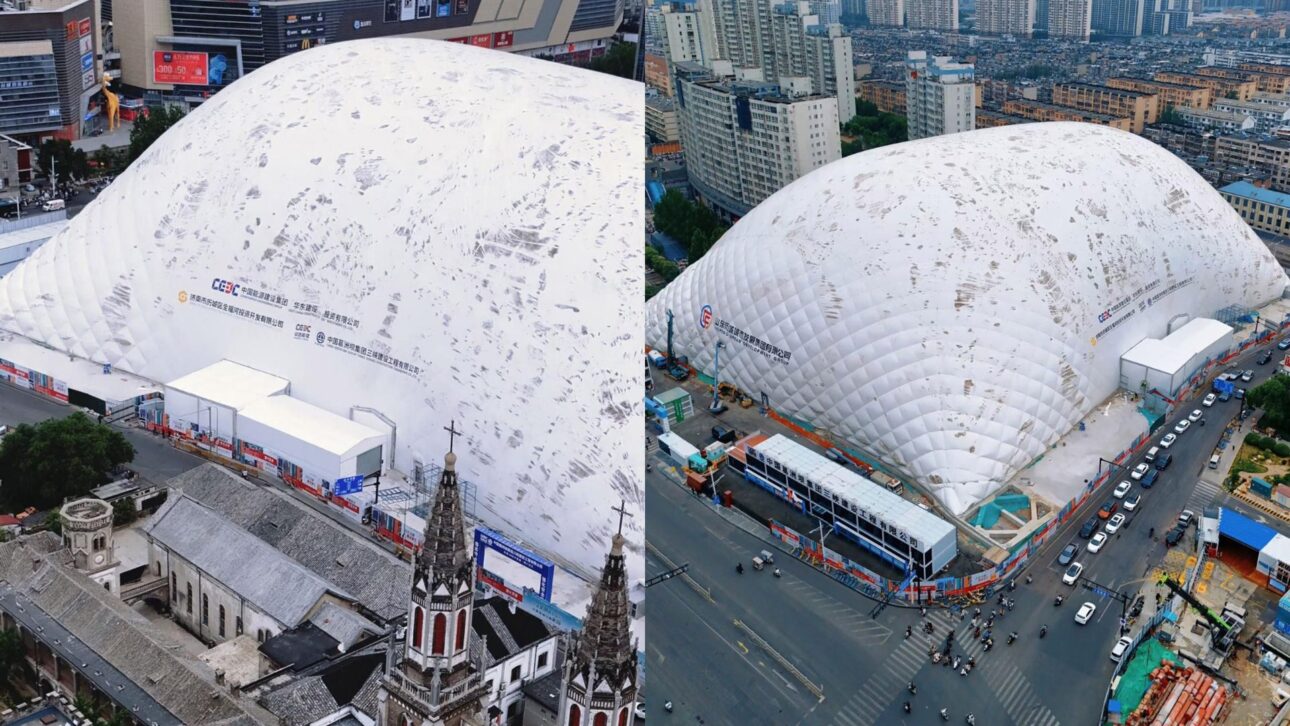
Supported by internal air pressure, the inflatable dome functions as a large membrane without pillars or beams in the center of the construction area.
This configuration keeps the space free for the circulation of workers, machines, and materials, allowing activities to continue within the structure without compromising the operation of the site.
In the Jinan project, the cover measures 159 meters in length by 108 meters in width and was made with PVDF plastic, a material described by the Global Construction Review as heat reflective.
The same publication reported that sensors monitor air pressure and internal temperature, data used to maintain the stability of the membrane and operating conditions.
Besides reducing dust dispersion outside the site, the membrane helps control air circulation within the covered area.
According to Domus, temperature and pressure sensors regulate ventilation and activate water mist systems at exhaust points, reducing the concentration of suspended particles.
This control prevents the cover from functioning as a closed environment without air renewal, an essential point for the safety of teams during excavation and material handling activities.
To maintain membrane pressure and preserve the quality of the internal environment, the system relies on continuous ventilation during machine operation, cutting, foundations, and other stages of the project.
Structure reduces dust, noise, and climatic impacts
Local authorities also presented the installation as a way to allow work in different weather conditions, without direct exposure of the site to rain, wind, and snow.
The Global Construction Review reported that, according to public officials, the dome favors construction in any weather, extends the operation window, and reduces noise pollution by 80%.
Protection against climatic factors can reduce stoppages in exposed works, especially during sensitive stages of excavation, foundation, material transport, and structure assembly.
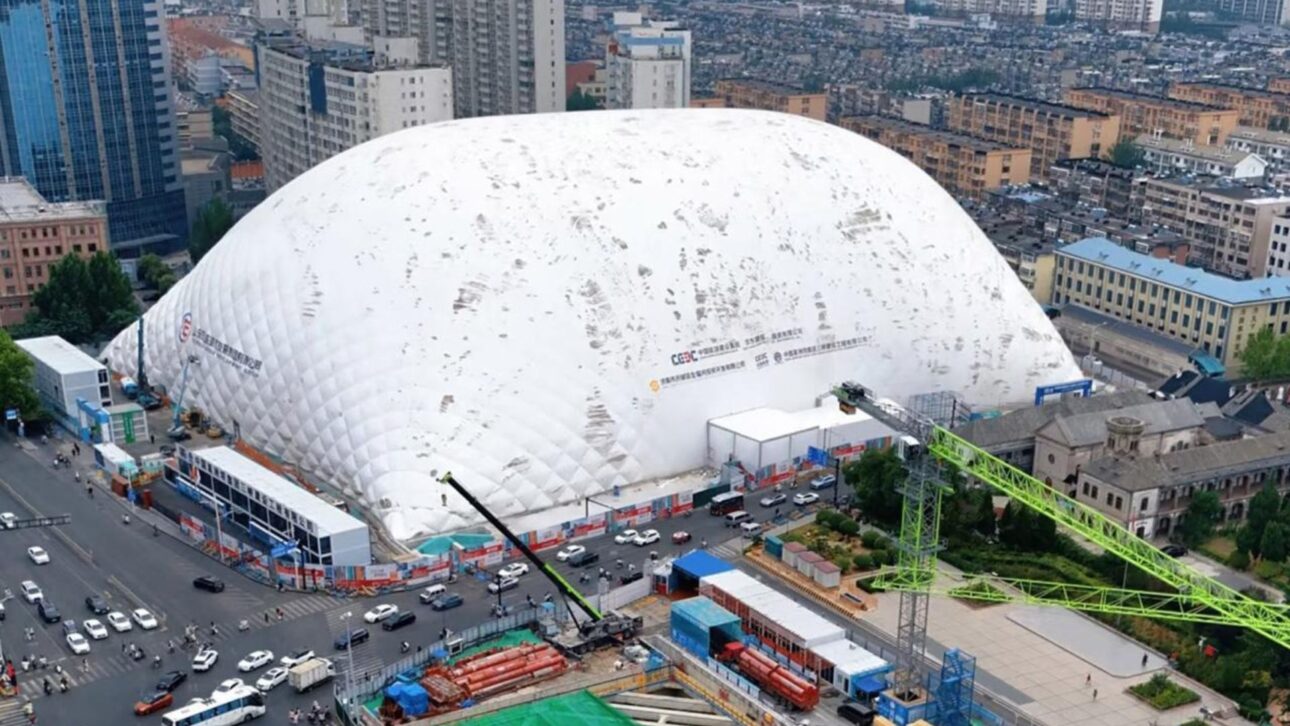
Still, the productivity gain depends on the type of project, local work rules, safety applied within the site, and the ability to operate under a pressurized cover.
In the case of Jinan, the progress of the works was expected to gain momentum in October, with the start of the foundations, according to the Global Construction Review.
Based on reports from the local media, the same publication reported that inflating the cover took about ten hours to encompass the main area of the site.
CCTV, the Chinese state broadcaster, described the structure as the largest of its kind in the world and stated that it was designed to reduce noise and pollution.
Released in July 2025, the facility was also presented by the broadcaster as a measure to protect local communities and reduce environmental impacts around the construction site.
Civil construction bets on domes with sensors
The use of inflatable bubbles in construction reflects a growing concern about the environmental impact of civil construction in urban centers, especially where construction sites coexist with residences and public facilities.
In regions with residential buildings, schools, universities, churches, and nearby commerce, dust and noise cease to be merely operational problems and start to directly affect the neighborhood’s routine.
Beijing has already tested similar technology in excavations in the Lize financial district, according to Domus, which also reported incentives for construction companies to adopt inflatable membrane systems.
The publication linked the initiative to guidelines from China’s Ministry of Ecology and Environment for more sustainable construction practices by 2030.
Even with the published results, large-scale adoption requires technical evaluation on a case-by-case basis, especially in projects with significant movement of workers and machinery.
Structures of this size need anchoring, permanent pressure control, ventilation, fire prevention, and internal monitoring, as teams remain inside the covered space during activities.
Domus describes the membrane as reusable, fire and wind-resistant, and anchored to the ground by 38 steel cables.
These characteristics help explain why the model can be transferred or adapted to different sites, although costs, logistics, and local regulations may limit its use in smaller projects.


Technology attempts to reduce disruptions around construction sites
By concentrating dust and noise within a controlled area, the bubble prevents part of the impacts from spreading without a physical barrier around the construction site.
With this isolation, the construction site tends to cause less inconvenience for those who live, work, or circulate nearby, especially in areas of high urban movement.
On the other hand, the system does not eliminate the need for environmental and labor inspections, nor does it replace safety protocols applicable to conventional construction sites.
In covered environments, ventilation, air quality, temperature, and emergency routes need to be continuously monitored so that the reduction of external impact does not create internal risks.
The Chinese experience presents an alternative for cities trying to reconcile urban expansion, environmental preservation, and the protection of the population living near construction sites.
Although the technology still depends on independent confirmation in different contexts, the published data indicates that inflatable domes could become a relevant tool in large-scale construction projects.
Within this broader strategy of environmental control, China combines inflatable membranes, sensors, and forced ventilation to reduce the most visible effects of civil construction.
The result is a visually unusual construction, but designed to address a daily problem of large cities: building without spreading so much noise, dust, and disruption around.




Be the first to react!