Portuguese
  Spanish


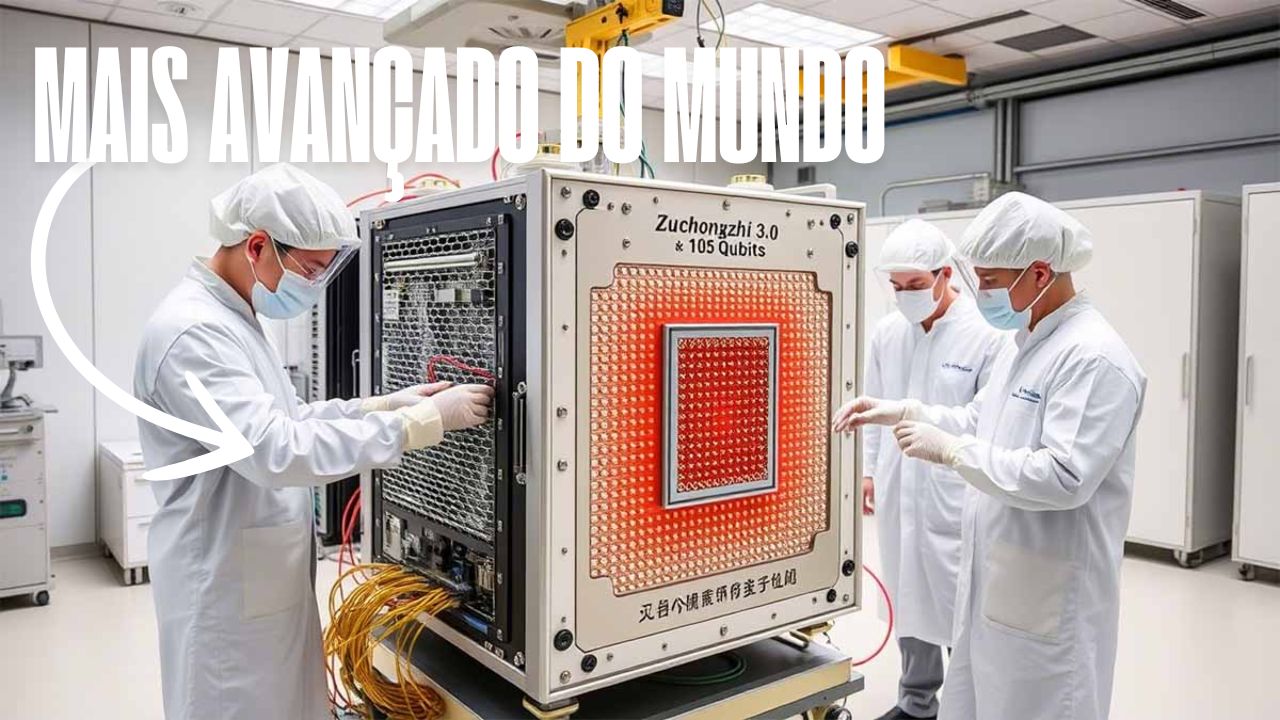


New Zuchongzhi 3.0 System Achieves Unprecedented Speed and Surpasses Classic Supercomputers, Reinforcing China’s Leadership in the Quantum Race
China has just unveiled the Zuchongzhi 3.0, one of the most powerful quantum computers ever developed. The system, which operates with 105 readable qubits and 182 couplers, can perform calculations trillions of times faster than the best conventional supercomputers. The technology represents a leap in quantum supremacy, putting the Asian country at an advantage over the United States in the global race for quantum computing.
Developed by researchers from the University of Science and Technology of China (USTC), the Zuchongzhi 3.0 surpasses the latest advancements from IBM, Google, and Intel, consolidating China’s position at the forefront of quantum computing.
China Reaches New Level in Quantum Supremacy with the Zuchongzhi 3.0

The major differentiator of the Zuchongzhi 3.0 is its ability to process information at speeds impossible for traditional computers. Its performance in random quantum circuit sampling tests has proven to be quadrillions of times faster than conventional systems.
-
Scientist Challenges Famous Human Evolution Theory, Argues Homo Sapiens Evolved Gradually Over Thousands of Years

-
15-Year-Old American Builds Ocean Generator with PVC Pipe and 3D-Printed Propeller for $12, Wins National Prize, Presents at White House, and Makes Forbes 30 Under 30 List

-
$12 Billion Invested in AI Data Centers in Semi-Desert Mexican State, But 17 of 18 Municipalities Now Face Water Shortages, Residents Receive Water Only 3 Days a Week
-
How Much Does Starlink Satellite Internet Cost for Cars, Trucks, and RVs? Prices for Antenna, Accessories, and Plans





Moreover, it surpasses Google’s Sycamore by six orders of magnitude and can solve problems that would take thousands of years to complete on conventional supercomputers. This reinforces the role of the Chinese quantum computer as one of the most advanced in the world.
Impacts of Quantum Computing in the Real World
Advances in quantum computing promise to transform various strategic areas of the global economy, from cryptography and artificial intelligence to the pharmaceutical and chemical industries. Some of the most promising applications of the Zuchongzhi 3.0 include:
- Development of New Medications: Simulating molecules to create more efficient drugs.
- Advanced Cryptography: Creating and breaking highly sophisticated digital security systems.
- Artificial Intelligence: Processing data and machine learning at unprecedented speeds.
- Energy and Climate: More accurate modeling for optimizing energy consumption and weather forecasting.
China is already heavily investing in the implementation of secure networks based on quantum cryptography, which can make communications unbreakable by conventional methods. This is a significant advancement in quantum computing, positioning the country at the forefront of this technological revolution.
The Future of Quantum Computing in China and the World
The research team behind the Zuchongzhi 3.0 is already working on new applications for the technology, including quantum error correction, complex chemical simulations, and optimizations for artificial neural networks.
Meanwhile, major Western companies like Google, IBM, and Amazon are also advancing their quantum projects, but China has demonstrated an accelerated capacity for innovation, investing billions of dollars in the expansion of quantum computing in China.
The next step in Chinese research involves the construction of commercial quantum computers that can be used by businesses and governments to solve problems that were previously impossible for classical computing.