






 Portuguese
  Spanish
  4 min of reading
  101 comments


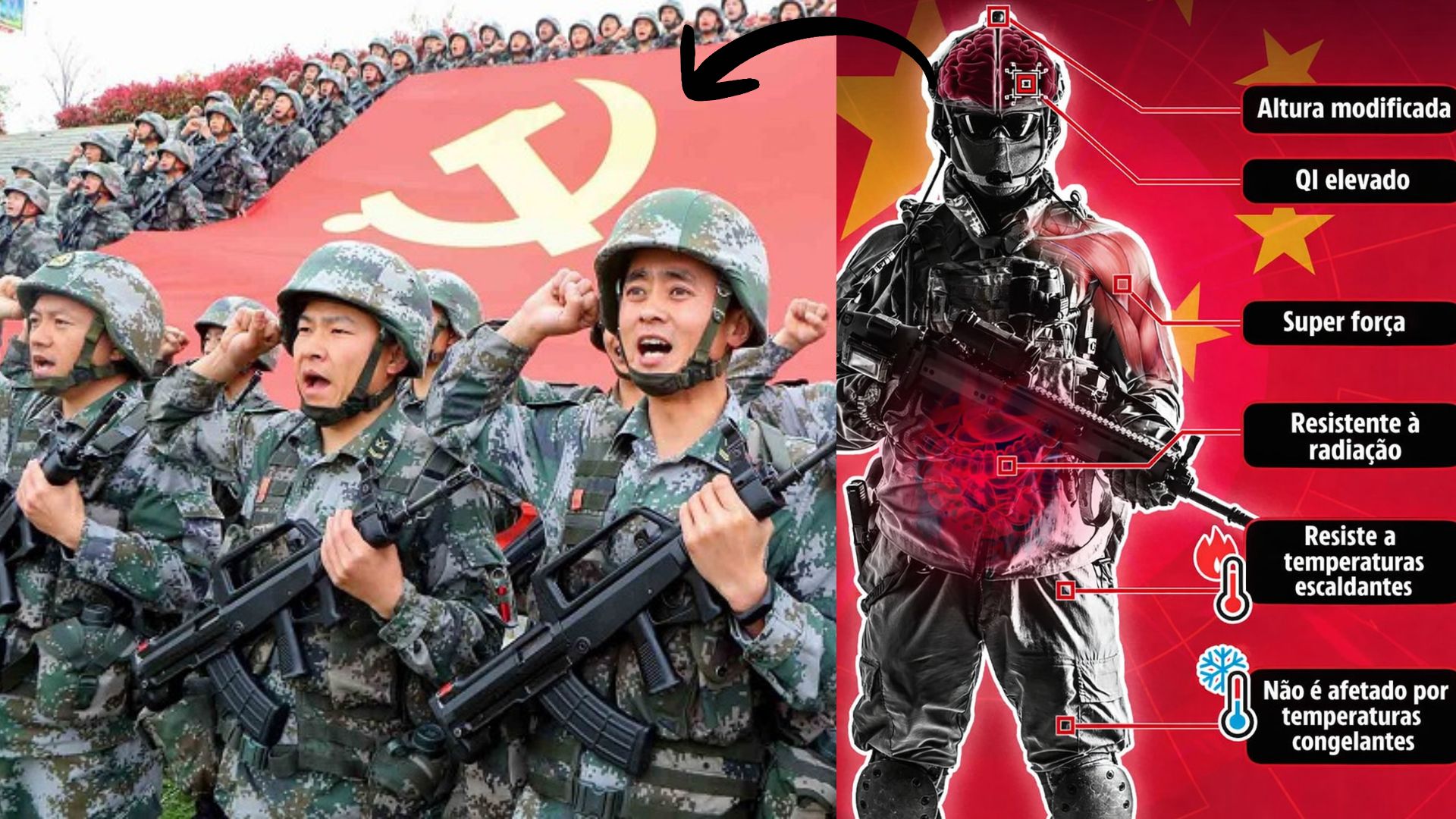


Suspicions About Chinese Military Advancements Reignite Alerts in the West and Place Biotechnology at the Center of the Strategic Debate, Involving Intelligence, Genetic Data, and Ethical Limits in a Scenario of Global Competition Among Major Powers.
Authorities and security analysts in the West have once again raised suspicions that China is investing in genetic modification techniques and other forms of biological enhancement with potential military applications.
The information, cited by the portal D24am, is based on statements from expert Anthony Vinci, presented as a former senior U.S. intelligence officer, who points to signs of initiatives aimed at increasing troop resistance to extreme environments, including areas with high levels of radiation.
According to Vinci, there would be signs of a program directed towards the biological enhancement of People’s Liberation Army soldiers, focusing on adaptation to scenarios such as deserts, regions of extreme cold, and radioactive environments.
-
Finnish company creates recycled plastic and biomass blocks that fit together without cement, are 10 times lighter than common blocks, and have already been used to build schools in earthquake-affected areas.

-
A US startup wants to build a 10 km space cannon to launch multi-ton payloads into orbit at Mach 23, replacing part of the rockets with a colossal structure that looks like a science fiction weapon.

-
Extreme droughts and floods have doubled on the planet since 1901, according to a study of 1,300 river basins that reveals increasing pressure on agriculture, rivers, soils, ecosystems, and water supply.

-
Turkey begins aligning 5,000 giant concrete blocks of 21 tons in the Black Sea to erect a wall against giant waves, after the sea invaded the port of Faroz, destroyed nets, and sank 5 fishing boats.


He stated that this movement aligns with Beijing’s declared goal to modernize its armed forces and achieve a standard considered “world-class” by 2049, a symbolic date for the Chinese government.
Statements About Military Impact and International Security
In an interview with the British tabloid The Sun, Vinci stated that the development of genetically modified soldiers could represent risks to international security.
“It is a danger for everyone if China has super soldiers and is able to outmatch its enemies in a war or threaten Western interests in any way,” he said.
According to the analyst, this type of capability could allow for the execution of missions currently considered high-risk or unfeasible for conventional troops, especially in special operations.
“Imagine special operations soldiers with significantly greater survival capability, able to remain submerged for long periods or operate in extreme cold,” he asserted.

Radiological Resistance and Limits of Public Evidence
Among the possibilities mentioned by Vinci are genetic modifications associated with radiation resistance, which, according to him, would allow the deployment of troops in areas affected by nuclear weapons or radiological devices.
The expert also cited potential objectives such as increased physical strength, speed, height, and cognitive abilities, with possible reflections on military decisions and intelligence activities.
So far, however, these assessments are based on analyses of technological trends and strategic documents, with no public confirmation of an active military program in China aimed at the genetic editing of soldiers.
U.S. Reports and the Advancement of Military Biotechnology
The debate is supported by official reports produced in the United States regarding advancements in biotechnology and its integration with artificial intelligence systems.
A final document from the National Security Commission on Emerging Biotechnology, released in 2025, indicates that China is rapidly advancing in the sector and shows interest in integrating biomedical innovation, industry, and defense.
The report highlights that the convergence of biotechnology and artificial intelligence can alter strategic competition patterns and influence how states plan military capabilities and national security policies.
Collection of Genetic Data and Controversies Involving BGI
According to Vinci, the large-scale collection of genetic data would be one of the pillars of this process.
One of the cases cited involves the Chinese company BGI, which was the subject of reports published by the Reuters agency in 2021 regarding prenatal tests used in different countries and the use of genetic data in population research.
At the time, the company stated that the tests were not developed in partnership with the Chinese military and denied any military purpose, claiming to follow data protection standards.
That same year, another journalistic investigation pointed out that a professor affiliated with the University of Copenhagen participated in research with co-authors involving Chinese military institutions.
The university stated that it had no prior knowledge of one of the mentioned links, while BGI again denied that the research had military objectives.
The He Jiankui Case and International Ethical Debate
The debate over the limits of biotechnology in China is often associated with the case of scientist He Jiankui, who was sentenced in 2019 to three years in prison for genetically editing human embryos.
The intervention resulted in the birth of children with alterations in their DNA and was widely condemned by scientific organizations and governments around the world.
Experts in ethics and security point out that the episode highlighted supervisory failures and reinforced global discussions about the legal and moral limits of genetic editing, especially when involving human beings.







Será que esse vinci é o mesmo que disse que o Iraque tinha armas químicas e sei lá mais o que, para ter um motivo “justificável” para atacar eles, mesmo sendo uma mentira?
Kkkkk a verdade mesmo é que as fake news estao gerando um nova raça humana com micro cognição, capazes de acreditar em absurdos como este!!!
“pode estar” e “suspeita” foi se o jornalismo sem fontes e ficou o tabloide lixo em troca de trafego pago…algoritmo lixo pare agora de me enviar lixo…respeite o system instruction ” jornalismo útil com fatos/fonte”