






 Portuguese
  Spanish




China Develops Innovative Project That Could Revolutionize The Aerospace Industry: Electromagnetic Cannon Promises To Reduce The Cost Of Rocket Launches.
Chinese scientists are developing innovative solutions for the launch of space rockets. One of these solutions is the construction of an electromagnetic cannon, which is constantly evolving. The ongoing effort to achieve new advancements drives China to explore new ways to launch its spacecraft.
China’s Electromagnetic Cannon Was Ideated in 1918
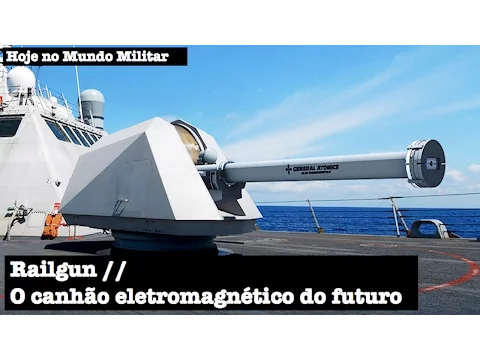

The project they are developing is nothing less than futuristic and consists of building a massive electromagnetic cannon, or railgun, capable of firing 50-ton vehicles into space at a speed of 1,957 kilometers per hour, or Mach 1.6. Electromagnetic cannons exploit electromagnetism to enable the firing of objects even at very high speeds.
In reality, this type of instrument has a history of over a century. In fact, the first project of this kind was carried out in 1918 by French inventor Louis Octave Fauchon-Villeplee and obviously had military objectives. This first prototype of an electric cannon consisted of two parallel conductor rods connected by the wings of a projectile.
-
Brazilian Researchers Develop Cost-Effective Method for Key Component of Green Hydrogen Electrolyzers, Enhancing Energy Efficiency and Equipment Longevity

-
1,700-Year-Old Roman Mosaic Discovered by Farmer Planting Cherry Trees in Turkey

-
Brazil launches $1.9 billion plan in response to El Niño, issuing national extreme heat alert and bolstering public health system

-
Polyformer Machine Converts PET Bottles into 3D Printer Filament, Reducing Costs and Expanding to Over 50 Countries




This entire device was then completely surrounded by a magnetic field. Over the years, this idea has been revisited multiple times. For example, during the Second World War, it was explored by German Joachim Hansler to conceive an electric anti-aircraft cannon. Even today, this type of technology continues to be explored almost exclusively by the armed forces of various countries.
Now, China is trying to adapt it for use in astrophysics. Clearly, there are some modifications to be made: the original project was designed to fire at considerably smaller and lighter objects than a spacecraft. These objects could thus reach much higher speeds than a 50-ton vessel.
China’s Electromagnetic Cannon Has More Than 10 Years Of Research
The project for China’s electromagnetic cannon began to avoid the enormous costs of traditional rockets used until then, and despite still being in an experimental phase, has been active since 2016.
The project has been named Tengyun and is currently the only project of its kind in the world, not because no one has thought of alternative uses for this type of technology, but because those who previously decided to undertake a similar project had to abandon and discontinue it due to very high costs and the lack of truly exploitable results in other contexts.
Today, after nearly 10 years of research, China continues its investigation work on its electromagnetic cannon, believing in the possibility of developing a device capable of launching a spacecraft using predominantly electromagnetic propulsion.
It is worth mentioning that the development of China’s electromagnetic cannon does not completely rule out the use of fuel, which is essential for current space rockets, but requires incredibly smaller amounts.
Project Can Launch Rockets Up To 50 Times Cheaper
The use of China’s electromagnetic cannon would reduce fuel consumption and launch costs to a fraction of the normal price. China aims to reach a cost of US$ 60 per kg of payload, according to the portal South China Morning Post. This is 50 times less than the cost of launches aboard a SpaceX Falcon 9, which costs around US$ 3,000 per kg.
China has already built a test track 2 km long in the city of Datong, Shanxi province. It is the planet’s most ambitious high-speed magnetic levitation facility, according to the Hong Kong newspaper. In its current configuration, it can launch a heavy object at speeds close to 1,000 km/h. The idea is to expand its capacity to reach 5,000 km/h.





Seria bom mencionar que o canhão está mais para uma pista de autorama do que para uma arma que dispara projétil. Pede para IA de vocês ilustrar uma pista de lançamento, onde a cápsula/fogete acelera em uma pista sem atrito, pela ação eletromagnética, e no final a pista faz ângulo de lançamento para o que estiver sendo lançado.
Se queimar um neurônio e meio conseguirá imaginar o que acontece com o impacto de um disparo a 1,6 a velocidade do som contra uma cápsula/foguete. Mesmo assim vou ajudar com uma dica: o objeto não será arremessado.
Julio Verne ataca outra vez. Ele imaginou uma solução parecida em Da Terra a Lua. É claro que estava pensando com a cabeça do século XIX e pensou na pólvora em vez do eletromagnetismo. Mas é sempre interessante quando a realidade alcança a ficção científica de alguma forma.