






 Portuguese
  Spanish


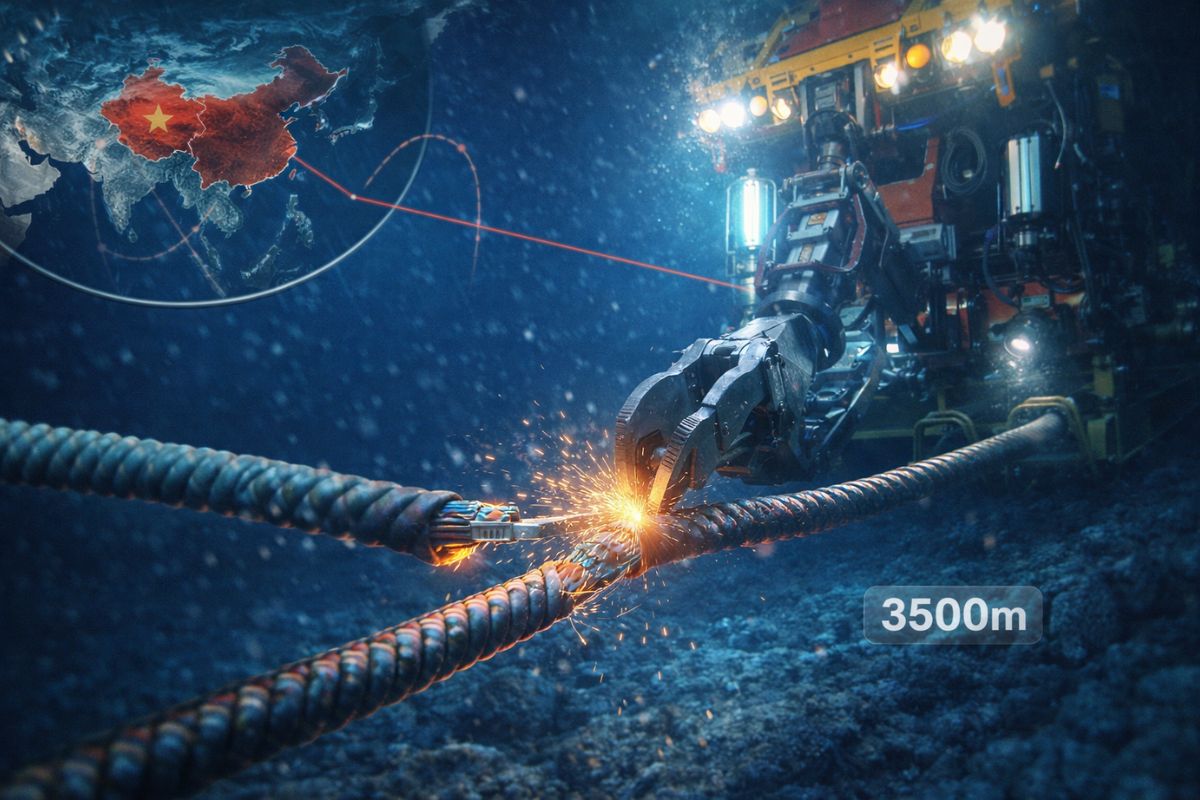

Drone-operated device cut structures at 3,500 meters in April 11 test. Brazil has 16 submarine cables along the coast and one of them is partially operated by China Unicom.
The research vessel Haiyang Dizhi 2 completed its first deep-water mission of the year on April 11, 2026, according to the Ministry of Natural Resources of China. Onboard, engineers tested an electro-hydrostatic actuator capable of cutting underwater structures, including armored fiber optic cables, at a depth of 3,500 meters. The official newspaper China Science Daily stated that the test “filled the last mile between equipment development and engineering application,” indicating that the device is ready for operational use.
The device was developed by engineers from Zhejiang University. It supports pressures above 35 megapascals, uses corrosion-resistant materials, and integrates hydraulic system, electric motor, and control unit into a single compact device. It can be mounted on small unmanned underwater vehicles, eliminating the need for large surface fleets.
Why is this more serious than it seems?

Submarine fiber optic cables carry approximately 99% of international data traffic. Internet, telephony, financial transactions, military communication, and banking operations between continents depend on these lines installed on the ocean floor. There are about 600 cable systems in the world, totaling 1.5 million kilometers, equivalent to 30 times around the Earth.
-
A fossil kept for years in a small museum in Montreal concealed 450-million-year-old soft tissue, a discovery that has only happened once before in history.

-
Three teenagers transform cut cardboard into Japanese origami-style packaging that promises to retire styrofoam and bubble wrap, win a $12,500 prize, and target giants like Amazon, FedEx, and Home Depot after a robot motor arrived broken.

-
The large jar blender has a rival: Oster Ultra Power bets on 1,000 W, six stainless steel blades, and two portable cups with leak-proof lids.

-
Tesla injected an additional $250 million into the German factory, doubled the battery cell target, and opened its own production line for startups.



A Chinese report from September 2025, cited by the South China Morning Post, already described the technology as intended “for cutting submarine cables and operating deep-sea claws.” The depth of 3,500 meters places most cables in the Atlantic Ocean, Pacific Ocean, and South China Sea within the reach of the device.
The geopolitical context amplifies the severity. In recent months, the British Navy tracked three Russian submarines near vital underwater infrastructures. Cables were cut in the Red Sea in 2025. A shadow fleet Russian tanker dragged its anchor for 90 kilometers on the bottom of the Baltic Sea in an attempt to sever cables. China now demonstrates that it has the technological capability to do the same in much deeper waters.
The Chinese technological evolution in this area is alarmingly rapid

In 2022, a team repairing underwater pipelines took five hours to make a single cut in an 18-inch pipe. In 2023, remotely operated Chinese vessels were already cutting 38-inch diameter pipes at 600 meters deep, with a repair completed in 20 minutes. By April 2026, the device operates at 3,500 meters.
In four years, China multiplied operational depth by nearly six and reduced operation time by over 90%.
The Chinese government presents the equipment as a tool for the construction and repair of underwater pipelines and gas pipelines.
The civil application is real. But a device that cuts armored cables at 3.5 kilometers deep and can be carried by an underwater drone doesn’t require much imagination to understand its military use.
What does this have to do with Brazil?
Brazil has at least 16 systems of underwater cables connected to its coast, according to data from the IX Fortaleza Forum 2025 and Tecnoblog. Fortaleza, Praia Grande (SP), Santos, Rio de Janeiro, Salvador, and Recife are the main landing points. These cables connect Brazil to the United States, Europe, Africa, and South America.
The EllaLink, inaugurated in 2021, connects Fortaleza directly to Sines, Portugal. It was built partly in response to the NSA spying scandals revealed by Edward Snowden, because before that, almost all Brazilian traffic to Europe passed through American servers. The SACS connects Fortaleza to Luanda, Angola. Google’s Firmina went into operation in 2025. And the SAIL, which connects Fortaleza to Cameroon, is partially operated by China Unicom.
If one or more of these cables are cut, repaired, or just threatened, the impact on the internet, banking systems, the financial market, and communications in Brazil is immediate. Repairing a cable in deep waters can take weeks and cost tens of millions of dollars. Meanwhile, traffic needs to be redirected through alternative routes that do not always have the capacity to absorb the demand.
China has just demonstrated that it has the technology to cut any cable on the planet at 3,500 meters deep using an underwater drone. And one of those cables that connects Brazil to the world is partially operated by a Chinese state-owned company. What do you think about that?


