Portuguese
  Spanish


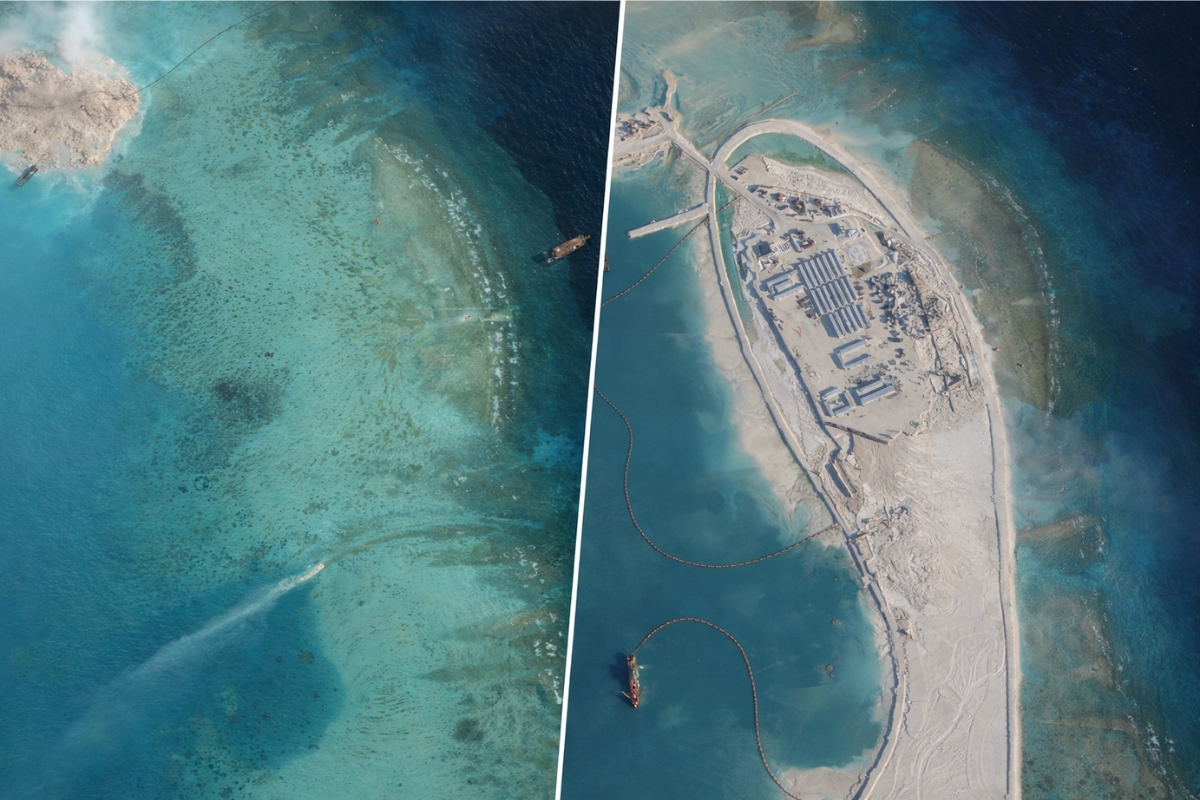

Beijing transformed a reef in the South China Sea into a new base in the Pacific, increased military presence, and strengthened control over a decisive route
While global attention was focused on the conflict in the Middle East, Beijing quietly advanced in one of the most sensitive areas of the planet. In just a few months, an almost invisible sandbank began to take shape, structure, and strategic value.
The movement changes the reading of the regional dispute. By creating land where there was previously only open sea, China expands its presence, reinforces its surveillance power, and positions itself over a vital maritime route for balance in the Pacific.
The impact goes beyond the work itself. The physical transformation of the reef creates a fait accompli and makes any late reaction difficult, pressuring neighboring countries and raising tensions around an increasingly important territory.
-
European Parliament Approves Digital Euro, Aiming to Challenge Visa and Mastercard’s Dominance and Transform Payments Across Europe by 2029

-
Israel finds Hezbollah militarized tunnel over 200 meters long under village, with 4 missile launch shafts, 12 chambers, anti-tank missiles, drones, and weapons depots at a depth of 25 meters.

-
Ukraine launches largest drone attack on Moscow since 2022, Russia claims to have intercepted nearly 200 aircraft near the capital, Kapotnya refinery targeted again, and offensive reignites alert about war reaching the Russian energy heart just a few kilometers from the Kremlin.

-
Truck drivers, freight, and fines from 2022 take center stage in politics: Chamber approves MP with amnesty, mandatory tracking by CIOT, million-dollar penalties, and new minimum wage for those who spend more than 24 hours on the road.



Antelope Reef became a key piece while global focus was on another crisis

The center of this movement is Antelope Reef, a reef that went from being an almost imperceptible point to becoming a new platform for strategic projection. The change occurred at an accelerated pace, precisely when international news was following developments in the Middle East.
This coincidence amplified the weight of the advance. With less immediate external attention, the transformation of the reef progressed almost without opposition and consolidated a new reality in a sensitive area of the South China Sea.
Sandbank gained area, reinforced perimeter, and space for larger structures
What was once just a sandbank began to show clear signs of expansion. The land gained visible area, more defined perimeters, and enough space to accommodate more complex facilities.
This change represents not just territorial growth. It paves the way for a permanent presence, logistical support, and strengthening control over a maritime strip crucial for trade, surveillance, and regional influence.
Satellite images show rapid construction and impressive scale
The comparative images reveal the speed of the transformation between December 19, 2025 and February 17, 2026. In a short interval, the reef went from being a discreet formation to becoming an expanding platform.
According to Telegraph, a British newspaper with international coverage of politics and defense, the pace of construction at Antelope Reef exposes an operation with significant logistical capacity, supported by dredgers working in a coordinated manner to create extensive land areas in a short time.

Construction advances in disputed area and increases legal tension
The expansion also carries diplomatic and legal weight. The Chinese strategy presents the work as an internal issue, which helps reduce the initial impact of criticism and shifts the dispute to the field of international narrative.
In practice, this does not end the controversy. According to the understanding of the UN Convention on the Law of the Sea, this type of construction does not create new sovereign rights, which keeps the reef within a sensitive and highly contested zone.
Created land already indicates military use from the start
The dimensions of the new area allow for imagining a structure much larger than a simple support facility. The space accommodates runways for aircraft, surveillance systems, radars, and defense resources capable of enhancing Chinese presence in the region.
The most striking point is that the current design already suggests a strategic use from the outset. Instead of a discreet expansion with only a civilian appearance, the land emerges with direct potential to strengthen the militarization of the area.
New enclave reinforces surveillance and changes the balance in the Pacific
More than occupying a reef, China expands a network that connects maritime presence, monitoring capacity, and power projection. This type of enclave functions as a supporting piece in a larger architecture of regional control.
The effect is cumulative. Each new consolidated area increases the capacity to observe, deter, and respond quickly, altering the balance around one of the most strategic maritime routes in the world.
While the world followed the conflict in the Middle East, Beijing advanced over a piece of territory capable of repositioning the regional dispute. The gesture carries geopolitical weight and transforms an almost ignored point into an asset of enormous strategic value.
Now, the expanded reef ceases to be a detail on the map and becomes part of a larger mechanism of pressure, surveillance, and military presence. The movement reinforces Chinese reach and changes the strategic reading.