Portuguese
  Spanish




Global space race intensifies with simultaneous advances by the United States and China, while Brazil emerges as a strategic partner in scientific and technological projects related to Earth observation and future orbital initiatives.
China announced that it will expand its space missions in 2026 and strengthen international cooperation in the sector, including a partnership with Brazil in the CBERS program, shortly after NASA concluded Artemis II, the first crewed mission to orbit the Moon in over five decades.
The move was announced by the state agency Xinhua in statements from the China National Space Administration, CNSA, on the eve of China Space Day, celebrated on April 24, and the China Space Conference, held from April 23 to 25 in Chengdu.
This new Chinese phase occurs at a time of more intense technological competition between major powers, with the United States resuming crewed flights around the Moon and Beijing accelerating plans for missions, reusable rockets, scientific satellites, and prolonged human presence in space.
-
Artist’s 15-Meter Lighthouse in the Mojave Desert, 160 km from the Sea, Intrigues Visitors with 19 km Range After Years of Bureaucracy

-
Bluetti AC70 Solar-Powered Station: Powers Fridge and Wi-Fi During Blackouts, Delivers 1,000W, 3,000 Charge Cycles, Priced at $900

-
Enormous Black Hole Phoenix A* Challenges Scientific Understanding with Mass of 100 Billion Suns, Surpassing Famous TON 618 in One of the Largest Known Galaxy Clusters
-
Say Goodbye to Storing Wine in a Regular Fridge: Midea’s Climate-Controlled Cellar Holds 34 Bottles, Maintains 5-18°C, and Uses Only Half a kWh Daily


Brazil at the Center of Technological Cooperation with China
In the Brazilian case, the cooperation cited by China is primarily based on the CBERS, an acronym for China-Brazil Earth Resources Satellite, a program created from an agreement signed in 1988 to develop Earth observation satellites.

“China-Brazil space cooperation is widely considered a model of South-South cooperation in the high-tech sector,” CNSA stated, recalling that the two countries have signed different collaboration plans over the past decades.
The Chinese statement did not detail new bilateral projects but indicated the continuation of CBERS as the axis of the space relationship between the two countries.
In Brazil, this type of satellite is applied in environmental monitoring, territorial planning, agriculture, natural resource management, and tracking deforestation areas.
Artemis II Mission Reinforces United States’ Leading Role
Artemis II, in turn, reinforced the United States’ position in lunar exploration.
The NASA mission was launched on April 1, 2026, and returned to Earth on April 10, after taking four astronauts on a test flight around the Moon aboard the Orion capsule.
The crew consisted of Reid Wiseman, Victor Glover, and Christina Koch from NASA, as well as Jeremy Hansen from the Canadian Space Agency.
The flight tested life support, navigation, communication, and safety systems ahead of future lunar landing missions in the Artemis program.
Brazil also appeared in this mission through another path.
Artemis II astronauts used an actigraph developed from research linked to the University of São Paulo, an equipment similar to a scientific watch used to monitor sleep patterns, movement, and light exposure during the trip.
Chinese Expansion Includes More Launches and Lunar Base

While the United States advances in the Artemis program, China is trying to consolidate its own expansion schedule.
According to Liu Yunfeng, deputy director of CNSA’s system engineering department, the country carried out 92 space launches in 2025, a 35% increase compared to the previous year.
Beijing also reported that it plans to conduct crewed missions in 2026, including Shenzhou-23, flight tests with reusable rockets, and new actions to strengthen the commercial space sector, an area seen as strategic for reducing costs and increasing the frequency of orbital operations.
China also maintains the goal of sending astronauts to the Moon before 2030 and developing a lunar base, in partnership with other countries.
The project is part of the International Lunar Research Station, a Chinese initiative that competes, in influence, with the U.S.-led Artemis Accords.

Scientific missions and continuous presence in orbit
Another point mentioned by CNSA was the SMILE mission, an acronym for Solar wind Magnetosphere Ionosphere Link Explorer, developed in cooperation with Europe.
The satellite is set to study the interactions between solar wind and Earth’s magnetosphere, an important phenomenon for understanding space weather effects.
In the week of the announcement, China also launched a Long March-4C rocket with a satellite aimed at detecting greenhouse gases.
The mission reinforces the use of space technology for climate observation, an area that directly aligns with applications of satellites like those from the CBERS program.
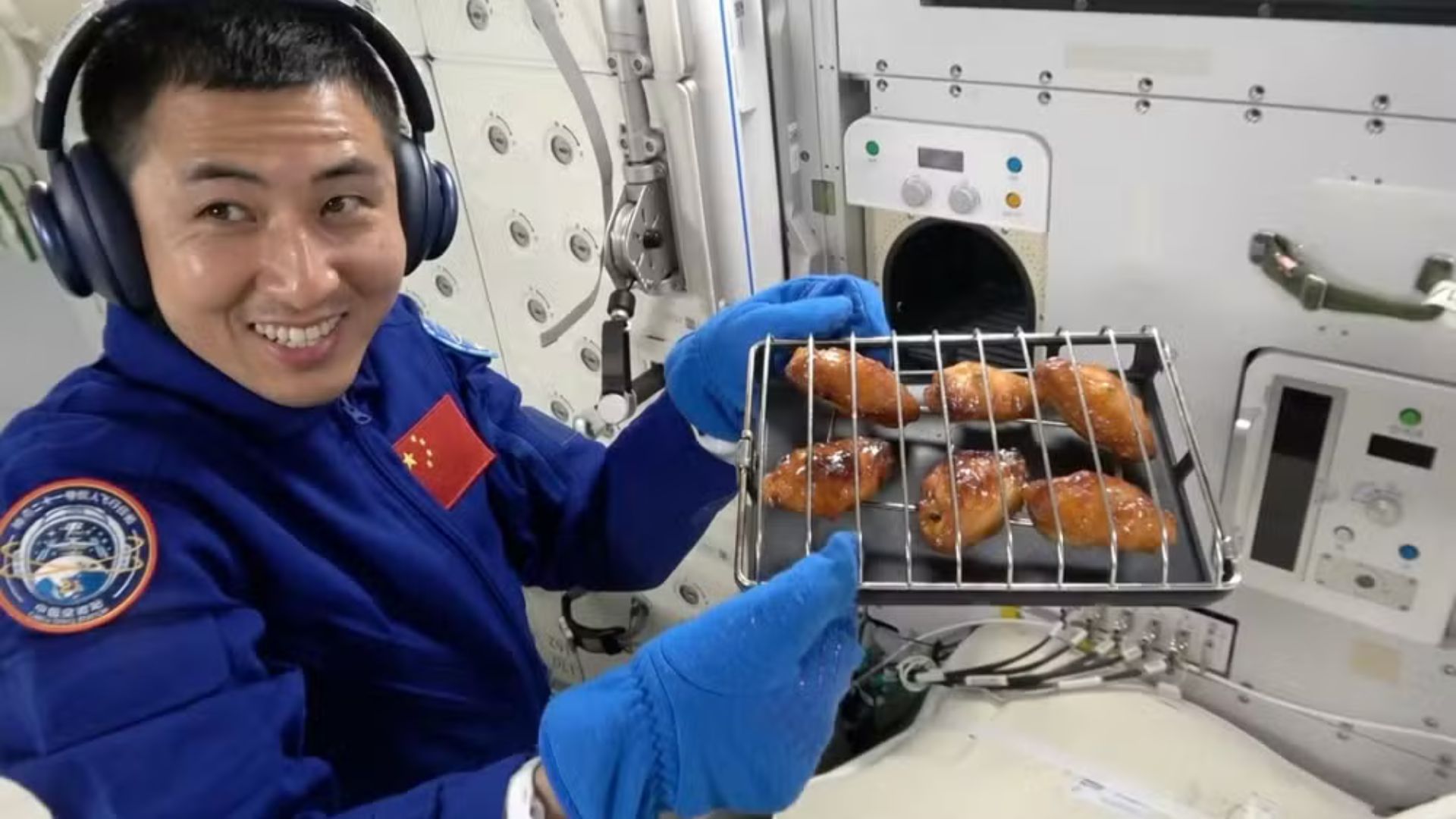
In orbit, the Shenzhou-21 crew also performed extravehicular activities at the Chinese space station.
Zhang Lu, Wu Fei, and Zhang Hongzhang installed protective equipment against space debris and inspected components used outside the orbital module.
The three taikonauts departed for the Chinese station on October 31, 2025, on a mission initially planned for about six months.
Chinese authorities decided to extend their stay by another month to test technologies related to prolonged stays in orbit.
Lunar communication and global strategic impact
China’s lunar far side communication capability has also become an important element in this technological dispute.
As this region has no direct line of contact with Earth, Beijing developed relay satellites to support more complex lunar missions.
This advancement gained prominence because spacecraft orbiting the Moon can face periods without direct communication with terrestrial control centers, depending on the trajectory and available infrastructure.
Artemis II experienced such segments during its flight around the natural satellite.
For Brazil, the dispute between the United States and China opens up space for cooperation, but also highlights the need for its own technological planning.
The country maintains space relations with both sides, while also seeking to transform partnerships into more robust industrial, scientific, and operational capacity.