Portuguese
  Spanish


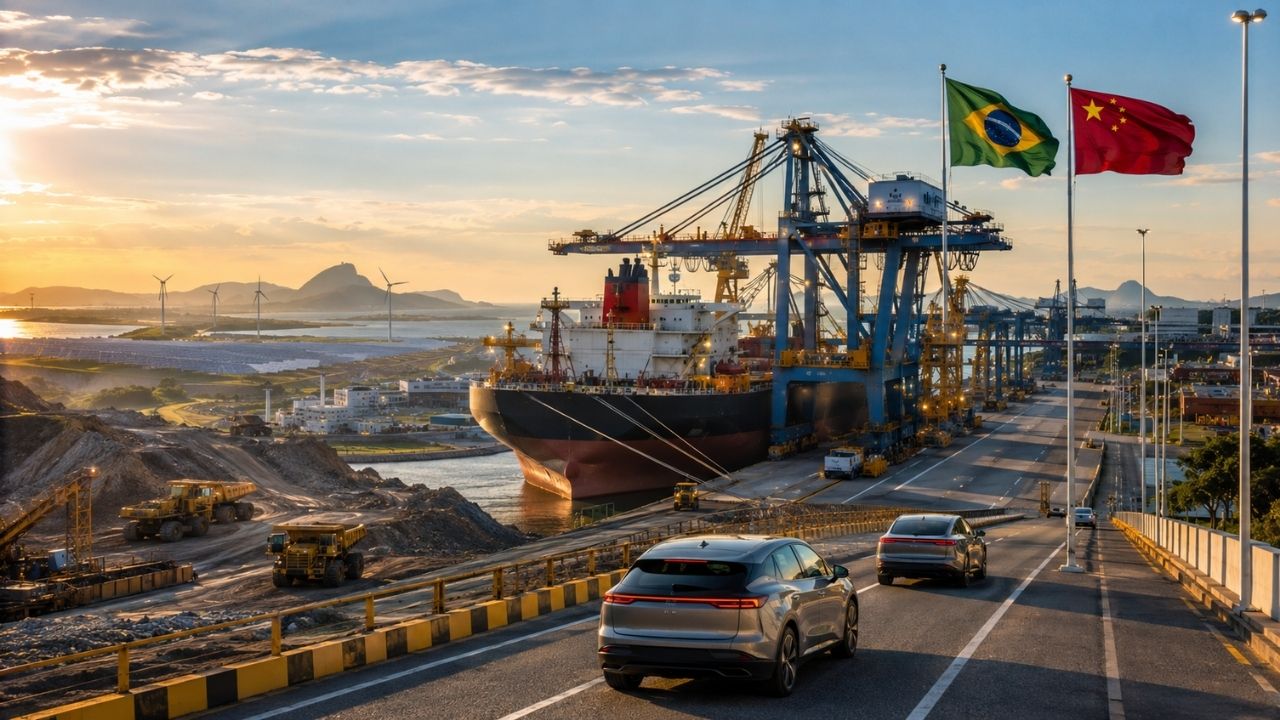

Chinese investment in Brazil advanced 45% in value, surpassed the pace of total foreign capital in the country, and made the Brazilian market absorb 10.9% of all Chinese capital sent abroad, ahead of the United States, in a turnaround that reinforces Brazil’s strategic weight in the global dispute for industry, energy, and technology.
Chinese investment in Brazil reached US$ 6.1 billion in 2025, making the country Beijing’s main global destination that year, according to an annual report released by the China-Brazil Business Council on Thursday. The movement involved Chinese mining companies, automakers, technology, and clean energy, distributed across 20 Brazilian states and concentrated in a record 52 projects.
According to information from the South China Morning Post, the data draws attention not only for the volume but also for the direction of the money. China did not expand its presence in Brazil only with large figures: it diversified sectors, occupied spaces left by Western companies, and accelerated projects linked to sustainability, at a time when the country also becomes a central piece in the dispute for economic influence in Latin America.
Chinese investment in Brazil grew far above total foreign capital
The 45% jump in the value invested by China in Brazil was far above the 4.8% increase recorded in the total foreign investment received by the country. The difference shows that the Chinese advance did not only follow a general trend of external capital inflow but grew at its own, much faster pace.
-
To erect the “Baleia” building on the richest avenue in Brazil, he bought 35 houses, paying with trips to Disney, a truck, and even an apartment, waited over 20 years, and today the complex is valued at R$ 2.5 billion.

-
The land belonged to her great-great-grandfather and was worth R$ 25 per square meter during the pandemic; the couple sold 250,000 m² for the nearly R$ 30 billion project that is transforming the “neighbor of Jericoacoara,” and today a house in the region goes for R$ 4.2 million.

-
Labor shortage reaches the truck drivers’ area: Brazil is already facing a deficit of 120,000 drivers, 65.1% of transport companies feel the impacts, and Mercedes-Benz strengthens training in the face of the new generation of technological trucks.
-
An important sector in Brazil is suffering from a labor shortage, requiring the qualification of 14 million workers by 2027, leading companies to invest R$ 5 million to train professionals and address the technical deficit.




The global comparison also reinforces the weight of the movement. While Chinese outflows abroad grew only 1.3% globally, Brazil absorbed 10.9% of all Chinese capital sent to other countries. This percentage placed the Brazilian market ahead of the United States, which received 6.8%.
In practice, this means that Brazil ceased to be merely a relevant destination in Latin America and began to occupy the global top of China’s investment strategy. The scale of the movement indicates a clear preference for sectors linked to production, natural resources, technology, electric mobility, and energy transition.
The 52 projects show a more widespread and diversified Chinese presence
The record of 52 Chinese projects in Brazil reveals an important change in the operating pattern of Beijing’s companies. The investment was not concentrated in a single sector or a single region but spread across 20 states, reaching different production chains.
According to Tulio Cariello, author of the report and research director of the China-Brazil Business Council, the main number matters less than the destination of the money. The interpretation is that there was greater diversification of investments, including in areas where China used to invest in the United States.
This point helps explain why the advance has a broader impact. It is not just about capital inflow but a reorganization of industrial priorities. Mining, electric cars, technology, sustainability, and clean energy have become part of the same movement of Chinese expansion in Brazilian territory.
Mining received US$ 1.76 billion and drove part of the turnaround


Mining was one of the strongest sectors in this advance. Chinese companies invested US$ 1.76 billion in the segment, a value more than three times higher than that recorded in 2024. This growth shows that the Brazilian mineral sector continues to be a central area for Chinese capital.
One of the most relevant movements was the purchase of gold mines from the Canadian Equinox Gold by CMOC, in an operation of approximately US$ 1 billion. The deal reinforced the Chinese presence in strategic mineral assets and increased the weight of mining within the economic relationship between the two countries.
This advance also helps explain why Brazil has become so important to Beijing. The country combines territorial scale, resource availability, and production chains capable of sustaining large-scale investments. For China, this creates opportunities in sectors directly linked to industry, technology, and long-term infrastructure.
Chinese automakers advance into factories left by Western companies
Another important axis of Chinese investment in Brazil appears in the automotive industry. Chinese automakers began to occupy areas left by Western manufacturers, transforming old industrial spaces into new hubs especially linked to electric cars.
BYD’s presence in electric vehicle production in Brazil symbolizes this transition. The image of the company’s vehicles on the production line in the country, in October 2025, illustrates a concrete change: the Chinese industry is not just selling to the Brazilian market, but also setting up local production structures.
This movement has a direct impact on the economic interpretation of the relationship between Brazil and China. By setting up factories, Chinese companies expand their industrial presence, bring production chains closer to the final consumer, and reinforce Brazil as a strategic platform for expanding sectors.
Technology and food delivery also enter the new Chinese phase
The Chinese advance was not limited to mining and the automotive industry. Technology companies also began launching operations in the country, including initiatives linked to the food delivery sector, such as Meituan’s food delivery arm.
This point shows that the Chinese presence in Brazil is becoming broader and less dependent on traditional sectors. Technology now functions as an expansion front capable of connecting urban consumption, digital services, and new models of business operation.
Although the most visible financial volume is in areas such as mining and industry, the entry of technology companies expands the reach of investment. It also places Brazil in a relevant position for Chinese companies seeking large, urban markets with growth potential in digital services.
Clean energy and sustainability broke records among projects

The energy transition is another central fact of the new phase of Chinese investment in Brazil. Projects in sustainability and clean energy reached 31 initiatives, equivalent to 60% of all Chinese ventures in the country that year.
This percentage is relevant because it shows a change in profile. Chinese capital is not only focused on mineral assets or factories, but also on areas associated with the low-carbon economy, energy infrastructure, and productive reorganization linked to sustainability.
For Brazil, this direction can reinforce the country’s position in global chains connected to clean energy. For China, the investment expands its presence in a market that combines natural resources, industrial demand, and potential for large-scale sustainable projects.
Brazil takes on a strategic position in the global economic dispute
By surpassing the United States as the destination for Chinese capital abroad in 2025, Brazil gained a symbolic and practical dimension within Beijing’s strategy. The country not only received more money but concentrated a significant share of global Chinese flows.
This movement also occurs in a scenario of dispute for influence in Latin America. The expansion of Chinese mining companies, automakers, and technology companies across Brazilian territory creates an economic presence that is difficult to ignore, especially when distributed across 20 states and different sectors.
The consequence is that Brazil is consolidating itself as a point of convergence between industry, natural resources, clean energy, and consumption. China, in turn, strengthens its ability to operate in areas that combine economic return, productive strategy, and regional influence.
What changes with the new phase of Chinese capital in the country
The advance of Chinese investment in Brazil indicates a deeper economic relationship, less concentrated on commodity trade. The presence of factories, mines, technological operations, and clean energy projects shows that Chinese capital is entering productive structures and long-term assets.
This could have significant implications for industrial sectors, supply chains, and how Brazil positions itself among major economies. The Chinese presence in electric cars, mining, and sustainability could also accelerate disputes over market, technology, skilled labor, and infrastructure.
There are still points to observe. The real impact of these 52 projects will depend on their execution, their capacity for integration with the local economy, job creation, sectoral regulation, and the continuity of investment flows in the coming years.
The central fact, however, is already established: Brazil became the main global destination for Chinese capital in 2025, with US$ 6.1 billion invested and an increasingly widespread presence across strategic sectors. The movement reveals that the relationship between the two countries has entered a broader stage, where mining, electric cars, technology, and clean energy now share the center of economic competition.
In the coming years, the Chinese advance could show whether this new phase will be just an investment peak or the beginning of a deeper reorganization of foreign industrial and technological presence in Brazil.
What do you think this advance in Chinese investment could represent for the Brazilian economy in the coming years? Leave your opinion in the comments.