Portuguese
  Spanish


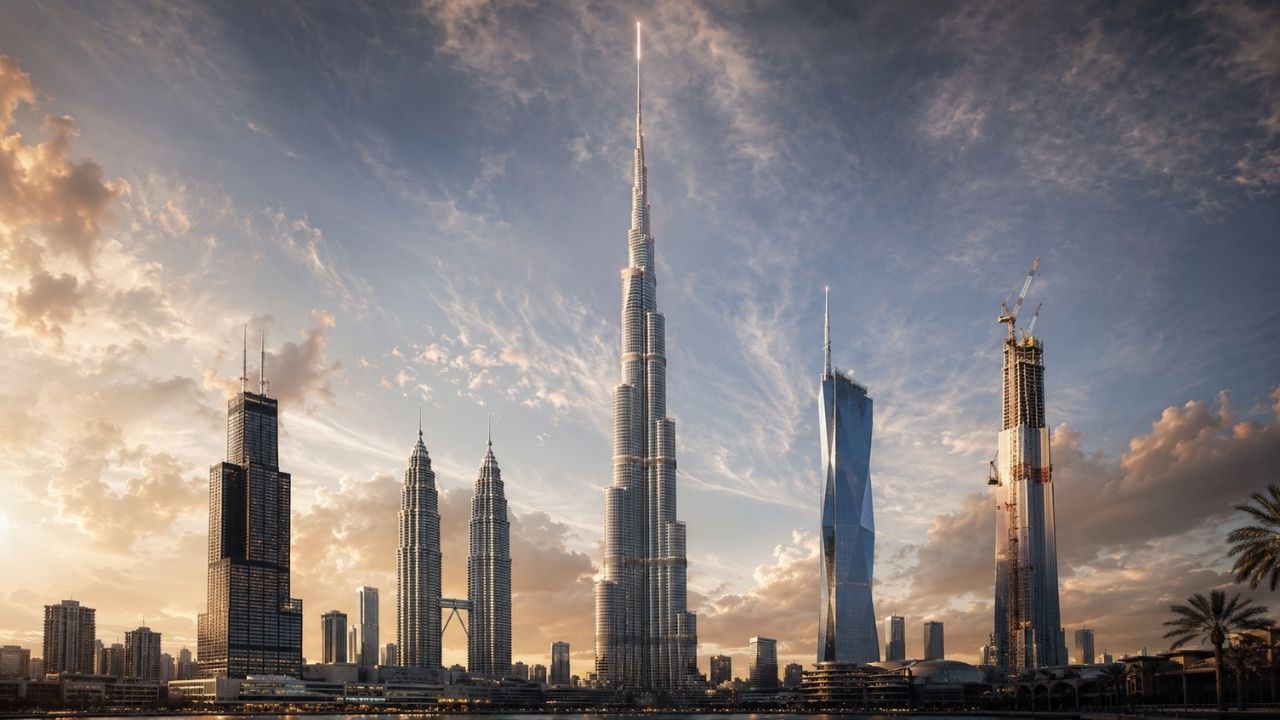


The world’s tallest buildings are not measured solely by occupied floors, and the so-called vanity height exposes a global dispute where a few meters can change rankings, fuel rivalries, and redefine the prestige of entire cities.
The world’s tallest buildings returned to the center of a global discussion in 2026, as the construction of Jeddah Tower, in Saudi Arabia, reaches the 100th floor and reignites the debate about what truly counts in the measurement of great skyscrapers. The dispute involves icons such as the Burj Khalifa, in Dubai, the Merdeka 118, in Malaysia, the Willis Tower, in Chicago, and the Petronas Towers, in Kuala Lumpur, all linked to an architectural race marked by technical rules, urban prestige, and structures that artificially inflate official height.
The most curious point is that, in this universe, the tallest building is not always the one where people reach the highest point. In some cases, pinnacles, decorative towers, and architectural spires add dozens or even hundreds of meters to the official ranking, creating what experts call vanity height and transforming the measurement of skyscrapers into a dispute as symbolic as it is structural.
The dispute over the world’s tallest buildings begins with measurement rules
The question seems simple, but it has never been entirely peaceful: what does it actually mean to say that a building is the tallest in the world? The answer lies with the Council on Tall Buildings and Urban Habitat, known by the acronym CTBUH, responsible for organizing the official rankings of this type of construction.
-
From matches sold by bicycle at age 5 to a global furniture empire: the lumberjack’s son founded IKEA at 17 in his uncle’s kitchen and transformed a small company into the largest furniture retailer on the planet.

-
The mansion in Flamengo, built in 1865 for the Baron of São Clemente and closed for 20 years, has become a spa, event hall, and gym for “Symphony,” a luxury condominium that sold 70% of its gross development value in the first month on the R$ 60 million land of the former Bennett College.

-
The Ipiranga convent, a 1924 building adjacent to the Museum that remained vacant for a decade and became home to dozens of cats, is reborn as “Alma Mater,” a luxury development worth R$ 130 million with a pool in the courtyard and a clubhouse in the former nuns’ chapel.

-
An empty pool of almost 3 meters turned into tilapia farming in the backyard after a family transformed the dangerous space for children into an urban greenhouse with eggs and organic food.




The most influential criterion measures the building from street level to the architectural top. This means that elements conceived as part of the design, such as pinnacles and decorative towers, can count towards the official height. However, antennas installed after construction, with a technical transmission function, are not included in this main count.
This seemingly technical difference was enough to cause one of the biggest controversies in skyscraper history, when the Petronas Towers, in Kuala Lumpur, surpassed the Willis Tower, then known as the Sears Tower, in Chicago. For many Chicago residents, the decision seemed unfair, as the American tower was taller to the roof and also reached a greater height when its antenna masts were considered.

But the official ranking favored the Petronas. Their twin towers were part of the original architectural design and raised their height to 451.9 meters, above the 442.1 meters of the Willis Tower. The indignation was so intense that new categories were later created, including the highest occupied floor and the highest point of any structure.
The Petronas case showed that a building’s height is also a matter of interpretation
The controversy between Kuala Lumpur and Chicago made it clear that the world’s tallest buildings do not compete only in concrete, steel, and engineering. They also compete in interpretation, symbolism, and classification rules.
The Willis Tower maintained significant advantages in other criteria. It had a higher roof and masts that took it to a greater altitude. However, as these masts had been added for television transmission and were not considered an essential architectural part, they were excluded from the main official measurement.
The Petronas Towers, on the other hand, transformed their upper elements into part of their visual identity. The result was a historic turnaround in the ranking and a lasting change in how architects, developers, and cities began to view the tops of buildings.
From then on, it became more evident that the design of a skyscraper’s upper extremity could decide its place in history, even when the effectively used floors ended far below the highest point displayed to the world.
Merdeka 118 entered the ranking with a spire that adds 176 meters to the official height

The Merdeka 118, completed in Kuala Lumpur in 2024, is one of the most striking examples of this logic. The building has its highest occupied floor at just over 500 meters, but its official height reaches 678.9 meters thanks to an enormous architectural spire.
With this, the building now occupies second place in the world ranking, behind only the Burj Khalifa. The difference between the occupied space and the official top reaches 176 meters, a measurement that, alone, would be taller than many well-known skyscrapers.
This contrast becomes even more striking when compared to the Shanghai Tower. Although Merdeka 118 is above it in the official classification, the Chinese tower has a restaurant on the 120th floor, more than 50 meters above the highest occupied floor of the Malaysian building. In practical terms, someone in the Shanghai Tower could be in a usable space higher than a person in the highest occupied point of the officially higher-ranked building.
Even so, Merdeka 118’s proponents argue that its spire is not just a ranking strategy. The silhouette is said to be related to the pose associated with the moment Malaysia’s founding father declared independence, called “merdeka,” in 1957. In this sense, the upper structure would also carry a national and historical message, not just a competitive function.
Burj Khalifa consolidated the era of height as an instrument of global prestige

No building has had more impact on this contemporary dispute than the Burj Khalifa. Inaugurated in Dubai in 2010, it remains as the tallest structure in the world by available criteria, with 828 meters of height.
The number is impressive on its own, but the so-called vanity height also draws attention. Between the last technical floor and the top of the spire there is a gap of 242 meters. This upper portion, alone, would be among the tallest buildings in New York if placed in Manhattan.
The importance of the Burj Khalifa, however, goes beyond engineering. When its construction began in the mid-2000s, Dubai was still described as a relatively modest port city, with an economy strongly linked to natural resources. Unlike Manhattan, where skyscrapers emerged as a response to urban density and scarcity of space, Dubai did not need to erect such tall towers due to lack of land.
The objective was different. The Burj Khalifa functioned as a declaration of international ambition, helping to project Dubai as a tourist destination, business hub, and investment pole. Height ceased to be merely an urban solution and began to operate as an instrument of image, soft power, and real estate appreciation.
The race for a few meters had already transformed New York into a stage for rivalry


The dispute over height was not born with Dubai, Malaysia, or Saudi Arabia. In 1929, New York was already experiencing an intense architectural rivalry between Walter Chrysler and George Ohrstrom.
Chrysler wanted to erect a 65-story Art Deco tower that would become one of the city’s ultimate symbols. But his plan was challenged by the project of 40 Wall Street, conceived with the explicit intention of surpassing it. The two constructions began to alternate height increases in a dispute that mixed corporate ego, urban strategy, and public spectacle.
Chrysler’s response was theatrical. Its architect, William Van Alen, had obtained permission to build a steel spire of **38 meters**, discreetly mounted atop the building. In October 1929, this structure was hoisted and put into place during a single night.
With this, the Chrysler Building reached **319 meters** and surpassed 40 Wall Street, briefly claiming the title of the world’s tallest building. The episode showed that **a skyscraper’s top could be as decisive as its base, its floors, or its urban function**.
Moscow also used monumental skyscrapers to dispute symbolic power
The vertical race was not restricted to American capitalism. In the 1920s and 1930s, **Josef Stalin also turned his attention to Moscow’s skyline**, determined to make the Soviet Union match and surpass the architectural achievements of the United States.
From this impulse arose the monumental skyscrapers known as **the Seven Sisters**. Among them is the Hotel Ukraina, a building that occupies a curious position in classification rules.

According to the criteria of the Council on Tall Buildings, a structure needs to have at least **50% of its height composed of habitable space** to be considered a building, and not a tower. The Hotel Ukraina, with its large upper structure, has a facade corresponding to **42% of its total height**.
This means it is only **eight percentage points away from disqualification as a building**. The case demonstrates how the boundary between building and tower can become narrow when architecture uses upper elements to amplify its visual presence.
Jeddah Tower could take the dispute to a new level in Saudi Arabia
The Jeddah Tower, currently under construction in Saudi Arabia, represents the next major stage of this race. The original project envisioned a one-mile-high building, equivalent to **1,600 meters**, but the proposal was eventually abandoned as it was deemed impractical.
The revised plan remains ambitious: a structure **one kilometer high**. With construction reaching the 100th floor, the tower is approaching a decisive point for global rankings and for the debate on how far architecture can go in pursuit of records.
The upper floors are being built in steel, and the spire is expected to include stairs to allow maintenance of the aeronautical warning lights at a height equivalent to **240 floors**. Considering the standard floor height, this spire alone could exceed **300 meters**.
If this is confirmed, **the upper part of the Jeddah Tower could, by itself, be taller than many globally recognized supertall skyscrapers**. The building, therefore, not only attempts to surpass the Burj Khalifa but also broadens the discussion about how much of a tower should count as a building.
Vanity height reveals that skyscrapers are more than constructions
The expression vanity height summarizes a central tension of contemporary vertical architecture. On one side, there is engineering, structural calculation, material technology, and construction capability. On the other, there is **urban marketing, national dispute, real estate prestige, and the desire to mark the skyline with a recognizable symbol**.
This combination explains why cities as diverse as Dubai, Kuala Lumpur, Chicago, New York, Moscow, and Jeddah appear in the same narrative. Each, in its time, used or contested height as a way to assert relevance.
In the world’s tallest buildings, the main question ceased to be merely how many floors can be occupied. It also became important **how much the silhouette communicates, how much the top weighs in the ranking, and how much a monumental structure can transform the global perception of a city**.
In the end, the race for the tallest skyscrapers shows that humanity continues to look up when it wants to leave a mark. Cathedrals, pyramids, temples, and modern towers belong to the same symbolic tradition, now measured by complex technical criteria and by rankings capable of provoking international rivalries.
The progress of the Jeddah Tower indicates that this competition is far from over. In the coming years, the discussion will not just be about who built the tallest, but about what should truly be considered height when a city tries to transform steel, concrete, and spires into global prestige.
Do you think it’s fair that architectural pinnacles and spires count in the ranking of the world’s tallest buildings? Leave your opinion in the comments.