





 Portuguese
  English
  Spanish
  3 min of reading
  0 comments


Geometric pattern found in Pilea peperomioides shows how nature solves distribution challenges with logic similar to that used by humans.
A scientific discovery revealed a sophisticated mathematical pattern hidden in a very common indoor ornamental plant.
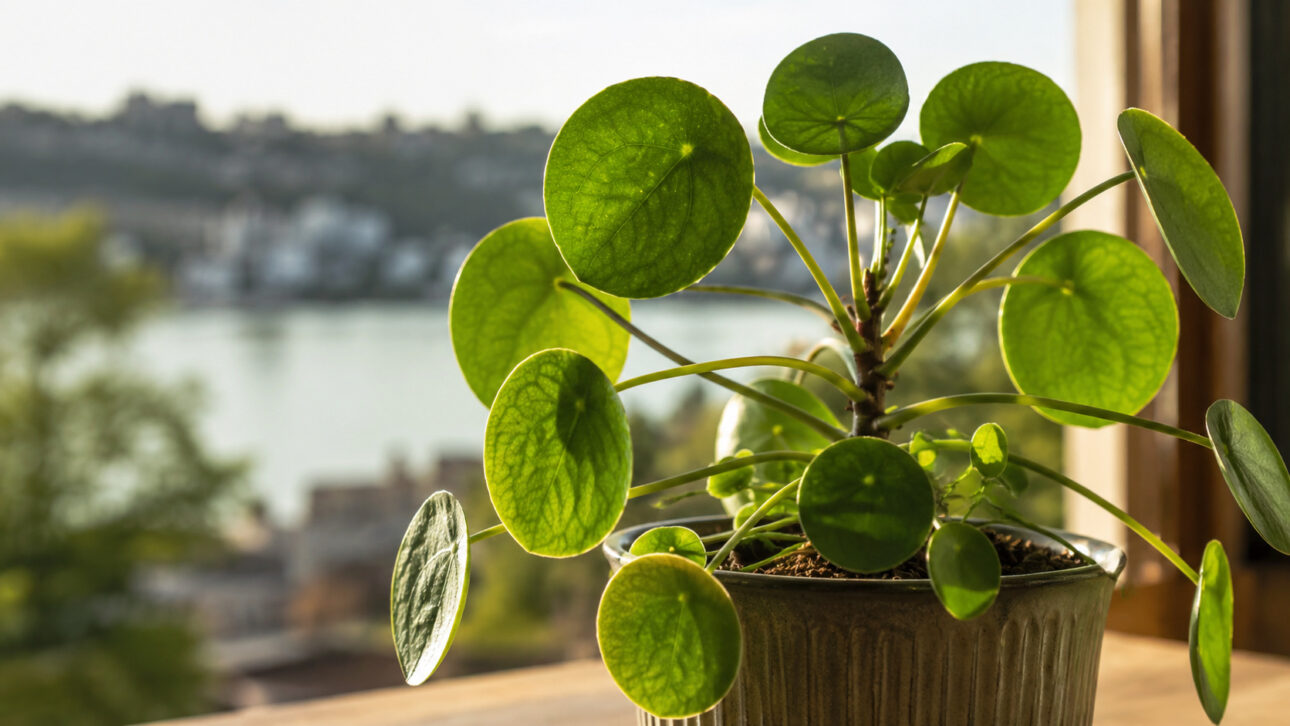
The Pilea peperomioides, known as the Chinese money plant, organizes its internal veins following the Voronoi diagram, a geometric model used in urban planning, internet networks, and logistical planning.
The study, published in the scientific journal Nature Communications, showed that the plant distributes water and nutrients efficiently, without measuring distances as humans do.
-
Faster than the Concorde: the first supersonic fighter for two pilots capable of reaching 2,470 km/h, flying at twice the speed of sound, and carrying out combat missions for the Brazilian Air Force (FAB) emerges in Brazil.

-
Student reaches page 16 of Google, uncovers laser data forgotten since 2013, and reveals lost Mayan city beneath the Mexican jungle, with pyramids, plazas, and more than 6,500 hidden structures.

-
Greenland sharks can live for centuries, and now scientists have sequenced 96.7% of the animal’s genome, revealing genetic clues linked to DNA repair, cancer resistance, and extreme aging.

-
End of the house built brick by brick? Tech giant LG teams up with an Australian construction company to create modular homes with solar energy and battery that can save up to 35% on the electricity bill.


According to the researchers, this behavior draws attention because it reveals a natural logic capable of solving complex organization and transportation problems.
Technical investigation reveals hidden geometry in the leaves
The scientific analysis began with the mapping of hydathodes, small pores present in the leaves of the Pilea peperomioides.
The researchers observed the veins surrounding these structures and identified regions very similar to the classic Voronoi diagrams.
This model divides spaces into areas organized around central points. In practice, each region is closer to its main point than to any other.
The same type of calculation appears in systems used to define areas served by schools, hospitals, and distribution centers.
Natural pattern impresses researchers
Similar patterns have already been observed in nature, such as in giraffe spots and mineral structures.
The Chinese money plant, however, represents one of the most precise examples of this mathematical system in biological operation, according to the study’s authors.
Researcher Cici Zheng, currently at the Allen Institute, explained that plants do not measure distances explicitly.
This result arises through local biological interactions between cells and plant tissues, creating a geometric solution similar to that used by humans.

Discovery brings mathematics and plant biology closer
The study also shows how living organisms can solve complex challenges throughout evolution.
According to Saket Navlakha, researcher at the Cold Spring Harbor Laboratory, many natural systems operate with a sophisticated mathematical logic still poorly understood by science.
The discovery brings together areas such as plant biology, mathematics, computing, and engineering, reinforcing how nature can inspire new forms of organization.
This crossover helps explain how plants efficiently distribute internal resources.
Applications can inspire new technologies
The discovery not only serves to better understand the functioning of plants.
The pattern found in Pilea peperomioides can inspire new applications in engineering, computing, and artificial intelligence, based on natural strategies developed over millions of years.
The Voronoi diagram already appears in human systems of organization. Now, the plant shows that nature also uses similar solutions to deal with internal challenges.
The Chinese money plant has ceased to be just a popular ornamental species and has become an impressive example of living mathematics.
What is more striking: a common plant hiding such precise geometric logic or science still discovering solutions that nature has been using for millions of years?








Be the first to react!