





 Portuguese
  English
  Spanish
  5 min of reading
  0 comments


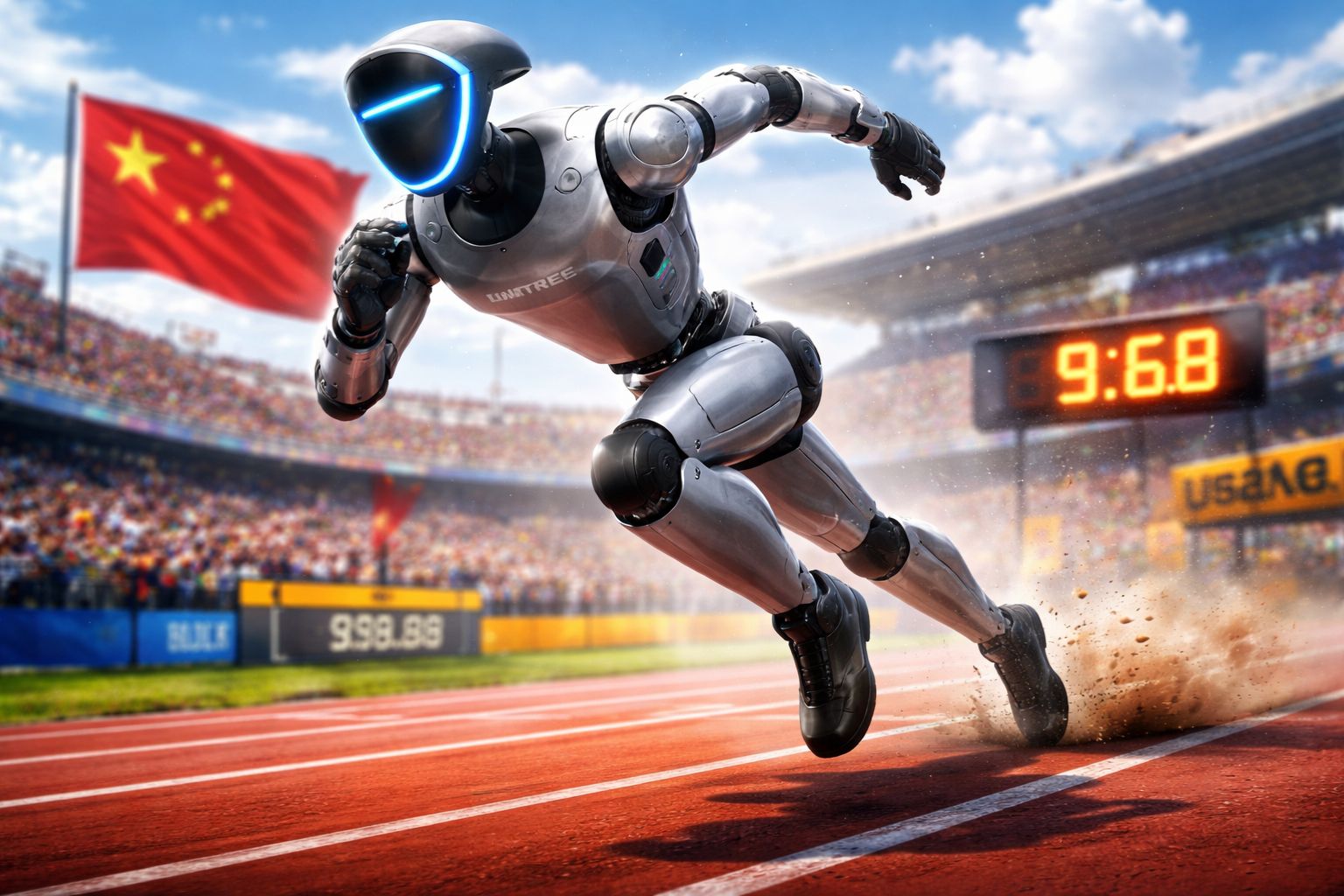
A humanoid robot from Unitree Robotics completed 100 meters in 10 seconds, less than half a second from Usain Bolt’s world record of 9.58 seconds. The previous mark for bipedal robots was 24.73 seconds, set by Cassie from Agility Robotics in 2022, making the achievement a reduction of over 60%.
The robot humanoid Unitree H1, developed by the Chinese company Unitree Robotics, has just done something that seemed impossible for a bipedal machine: run 100 meters in 10 seconds. The time, recorded on video with a stopwatch showing 00:10:01 at the end of the race, places the robot less than half a second from Usain Bolt’s world record, who completed the same distance in 9.58 seconds during the World Athletics Championships in Berlin in 2009. The previous mark for bipedal robots belonged to Cassie, from Agility Robotics, which covered 100 meters in 24.73 seconds in May 2022, a time certified by Guinness World Records. The Chinese robot not only broke this record but shattered it.
Unitree Robotics celebrated the achievement on social media with a phrase that summarizes the magnitude of what happened: “Unitree breaks the world record again. With the physique of an average person, running at the speed of a world champion!” The robot weighs about 62 kilograms and has a leg length of 80 centimeters, proportions that are not very different from those of an adult human. In the promotional video, the company stated that the footage was not sped up or generated by artificial intelligence, a necessary disclaimer in an era where spectacular technological feats are met with skepticism until proven otherwise.
What the Unitree robot did and why the achievement is so impressive
To understand the magnitude of what the Unitree H1 robot accomplished, it is necessary to contextualize the evolution of bipedal locomotion in machines. Until recently, humanoid robots had difficulty simply walking without falling, and the most advanced moved with the speed and grace of a tourist carrying luggage on an uneven sidewalk. Cassie, which held the previous record, took nearly 25 seconds to cover 100 meters, an average speed of about 14.4 km/h, respectable for a robot, but slow for any fit human.
-
For the first time in history, a submarine cable will descend to four thousand meters deep under the ice of the North Pole to ensure that the internet between Europe and Asia no longer depends on conflict zones in the Middle East.

-
A British company has installed in the middle of the ocean the world’s first floating platform that generates electricity 24 hours a day from the temperature difference between the surface and the depths of the Atlantic, without relying on wind or sun.
-
The James Webb telescope spotted a planet 700 light-years from Earth with mornings full of sand clouds and nights with clear skies, the temperature difference between the two hemispheres reaches an impressive 170 degrees.
-
A former Hong Kong police officer has just become the first astronaut from her city to go to space. She embarked on the Shenzhou-23 mission alongside two other colleagues who will face muscle atrophy, radiation, and prolonged fatigue in orbit.




The Chinese robot completed the same course in 10 seconds, which corresponds to an average speed of 36 km/h. This is the difference between a light jog and a world-class sprint. For a bipedal robot to maintain this speed for 100 meters without losing balance, tripping, or damaging its actuators, a level of motion control, dynamic stability, and power is required that until recently was considered exclusive to the best human athletes.
How the robot can run as fast as an elite human
According to the portal of G1, the Unitree H1 uses a combination of high-power electric motors, real-time balance sensors, and motion control algorithms that adjust the posture and force applied by each leg every fraction of a second. Running on two legs is one of the most complex problems in robotics because it involves a continuous sequence of controlled falls: with each step, the robot is technically falling forward and needs to position the next leg in the right place, with the right force, at the exact moment.
The speed of 36 km/h greatly amplifies this complexity. In a sprint, the contact time of each foot with the ground is in milliseconds, and any miscalculation in applying force or in the landing angle can result in a fall, structural damage, or catastrophic loss of balance. The fact that the robot completed the 100 meters without visible incidents suggests that Unitree’s control algorithms have reached a level of maturity that allows operation at speed regimes that few imagined possible for a bipedal machine.
The comparison with Usain Bolt and what it really means
The difference of less than half a second between the robot and Usain Bolt’s record is impressive, but the comparison deserves nuances. Bolt reached his maximum speed of 44.72 km/h during the 100-meter race, while the robot maintained an average speed of 36 km/h throughout the entire course. It is likely that the robot did not reach speed peaks comparable to Bolt’s, but its consistency over the 100 meters compensated for the lack of explosive acceleration.
There are also fundamental differences in biomechanics. Bolt, at 1.95 meters tall with proportionally long legs, covers more distance per stride than the robot, which has 80 centimeters of leg and needs to take significantly more steps to cover the same distance. This means that the robot’s actuators are operating at much higher stride frequencies, which imposes enormous demands on the motors and control systems. The comparison with Bolt is inevitable and generates engagement, but the technical achievement lies more in engineering than in athletic competition.
What the Chinese robot record means for global robotics
The performance of the Unitree H1 is not just a speed record. It is a demonstration that Chinese bipedal robotics has reached a level that repositions the country as a global leader in one of the most challenging areas of mechanical engineering and artificial intelligence. Unitree Robotics, already known for its affordable quadruped robots and the humanoid robot R1, now proves that it can compete with and surpass Western laboratories that have invested billions in locomotion research.
For the industry, the significance goes beyond the race. A robot capable of maintaining dynamic balance at 36 km/h possesses the necessary control fundamentals to operate in unpredictable environments: uneven terrain, stairs, ramps, unexpected obstacles. Speed is the most spectacular demonstration, but the technologies behind it have applications in logistics, rescue, industrial inspection, and any scenario that requires fast and reliable bipedal mobility.
What comes after a robot that almost matches Usain Bolt
The question that Unitree has left hanging is inevitable: is the next step to surpass Bolt’s 9.58 seconds and create the first bipedal robot faster than any human that has ever lived? The company has not explicitly made this promise, but the trajectory suggests that the goal is on the horizon. The reduction from 24.73 to 10 seconds in just three years indicates an evolution curve that, if maintained, would place the robot below 9 seconds in the near future.
The record also raises questions about the physical limits of bipedal robots. Unlike humans, who are limited by biology, robots can be redesigned, recalibrated, and updated indefinitely, which means that Bolt’s record may just be a temporary reference in a race where machines are still warming up. For robotics, 10 seconds in the 100 meters is a milestone. For what comes next, it is just the starting point.
A Chinese robot ran 100 meters in 10 seconds, almost matching Usain Bolt. Do you think machines will surpass the best human athletes soon? Does this impress or concern you? Leave your opinion in the comments.







Be the first to react!