Portuguese
  Spanish


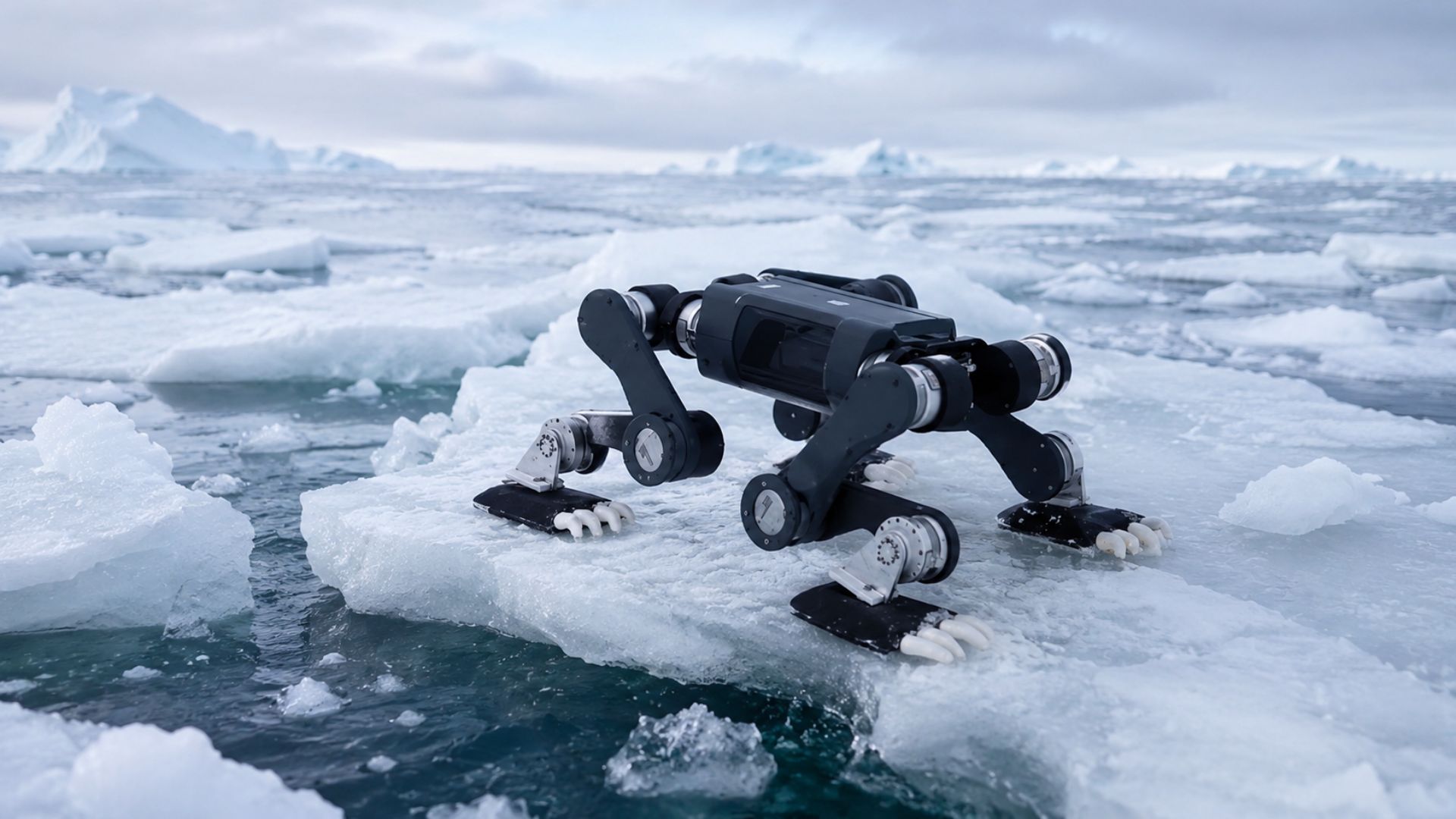

The robot is the Lynx S10, from the Chinese company DEEP Robotics, and weighs less than 20 kilograms. To face the Arctic, it gained wide paws inspired by polar bears and crampons, and collected real mobility data. Even so, it was a prototype in the alpha phase, not a ready product.
A four-legged robot dog became the first of its kind to cross floating ice blocks in the Arctic Ocean, paving the way for machines to perform fieldwork too dangerous for humans. According to the report released in June on the interestingengineering portal, the robot is a modified version of the Lynx S10, an autonomous platform from the Chinese company DEEP Robotics. The crossing shows that compact autonomous systems can tackle terrains where even experienced researchers act with caution.
According to the material, the Arctic has been one of the most dangerous places on Earth to explore for centuries. Under what appears to be solid snow, there can be icy water pools capable of swallowing people, vehicles, and equipment without warning, making data collection at the poles slow, expensive, and risky. It is important to note that the vehicle taken to the ice was still a prototype in the alpha phase, not a finished commercial product.
The robot that crossed the floating ice of the Arctic
The feat has a significance that goes beyond withstanding the cold. The modified version of the Lynx S10 became the first quadruped platform to walk on ice blocks in the Arctic Ocean, and what matters is not the robot enduring the cold, but navigating an unpredictable terrain, covered with ice, snow, and water, which usually requires extreme caution. The crossing suggests that autonomous machines may one day perform some of the most dangerous fieldwork.
-
Brazilian Lottery Winner Ordered by Court to Share $22 Million Jackpot with Ex-Partner, Sparking Major Legal Battle

-
Why Yellow is the Safety Color for Heavy Machinery: Origins and Benefits Since 1931

-
U.S. Channel Highlights 20 Brazilian Innovations Leading Latin America: From Açaí to Modular Homes and Biogas

-
Dog Goes Viral for Buying Its Own Food and Carrying the Bag Home in Its Mouth


The context helps to understand the risk. According to the material, data collection in polar regions is slow, expensive, and dangerous precisely because of these hidden traps under the snow. According to DEEP Robotics, the Lynx S10 “enables autonomous trajectory planning and intelligent obstacle avoidance.” Still, it is worth repeating that this Arctic unit was a prototype in the alpha phase, not a model ready for the market.
A compact robot of less than 20 kilograms and sixteen joints
The reduced size is part of the proposal. According to DEEP Robotics, the Lynx S10 is a compact quadruped robot that weighs less than 20 kilograms, even with the battery, and can be transported and installed by a single person, unlike larger platforms that require complex assembly. Even though it’s small, it has sixteen precision joints that allow it to bend, twist, and pass through spaces inaccessible to larger robots.
The standard capabilities are provided by the manufacturer. According to its creators, the standard version moves at up to 8 m/s on flat terrain, about 29 km/h, climbs obstacles up to 50 centimeters, switches between wheeled and legged movement, and can even stand in a bipedal posture to gain height.
For autonomy, it uses four very wide-angle cameras and LiDAR sensors at the front and back to build three-dimensional maps, identify obstacles, and plan routes without constant human control; the standard platform has IP66 sealing, operates from -20°C to 55°C, and carries more than 8 kg.
The bear paws and adaptations for ice


The Arctic ice required design changes. The challenges went far beyond the original specifications, so engineers modified the robot before the expedition. The standard wheels were replaced by large biomimetic paws, inspired by the wide paws of polar bears, which distribute the machine’s weight over a larger area and help prevent it from sinking into soft snow.
Other adaptations reinforced traction and protection. According to the material, anti-slip textures improved grip on smooth surfaces, integrated crampons provided extra traction on hard ice, and the sealing increased from IP66 to IP67, offering more water protection.
In an unusual change, the increased leg area made them function almost like shovels, allowing the robot to move in mud and in areas where ice and water mixed.
The tests on ice and what the prototype still needs to prove
The tests showed why the adaptations were necessary. In several places, the snow hid meltwater pools, and the robot encountered terrains that seemed firm but floated over submerged water pockets. Thanks to the redesigned feet and traction system, it maintained stability on these deceptive surfaces and, on one occasion, slid over an area that appeared to be solid ice but concealed water underneath.
The potential is great, but it still depends on maturation. According to DEEP Robotics, the robot could help in collecting environmental data, monitoring climate changes, and in search and rescue operations, without exposing people to the same risks, uses that remain as possibilities, and not as a service already delivered.
As the source itself emphasizes, the Arctic version was a prototype in the alpha phase, and the team is now using the mission data to improve the next versions. In other words, the crossing is a real milestone, but turning the prototype into a reliable field tool is still the next step.
The Lynx S10 robot dog, from DEEP Robotics, became the first four-legged to cross the floating ice of the Arctic Ocean, traversing treacherous surfaces with paws inspired by those of bears, crampons, and navigation by artificial intelligence.
It’s a milestone for autonomous fieldwork in places too dangerous for humans, but it is worth remembering that it is still a prototype in the alpha phase, that the specifications come from the manufacturer itself, and that broader uses, such as climate monitoring and search and rescue, are still potential, with new versions in development.
And you, would you trust a robot like the Lynx S10 to do dangerous work instead of people, or do you still think it’s too early for that? Share your opinion and exchange ideas with other readers about the use of robots in extreme environments, with respect for different views.