Portuguese
  Spanish




Revolution In Mining: ‘It Went Wrong’ For Graphene. The Revolutionary Discovery Of The Anonymous Hero, Boron Nitride, Is About To Transform The Industry Worldwide!
There is a silent revolution happening in the world of materials, and Rice University in the USA has broken a century-old paradigm. Pioneering scientists have revealed an extraordinary discovery: a material that defies expectations by being ten times stronger than powerful graphene. This anonymous hero is known as hexagonal boron nitride.
Both share the intriguing hexagonal structure, but this is where their stories diverge. Each hexagon of graphene is made up of carbon atoms, which has captivated the scientific community, but revealed its fragility when subjected to extreme conditions. In contrast, hexagonal boron nitride exhibits in its intriguing composition three boron atoms and three nitrogen atoms. This subtle atomic dance proves crucial for an astonishing unique resistance to cracking, challenging established concepts.
Scientists Discover Adamantium??


Measuring Forces Beyond Limits: The Battle Between Powerful Graphene And The Striking Mechanical Superiority Of Boron Nitride
In a battle of forces, graphene and boron nitride hexagonal face off in the ring of resistance. Surprisingly, the champion is not what we expected. While graphene boasts a strength of 130 gigapascals and an elasticity of 1 terapascal, hexagonal boron nitride, despite its seemingly lower indices, proves to be about ten times tougher in laboratory tests. The physics behind this phenomenon challenges Griffith’s theory established in 1921.
-
Chinese Manager Accused of Whipping Worker Sparks Protest by 1,200 Employees at Major Brazilian Factory

-
France Revamps 530 Social Housing Units with Large Balconies and Glass Facades Without Demolishing Existing Buildings

-
10-Year-Old Max Makes History with Paris Fashion Show, Launches Own Brand, Hires Staff, and Sets World Record as Youngest Runway Designer

-
Bolivian Female Construction Workers Form Association to Combat Discrimination and 38% Pay Gap in the Industry




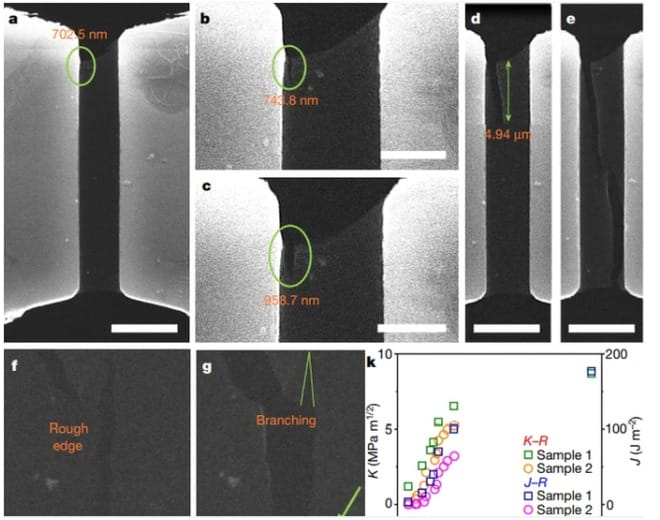
The real revolution lies in the journey of cracks. While graphene allows predictable linear movements, for example, when encountering a crack, it follows a zigzag dance straight through its hexagonal structure. However, boron nitride has a unique cunning. Due to the contrasting stresses between boron and nitrogen, its cracks dance bifurcated, following intricate paths from one end to another. This unique behavior confers extraordinary resistance, challenging traditional fracture mechanics.
From The Laboratory To The World: Hexagonal Boron Nitride As A Substitute For Graphene
The stage is set for a revolution in the applications of 2D materials. Hexagonal boron nitride, being stronger and more flexible than graphene, emerges as the ideal protagonist for fabricating electronic fabrics, smart adhesives, and even advanced medical implants, positioning it as an efficient alternative for innovations and large-scale production.
Its heat resistance and chemical stability open doors to precision electronic applications and low power consumption. The future looks bright for boron nitride, and researchers are eager to prove its advantages beyond the laboratory limits.
The journey of hexagonal boron nitride is far from ending in the confines of the laboratory. Researchers are determined to take this material hero to the global stage, testing it in real devices. The vision is clear: to make boron nitride not just a viable alternative, but superior to graphene in large-scale applications.
This is an invitation to witness the rise of a new champion of materials, shaping the future of technology and innovation, where science challenges the status quo and promises to transform the landscape of nanotechnology and open doors to revolutionary applications across various industrial fields.
Source: Nature