Portuguese
  Spanish


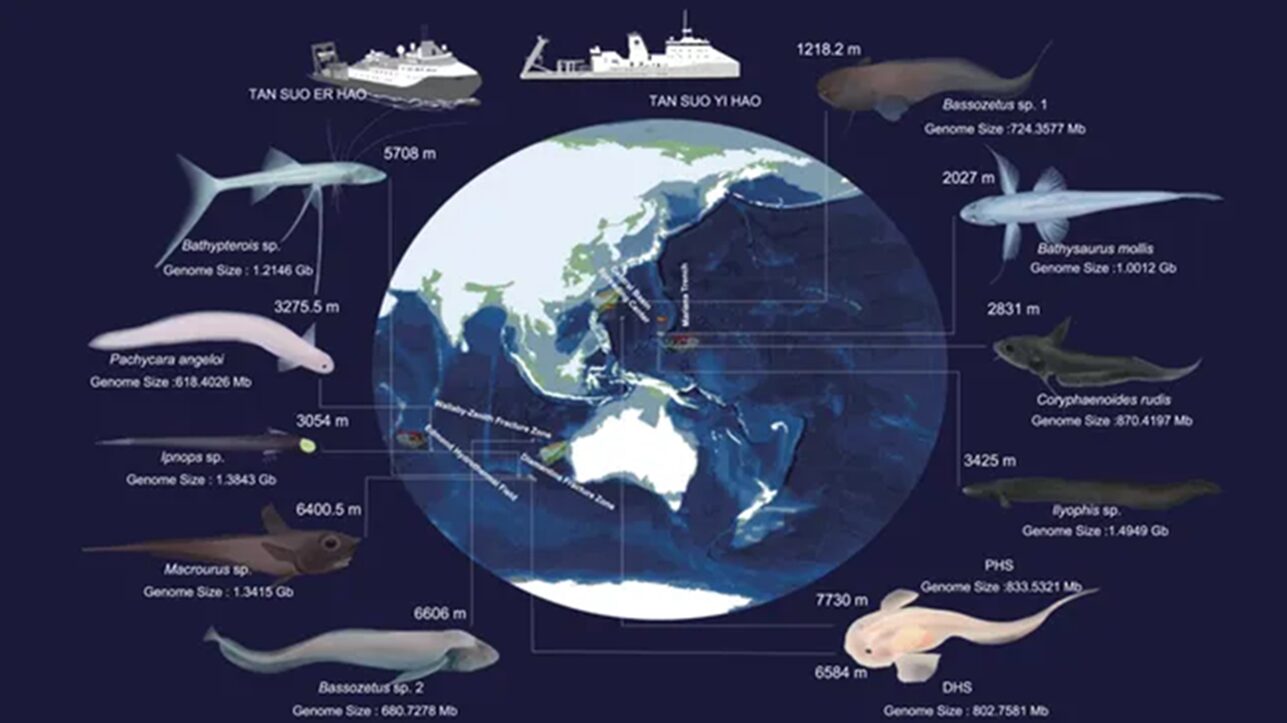


Even Separated by Millions of Years of Evolution, Fish Living in the Greatest Depths of the Ocean Developed the Same Genetic Mutation. A New Study Also Shows That Industrial Pollutants Have Reached Even the Most Remote Points of the Seafloor.
The deepest region of the oceans, the Mariana Trench, is home to abyssal fish with bizarre appearances and surprising genetic adaptations.
A new genetic study revealed that different species of abyssal fish — even though they evolved separately — developed the same genetic mutation to survive in extreme environments in the depths of the ocean.
The results impress due to the similarity between species living more than 3,000 meters below the surface, in places like the Mariana Trench, in the Pacific Ocean.
-
Brazilian Researcher Develops Protein Supplement from Tilapia Waste, Combining Innovation and Sustainability with Economic Potential

-
Women in São Paulo Unknowingly Tracked by Coin-Sized Tags Hidden in Cars and Belongings, Raising Stalking Concerns
-
Near a $750 million AI data center in Brazil, a resident’s well runs dry, leaving her unable to afford the $25,000 needed for repairs.

-
16-Year-Old from Brazil’s Sertão Wins Young Scientist Award for AI Predicting Rainfall with 94.5% Accuracy to Aid Farmers


The research, published on March 6 in the journal Cell, involved the analysis of DNA from 11 species, including snailfish, barreleye fish, and lizardfish.
They inhabit the hadal zone, one of the most inhospitable regions of the planet, located about 6,000 meters deep or more.
Same Gene, Different Evolutionary Histories
A curious piece of data from the study was the identification of an identical mutation in the Rtf1 gene in all species living below 3,000 meters.
This gene is responsible for controlling the coding and expression of DNA.
According to the study’s author, Kun Wang, from the Northwestern Polytechnic University, the mutation appeared at least nine times in different lineages of fish, all adapted to the seabed.
Despite these species having entered the depths at different times — from the Cretaceous (about 145 million years ago) to the Neogene (just 2.6 million years ago) — they acquired the same mutation independently.
This shows how extreme environmental conditions in the deep sea can shape evolution similarly in different organisms.
What is Convergent Evolution
The study is a classic case of convergent evolution, when different species, without a direct relationship to each other, end up developing similar characteristics by living in similar environments.
This is explained by ichthyologist Ricardo Betancur, from the University of California, San Diego, who did not participate in the study. “It is a powerful reminder that evolution often reuses the same limited set of solutions when faced with similar challenges,” he said in an interview with Live Science.
According to scientists, these adaptations involve not only genetic changes but also specific bone structures, alterations in circadian rhythms, and specialized forms of perception — whether through highly sensitive vision to light or other non-visual senses.
Technology to Reach the Abysses
The samples analyzed were collected at depths ranging from 1,200 to 7,700 meters, with the help of remotely operated vehicles and manned submarines.
The collection occurred both in the Mariana Trench and in other oceanic trenches in the Indian Ocean.
These regions represent some of the most extreme and inaccessible places on the planet, with high pressures, temperatures near freezing, and total darkness.
Still, life flourishes there, and now scientists know a little more about how this is possible.
Pollution in the Greatest Depths of the Earth
In addition to genetic discoveries, researchers also found something concerning.
Industrial chemicals were detected in the fish and marine sediments of the Mariana Trench.
This includes compounds such as polychlorinated biphenyls (PCBs), banned since the 1970s, and polybrominated diphenyl ethers (PBDEs), used as flame retardants.
PCBs were identified in the liver tissues of hada snailfish.
PBDEs appeared in sediment samples collected over 10,000 meters deep. These substances are known for their harmful effects on human health and the environment.
Human Impact Reaches Even the Mariana Trench
The findings confirm that pollution generated by human activities reaches even the most remote environments on the planet. Previous studies had already identified microplastics and chemical pollutants in the abyssal regions, but this new survey shows the even deeper reach of these contaminants.
The presence of industrial waste at such depths is a warning about how the impacts of civilization extend far beyond the surface. Even in the most isolated points on Earth, the mark of human activity is present — a reality that is difficult to ignore.
While scientists celebrated the advances in understanding evolution in extreme environments, the study also reinforces a disturbing paradox.
The same technologies that allow for exploration of the deepest regions of the ocean also reveal how much these places have already been affected by human action.
Amidst the cold, darkness, and high pressure, life persists — but carries the scars of an increasingly polluted world.