Portuguese
  Spanish


Researchers from the University of Vienna and TU Wien Recreated the Terrell-Penrose Effect, a Phenomenon Predicted 100 Years Ago, and Transformed the Theory of Relativity into Real Images That Reveal How Light Distorts Space.
Scientists from the University of Vienna and Vienna Center for Quantum Science and Technology (TU Wien) accomplished what seemed impossible: making the movement at the speed of light visible.
The team led by Dominik Hornof and Peter Schattschneider managed to visually capture the so-called Terrell-Penrose effect, a phenomenon predicted over a century ago and described by Albert Einstein in his theory of special relativity.
The study, published in the scientific journal Communications Physics (Nature, 2025), shows how an object in extreme motion does not appear to “contract,” as was believed, but rather rotates in the observer’s eyes, an illusion caused by the time it takes for light from each point to reach the camera.
-
Brazilian Researcher Develops Protein Supplement from Tilapia Waste, Combining Innovation and Sustainability with Economic Potential

-
Women in São Paulo Unknowingly Tracked by Coin-Sized Tags Hidden in Cars and Belongings, Raising Stalking Concerns
-
Near a $750 million AI data center in Brazil, a resident’s well runs dry, leaving her unable to afford the $25,000 needed for repairs.

-
16-Year-Old from Brazil’s Sertão Wins Young Scientist Award for AI Predicting Rainfall with 94.5% Accuracy to Aid Farmers


“If you wanted to photograph a rocket passing at the speed of light, you would need to consider that the light from different parts of it takes different times to reach you. The result is that the object appears to rotate,” Schattschneider explained in an official statement.
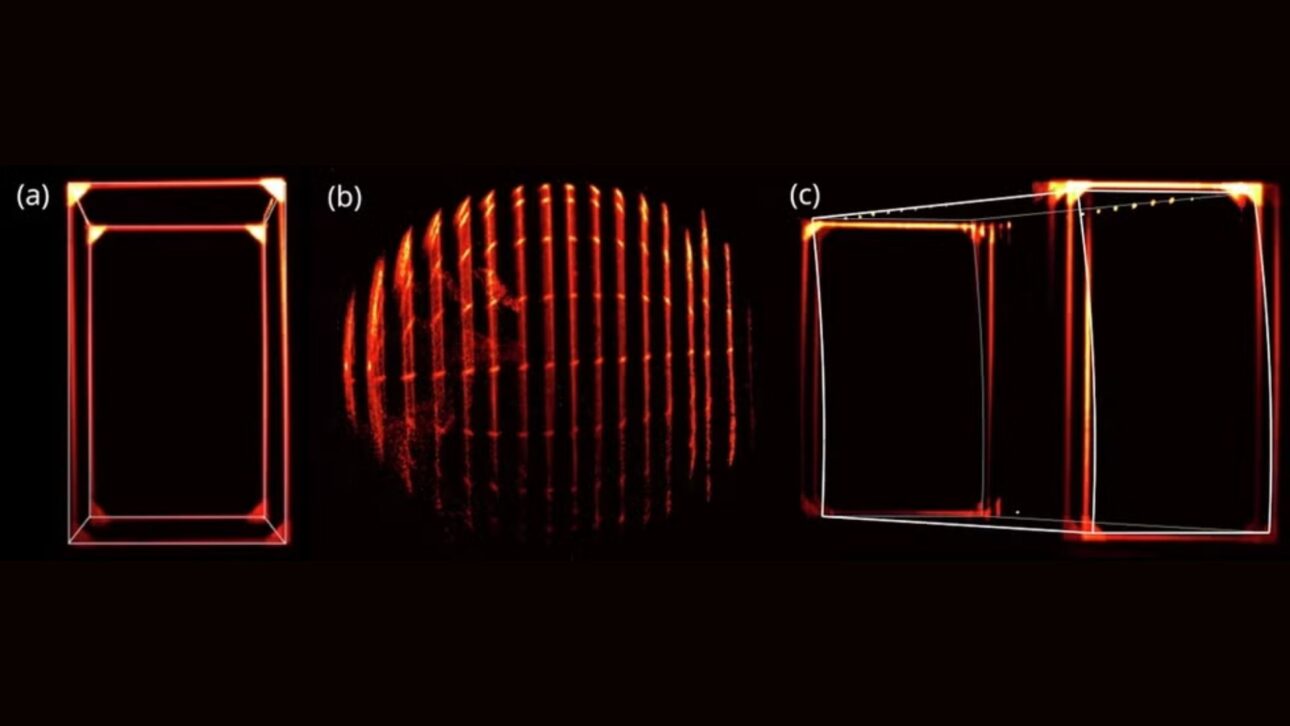
Light “Photographed” Like Never Before
To recreate the phenomenon, scientists developed a technique that combines pulsed lasers and high-speed photography. The idea resembles the panoramic mode of a smartphone: they sliced the reflection of light into hundreds of micro-images and then “stitched” them together, producing a sequence that simulates the view at the speed of light.
The result was described by the researchers themselves as “an impossible video.” A cube appears twisted, a sphere remains round, but with the pole displaced, exactly as the theory predicted.
With the method, the team managed to reduce the perception of the speed of light to just 2 meters per second, allowing the human eye to interpret the movement as if it were real.
An Experiment That Unites Art, Physics, and Photography
The study pays tribute to three historical physicists: Anton Lampa (1924), Roger Penrose, and James Terrell (1959), who theorized the visual effects of relativity without ever seeing them. Now, for the first time, science translated equations into images, creating a milestone in scientific communication and physical visualization.
In addition to being an impressive aesthetic achievement, the research could assist in new ways to simulate relativistic phenomena, even in areas such as quantum optics, ultra-fast photography, and experimental astrophysics.