





 Portuguese
  English
  Spanish
  6 min of reading
  0 comments


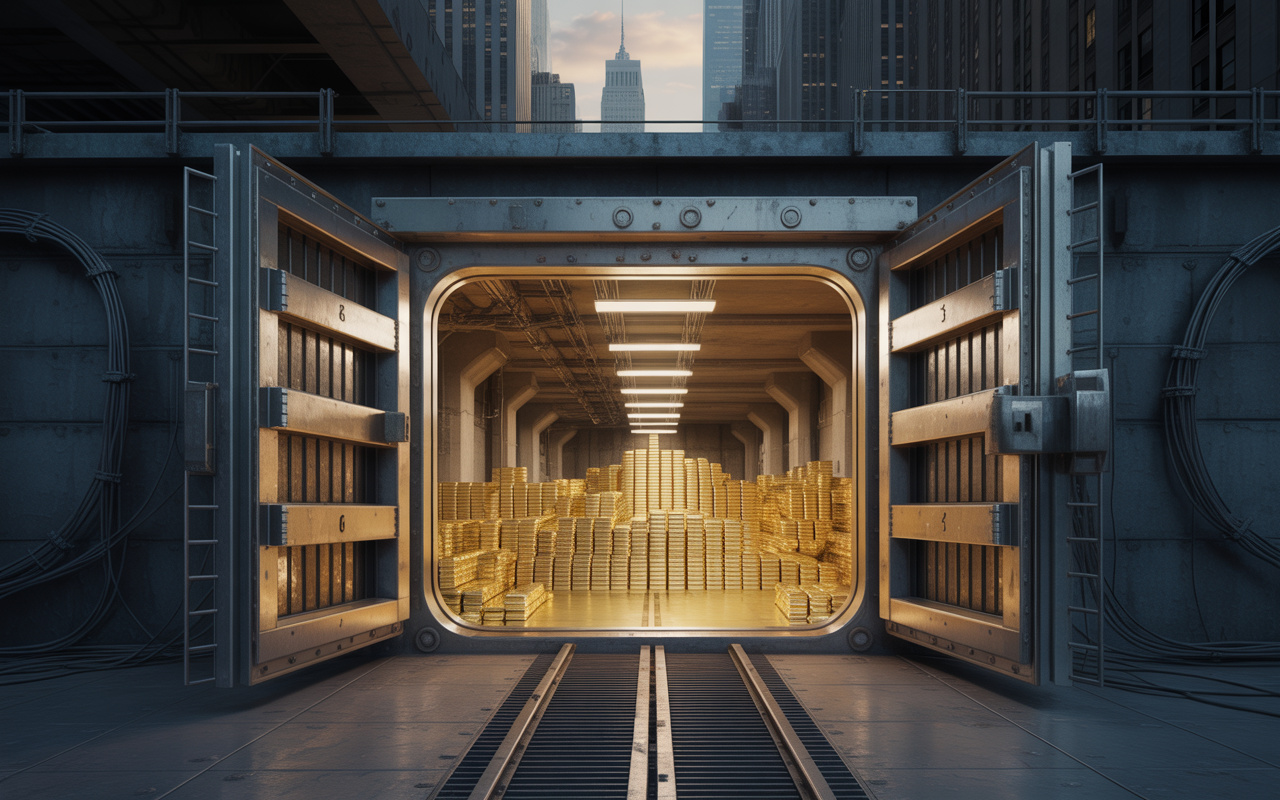
25 Meters Below Manhattan, The Federal Reserve Bank of New York Holds Over 6,000 Tons of Gold Valued at Hundreds of Billions of Dollars, Protected by 90-Ton Steel Doors.
In the financial district of Manhattan, New York (United States), at 33 Liberty Street, operates the Federal Reserve Bank of New York, an institution that is part of the U.S. Federal Reserve System. It is located approximately 25 meters below street level and 15 meters below sea level, where one of the planet’s most important gold vaults is situated.
The figure is official and public: according to the Federal Reserve itself, the vault stores more than 6,000 metric tons of gold belonging to foreign central banks, sovereign governments, and international organizations such as the International Monetary Fund (IMF). In market values, this represents hundreds of billions of dollars in international reserves.
What few imagine is that this “vault” is not just a fortified room but part of a geological and architectural structure designed to withstand disasters, attacks, and invasion attempts.
-
While many European countries still face pressure from expensive and unstable energy, the Czech Republic is preparing an $18 billion nuclear power plant to deliver steady electricity with technology from South Korea.

-
In France, an entire road disappears under up to four meters of water, reappears at low tide, and only allows passage when the ocean reveals the path to Noirmoutier.
-
While old nuclear plants often become industrial ruins or abandoned areas, in Germany the Gundremmingen plant will be reborn as a giant 400 MW and 700 MWh battery connected to the power grid.
-
As offshore wind turbines become increasingly larger, Japan is preparing a 5,000-ton crane ship capable of lifting giant foundations for machines of up to 20 MW.




The Underground Engineering That Protects Over 6,000 Tons of Gold
Unlike the classic image of a bank with visible vaults, the gold stored in New York rests on the bedrock of Manhattan, directly supported by the geological formation that sustains the island. The main vault has:
- A cylindrical steel door weighing approximately 90 tons, installed in a rotating cylinder
- Multi-timed locking system
- Restricted access through combined authentication and strict personnel control
- Individual compartments for each depositing country or institution


The gold does not belong to the United States. About 98% of the stored bars are foreign-owned, used as currency reserves and international financial guarantees.
Each gold bar weighs approximately 12.4 kg (the “Good Delivery” standard), and all are registered, cataloged, and periodically audited.
Why Countries Keep Their Gold Under Manhattan
The question is inevitable: why would sovereign nations leave their strategic gold reserves outside their own territory? The answer lies in a combination of historical, financial, and geopolitical factors.
After World War II, the United States consolidated itself as the financial center of the world. The dollar became the international benchmark currency, and New York began to concentrate currency operations, debt negotiations, and international reserves. Keeping gold at the Federal Reserve Bank of New York offers strategic advantages:
- Immediate liquidity for international financial operations;
- Ease of transfer between countries (without the need for physical transportation);
- Globally recognized security infrastructure;
- Operational neutrality of the Federal Reserve system.
Instead of transporting tons of gold from one country to another, it is simply a matter of transferring ownership internally between compartments of the vault itself.
The Invisible Tunnel Under Wall Street
The vault is not an isolated structure. It is connected to an underground network of technical passages and reinforced structures that integrate the financial system of the Wall Street area. New York is traversed by a complex subterranean mesh composed of:
- Subway tunnels;
- Electrical infrastructure;
- Telecommunications networks;
- Drainage systems;
- Technical passages connected to financial institutions.
The Federal Reserve operates within this densely structured urban environment, which adds extra layers of physical and logistical protection.

Security: Far Beyond Armed Guards
The security of the vault involves multiple layers:
- Physical Protection: 90-ton steel door, reinforced walls, and underground access;
- Human Control: no employee can access the gold alone; operations require multiple authorizations;
- Continuous Record: each bar is numbered and cataloged;
- Internal and External Audits: periodic inspections verify integrity and counts.
The system is designed to prevent both external threats and internal risks.
Exact Quantity and Estimated Value
According to public reports from the Federal Reserve Bank of New York, the vault once stored over 12,000 tons at the height of the Bretton Woods system in the 1950s and 1960s. Today, the volume is around 6,000 to 6,200 metric tons. To put this in context:
- 1 metric ton = 1,000 kg
- 6,000 tons = 6 million kg
- Each standard bar weighs ~12.4 kg
- This means approximately 480,000 gold bars
With the price of gold varying globally, the market value of these reserves may exceed US$ 350 billion, depending on the international quotation.
The Legacy of the Gold Standard and Bretton Woods
Between 1944 and 1971, the international financial system operated under the Bretton Woods agreement, where the dollar was pegged to gold at US$ 35 per troy ounce. During this period, countries maintained reserves in the New York vault to ensure their currencies’ convertibility.
In 1971, President Richard Nixon officially ended the dollar’s convertibility into gold. Nevertheless, many countries chose to keep their reserves at the Federal Reserve due to institutional and operational stability.
The Vault as a Geopolitical Symbol
The subterranean vault of Manhattan represents more than just wealth. It symbolizes:
- International Trust
- Financial Centrality of the U.S.
- Global Strategic Infrastructure
- Institutional Stability
In times of international crisis, the custody of these reserves becomes a sensitive topic. There have been public debates in countries like Germany and the Netherlands about the partial repatriation of their reserves, although much of it remains stored in New York.
How Gold Movement Works
When a country decides to sell gold to another country that also has reserves in the vault, there is no need for external physical transport. The operation occurs internally:
- Authorized employees move the bars between compartments
- The transfer is formally recorded
- Ownership changes without the gold leaving the building
This system reduces logistical risks, costs, and public exposure.
The Contrast Between Invisibility and Magnitude
Interestingly, millions of people pass daily above the vault without imagining that, beneath their feet, lie thousands of tons of one of the most strategic assets in economic history.
There are no flashy tourist signs indicating “here lies the largest gold vault in the world”. The building is imposing but discreet. The true magnitude lies underground.
Comparison with Other Global Vaults
Although other countries also store large gold reserves — such as Fort Knox (U.S.) or the Bank of England — the Federal Reserve Bank of New York stands out for being:
- The world’s largest custodian of foreign gold
- A center for international transactions
- Part of a financial system that moves trillions daily

Gold in the 21st Century: Still Relevant?
Even in an era dominated by digital currencies and electronic markets, gold remains relevant as:
- A Store of Value
- A Hedge Against Inflation
- A Currency Stability Instrument
- A Strategic Asset in Geopolitical Crises
In recent years, various central banks have increased their gold reserves, reinforcing the importance of the metal in scenarios of global uncertainty.
The Invisible Vault That Sustains Global Confidence
The subterranean vault of the Federal Reserve Bank of New York is not just a repository of precious metal. It represents an invisible link in the international financial architecture.
It begins at a 90-ton steel door beneath Manhattan, traverses tunnels and reinforced structures, and ends in hundreds of thousands of bars silently stacked on the island’s rock.
In an increasingly digital world, the physical existence of this monumental stock of gold serves as a reminder that behind algorithms, electronic currencies, and instant transactions, there remains a tangible asset that symbolizes trust, stability, and global economic power. And all this stays hidden, 25 meters beneath the bustling streets of New York.






-

-

2 people reacted to this.