Portuguese
  Spanish


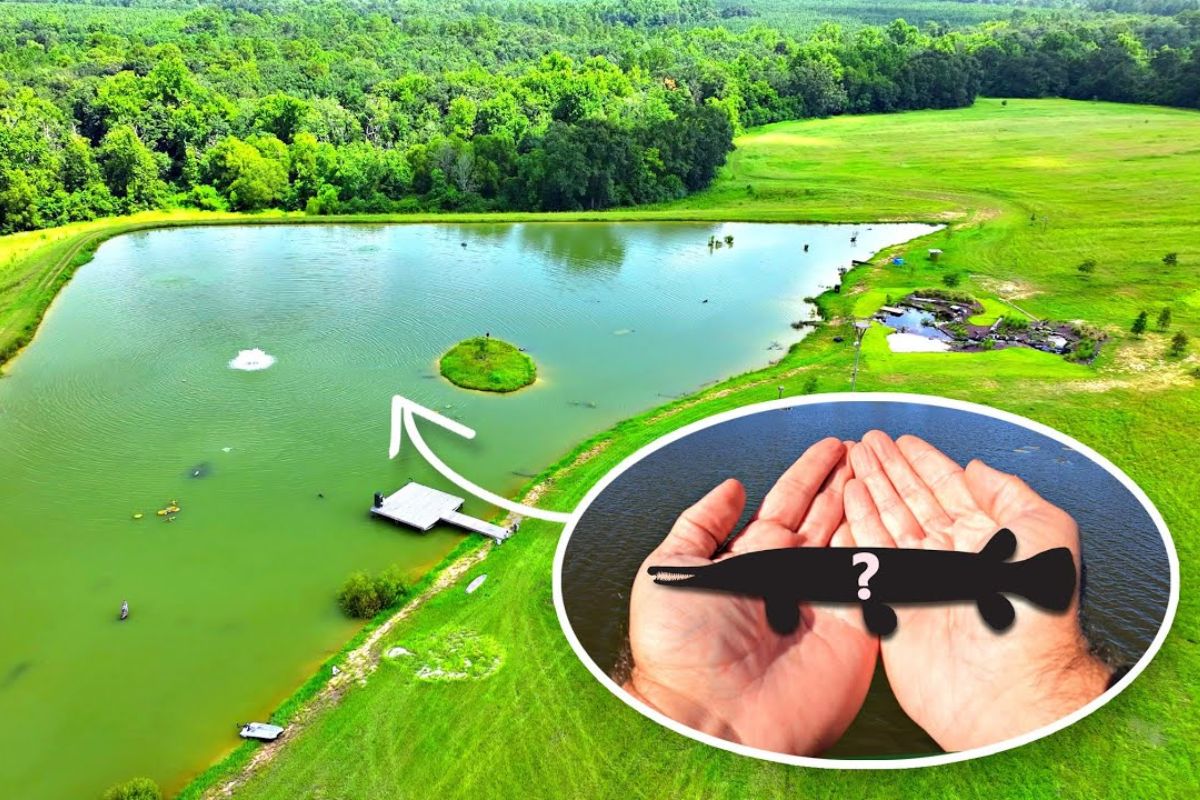


At Crimson Oak Farm, in the United States, the introduction of a juvenile alligator fish in a small lake raised alarms about ecological balance. The plan was to diversify species, but the combination of predators, warm water, and native fauna could turn recreational management into a chronic problem for decades at the very farm.
On the grounds of a farm in the United States, the decision to keep a new fish in a two-hectare lake became a real test of environmental management. The person in charge brought two juvenile alligator fish, an ancestral predator, and decided to start cautiously: first in an aquarium, then, only then, in the lake.
The choice was not made by chance. The farm had been adding species to avoid relying solely on tiger bass and forage fish, and had already received smallmouth bass, spotted bass, a small catfish, and rainbow trout fry. At the same time, the lake was the scene of natural disputes, with water snakes circling the shores, raptors nesting, and a young alligator using the area as territory, signs that the balance was already under pressure.
What Happened in the Two-Hectare Lake

The operation began with a basic but decisive caution: to prevent the newly arrived fish from becoming prey.
-
Brazilian Ship Refuels with 30% Renewable Fuel in Rotterdam: Transpetro Tests B30 for the First Time, Aiming to Reduce Maritime Emissions and Showcase a Quiet Transition in Key Global Ports

-
Brazilian Man Ingeniously Transforms Air Fryer into Functional Speaker with Radio and Volume Controls
-
Rows of “stone balls” emerge at low tide on California beach, with formations up to 1.5 meters aligned like a Pacific bowling alley

-
Japan Installs 800 Cameras in Tohoku Mountains Amid Rising Bear Attacks





The juvenile alligator fish had an elongated shape and resembled common bait fish in the lake, which increased the chances of being attacked by aggressive and hungry bass.
To reduce this risk, they were acclimatized in stages, slowly adapting to the water parameters.
After acclimatization, the two specimens were placed in a tank of about 300 gallons.
The objective was simple and technical: to buy time for the fish to grow large enough not to be swallowed and, at the same time, to allow daily observation of behavior, positioning in the water column, and acceptance of food before any transfer to the lake.
Why an Alligator Fish Changes the Dynamics of the Ecosystem

The alligator fish is not just any predator.
It is a “living fossil,” a fish with a long snout, sharp teeth, and a slow, methodical hunting strategy, more of an ambush than a chase.
In small systems, this combination can alter the pressure on smaller fish and reorder what’s left for bass and trout.
The dilemma appears in two directions.
If the alligator fish grows and enters the lake, it may compete for food with bass and, at certain stages, prey on juvenile fish of other species, including newly released trout.
If it does not grow, it remains vulnerable to larger bass.
In a two-hectare lake, the reduced space compresses encounters, shortens escape routes, and increases the predictability of where prey and predators meet.
The Risk Is Not Just Predation: Warm Water, Oxygen, and Persistence

The environmental context weighs heavily.
The person responsible for the lake described an unusually mild winter, with elevated water temperatures for the season, and this changes metabolism, appetite, and territoriality.
Trout, typically associated with cold water, can be pushed into specific refuge areas; bass, on the other hand, tend to maintain high activity and explore shores and structures more frequently.
In this scenario, the alligator fish enters with a relevant biological advantage: the ability to use its swim bladder as a primitive “lung” to breathe air. This means resilience in environments with low oxygen, common in warm, shallow ponds.
When one species tolerates stress better than others, it tends to persist and influence critical moments in the annual cycle, increasing the risk of imbalance over time.
Management and Monitoring: From Aquarium to Lake, Without Romanticizing the Decision
The management described at the farm mixes curiosity and control.
Before thinking of releasing the fish into the lake, there was a testing phase: reducing light to decrease stress, observing preference for shaded areas, offering bait fish caught at the shore, and then attempting a transition to non-living food, like fillets, to assess feeding flexibility.
This type of routine serves to measure risk, not to turn a predator into a “domesticated” part of an ecosystem.
At the same time, the farm was already monitoring bass through tagging and weighing, recording repeated captures and weight gain variations that do not follow a straight line.
This level of monitoring helps detect subtle changes, for example, declines in forage fish, increased competition, and alterations in average bass size.
In a small lake, the data becomes the defense against impulsive decisions, as the impact of a single predatory fish can be disproportionate.
When Diversification Becomes a Trap for Bass and Trout
Diversifying species is often treated as synonymous with balance, but this case exposes the gray area.
Adding smallmouth bass and spotted bass, introducing trout, and now bringing in alligator fish creates a web of interactions that may work in large rivers and fail in confined environments.
The two-hectare lake does not “dilute” pressure; it concentrates it.
The risk of a cascade effect is direct.
If the alligator fish reduces bait fish populations, bass will compete more aggressively for what’s left; this pushes the system into territorial and food disputes. If the trout lose cold areas or become easy targets, restocking loses efficiency.
And if the predatory fish reaches size and maturity, the mere possibility of spawning adds uncertainty, as the eggs of the alligator fish have been described as toxic to humans, birds, and mammals.
The central question shifts from whether the fish is “interesting” to whether the lake can support the project.
In the end, “putting a fish” is not a neutral gesture. It is an intervention in the balance between hunting, refuge, food, and thermal stress.
On a farm where the lake also coexists with a young alligator, water snakes, and predatory birds, the system is already under pressure, and any new piece can push the ecosystem to a point of no return.
If you had a small lake on your farm, what would be your limit: keep the alligator fish only in the aquarium, release it into the lake for testing, or give up before bass and trout pay the price? What, in your experience, destabilizes a lake more quickly, a new predator, warm water, or lack of bait fish?