Portuguese
  Spanish


France Introduced the De Grasse, a Colossal Nuclear Attack Submarine, with Cutting-Edge Technology and Capability to Operate for Over 270 Days a Year.
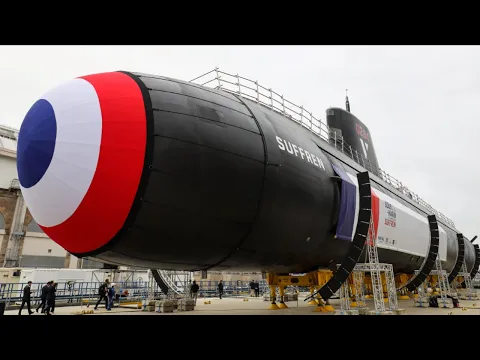
Last Tuesday, the 27th, the Barracuda program took another decisive step with the launch of the De Grasse, the fourth nuclear attack submarine (SSN) in the series developed by France. The vessel, manufactured by Naval Group, was officially transferred from its construction shed to the floating platform DME elevator, a move that precedes the testing and finishing phase at the dock before the start of sea trials, scheduled for 2026.
This milestone reaffirms France’s commitment to modernizing its submarine force, gradually replacing the Rubis-class models that have been operational since the 1980s.
The De Grasse is an essential part of a total of six submarines planned by 2030, combining technological innovation, firepower, and special operations capability with maximum discretion.
-
The U.S. Navy Conducts Submarine Tests in Idaho Lake to Detect Underwater Noises Hidden by the Ocean

-
Nuclear Submarine USS Alexandria Retired After 35 Years, Having Completed Over 1 Million Miles in Missions

-
MODEC Introduces New Hull Design for FPSO Gato do Mato to Produce Up to 120,000 Barrels of Oil Per Day in Brazil’s Pre-Salt Region
-
This Massive 12-Meter, 21-Ton Underwater Drone Can Operate Autonomously for Up to Five Days


Nuclear Submarines: Strategic Advance of the Barracuda Program
Led by the Direction Générale de l’Armement (DGA), in partnership with the French Commission for Alternative Energies and Atomic Energy (CEA), the Barracuda program represents one of France’s largest military investments today.
The project aims not only to replace the Rubis-class submarines but also to significantly enhance the capabilities of the French Navy in modern conflict environments.
The submarines of the Barracuda class are considered central elements of France’s deterrence and attack strategy.
They are designed to operate discreetly and efficiently across a variety of missions, from launching cruise missiles to transporting and deploying special forces.
Naval Group: Pillar of Construction and Innovation
Naval Group leads the complete manufacturing of the Barracuda submarines, from naval engineering to the construction of the most sophisticated components of the nuclear propulsion systems, in partnership with TechnicAtome.
The company is also responsible for the logistical support and maintenance of the submarines in Toulon, ensuring their operational capability for over 270 days a year.
“The launch of the De Grasse is an important milestone for the Barracuda program,” said Pierre Éric Pommellet, President and CEO of Naval Group. “I want to commend the dedication and expertise of the teams from Naval Group, TechnicAtome, DGA, CEA, the French Navy, as well as all our partners. Reaching this new milestone is a testament to the know-how of the French shipbuilding industry, which takes pride in serving our Armed Forces.”
Technical Characteristics of the New Nuclear Submarine
With a length of 99 meters and a displacement of 5,200 tons when submerged, the De Grasse impresses with its robustness and onboard technology.
The hybrid propulsion is based on a pressurized water reactor, similar to that used in the Triomphant-class SSBNs and on the aircraft carrier Charles de Gaulle.
The system includes a propulsion turbine, two turbine generators, and two electric motors.
The armament of the De Grasse is equally sophisticated: naval cruise missiles (NCM) from MBDA, heavy wire-guided F21 torpedoes – developed by Naval Group itself – and modernized Exocet SM39 anti-ship missiles.
Additionally, the vessel features a hatch for divers and the capability to attach a dry shelter on the deck, allowing for the transport and launch of underwater vehicles and special commands.
A Collective Effort of Thousands of Professionals
The construction of the Barracuda submarines mobilizes around 2,500 professionals, approximately 800 of whom are subcontracted directly by Naval Group.
The program relies on a broad network of companies from the French defense industrial and technological base, consolidating France as an autonomous and highly specialized naval power.
With the delivery of the De Grasse, the program reaches a new level and paves the way for sea trials, a critical phase for the final evaluation of the systems and performance of the vessel.
By 2030, the six submarines of the Barracuda class are expected to be fully operational, elevating French strategic power to a new level.

Source: Naval Power