Portuguese
  Spanish



USA Begins Production of Nuclear Warhead 24 Times More Powerful Than Hiroshima Bomb. Project Reignites Discussions on Armament and Global Balance
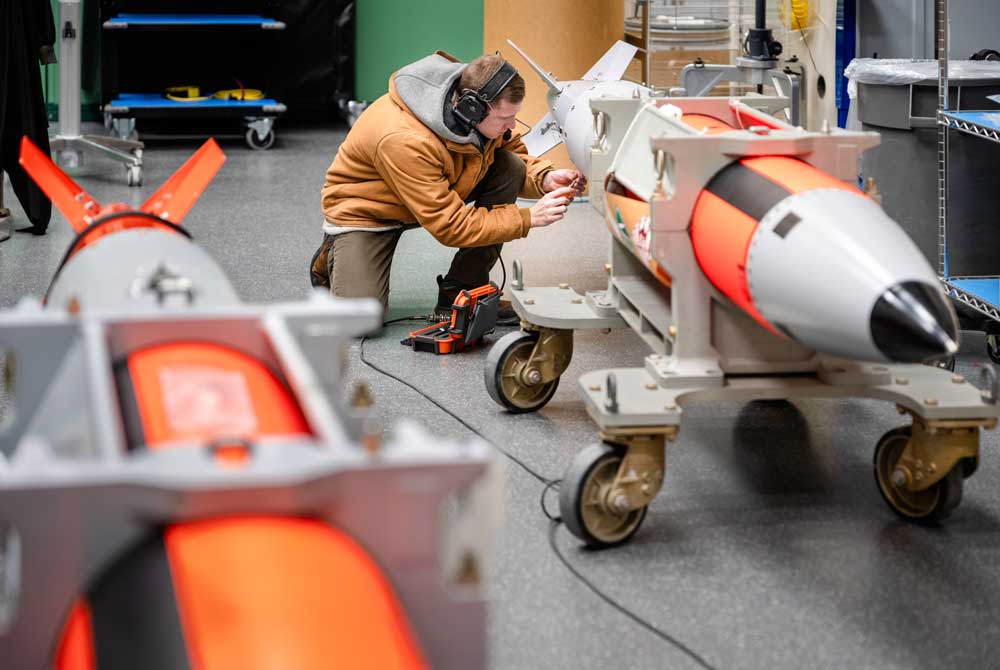
The United States will start production of its newest nuclear bomb earlier. The weapon, named B61-13, was developed by Sandia National Laboratories (SNL) and is part of the country’s nuclear arsenal modernization plan.
According to an official statement, the total production of the B61-13 will begin seven months ahead of schedule. The SNL stated that this was only possible due to an “innovative program planning,” which accelerated the timeline by over 25%.
This advancement reinforces the USA’s efforts to maintain its nuclear deterrence capacity amid international tensions. Even with the reduction in the number of nuclear weapons since the end of the Cold War, the USA, Russia, and China continue to invest in advanced military technology.
-
BAE Systems to Supply New Bofors 40Mk4 Cannons to the Brazilian Navy

-
Ukraine Bets on Swedish Gripen E Jets to Counter Russia, But 16 Fighters Won’t Arrive Until Late 2020s; Kiev to Use C/D Models for Pilot Training and Operations Amid Ongoing Missile and Drone Threats
-
End of an Era: US Navy’s C-2A Greyhound Makes Final Catapult Launch Before Retiring to Arizona Desert; Aircraft Supported Carriers in Wars and Humanitarian Missions for Nearly 60 Years
-
Italy’s New Military Helicopter, the Powerful AW249 Fenice, Impresses with AI, Advanced Weaponry, and Drone Integration in Combat


A New Generation of Nuclear Warhead
The B61-13 is a gravity nuclear bomb. This means it is dropped from an airplane and does not have self-propulsion. According to the National Nuclear Security Administration (NNSA), the project started in 2023. The total investment in the weapon reached US$ 92 million.
The new model is a variant of the older B61-7. The difference lies in the safety systems and the embedded technology. The B61-13 will have a tail kit that allows it to guide itself to the target after being launched.
Moreover, it is a variable yield nuclear bomb. This means its destructive power can be adjusted before launch. The yield can vary from 10 to 360 kilotons. For comparison, the bomb dropped on Hiroshima had a yield of 12 to 18 kilotons. The one on Nagasaki, between 18 and 23.
With this new capability, the bomb can be used more precisely, targeting specific objectives and reducing collateral damage. The B61-13 surpasses earlier models, such as the B61-12, which has a maximum yield of 50 kilotons.
Modernization of Arsenal Without Increase in Warheads
The introduction of the B61-13 is part of a replacement process. It will replace older versions, such as the B61-7 and B61-12. This way, the USA can maintain a more efficient arsenal without raising the total number of warheads.
The B61 bomb is the oldest nuclear weapon of the United States still in use. It has been active since 1968 and has undergone several life extension programs. The new version represents a continuation of this history, now with more modern technology.
Initially, the B61-13 will be transported by the B-2 Spirit bomber. Later, it will be incorporated into the new B-21 stealth bomber from manufacturer Northrop Grumman.
Strategic Role in Global Tension Scenario
The early arrival of the B61-13 occurs at a time of global instability. The war in Ukraine, China’s advancements in its nuclear capability, and the recent political stances adopted by the USA heighten the atmosphere of alert.
Even with the number of nuclear weapons declining in recent years, the arsenals of the USA and Russia still hold about 5,000 warheads each. The introduction of the B61-13 marks an important update in this race for cutting-edge military technology.
The development of the new warhead indicates that the United States intends to maintain its deterrent strength with more precise, modern, and secure armament.
With information from Interesting Engineering.