






 Portuguese
  Spanish


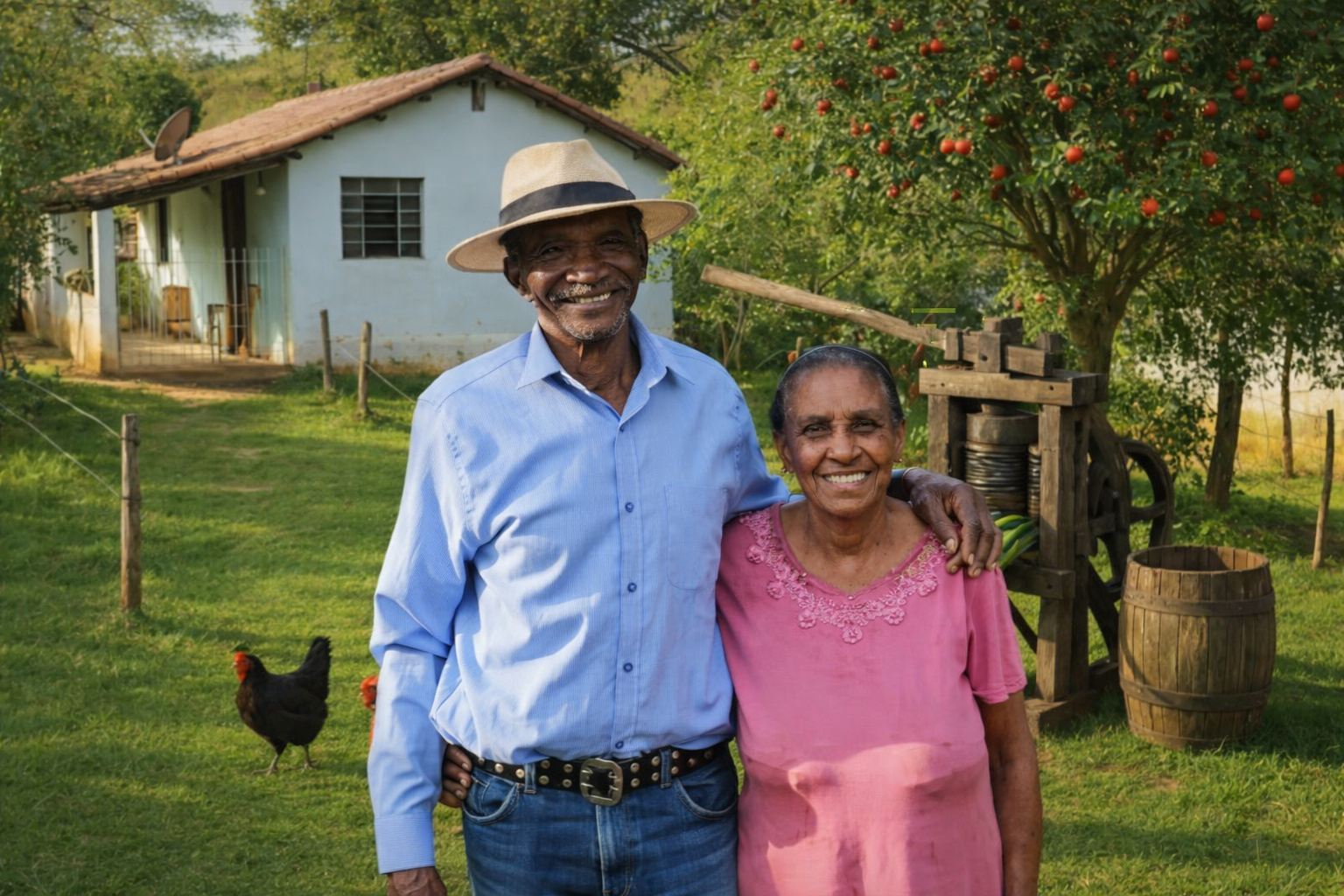


Couple from Minas Gerais Keeps Active Agricultural Routine Even After Eight Decades of Life, Preserves Traditional Methods and Resists Lack of Labor in Brazilian Fields
In the interior of Minas Gerais, in a simple property surrounded by sugarcane fields and fruit trees, Mr. João Balduino, a farmer over 90 years old, challenges time by maintaining a heavy work routine in the field alongside his wife, Mrs. Maria, with whom he has shared a life in the countryside for decades, the artisanal production of rapadura, and the simple habits that have shaped their longevity.
Even after nine decades of life, the couple remains active. He cuts sugarcane, uses an axe, operates a brush cutter, climbs and descends stairs more than 50 times a day, and participates directly in the operation of one of the last active mills in the region. Mrs. Maria, in turn, takes care of the garden, assists in the preparation of rapadura, and maintains the routine of the house that holds the history of several generations of the family.
The Heavy Routine in the Field That Continues Even After 90 Years

The information was disclosed in a video published on social media and specialized rural lifestyle channels, where Mr. João Balduino is shown working normally on the property where he was born and has lived for over 70 years. Soon to turn 91 years old, he asserts that he has never managed to stay still and that work has always been part of his physical and mental health.
-
Brazilian Farmer Invents Low-Cost Tractor Using Motorcycle Parts, Efficiently Working 2 Acres on 1 Liter of Diesel

-
Regenerative Farmers Use Keyline Plow to Improve Pasture Hydration, Storing 1 Gallon of Water Every 30 Centimeters

-
Bicolor Pumpkin Resembling Hand-Painted Art Discovered by Brazilian Researchers in the Capital Due to “Spontaneous Mutation”

-
In China, a 26-story building produces 1.2 million pigs annually, revolutionizing livestock farming with tube feeding and AI surveillance.


In the past, according to the farmer, he could carry up to 80 kilograms by himself. Today, the limit has dropped to about 50 kilograms, but this does not prevent him from staying active. He still works with an axe, chainsaw, brush cutter, and participates in cutting sugarcane, always respecting the limits of his body. When he feels pain in the morning, he rests for a few hours and resumes work in the afternoon.
For the farmer, working slowly is better than not working at all. “If it’s to be a hindrance, it’s better not to go,” he says, explaining that he prefers to guide and teach when he cannot perform heavier tasks. Beside him, Mrs. Maria accompanies the routine, helps as much as she can, and maintains the balance of domestic and productive life.
Artisanal Rapadura Production Preserves an Almost Extinct Tradition

The mill maintained by the couple is one of the last still active in the region. According to Mr. João Balduino, decades ago there were about 15 mills in the vicinity. Today, only his remains operational. Part of the structure is over 100 years old, while other equipment has been adapted over time, moving from animal traction to motorized and electric systems.
The production of rapadura follows traditional methods. Sugarcane is cultivated by the farmer himself, without the use of chemical fertilizers. Each planting allows for up to 15 cuts before renewing the sugarcane field. Currently, the couple produces between 1,000 and 1,200 rapaduras per year, a much lower number than in the past when they produced up to 200 or 300 units per day, with the help of other workers.
Today, production occurs on a smaller scale mainly due to the lack of labor in the fields. Nevertheless, rapaduras tend to sell quickly. Many customers place advance orders, and part of the production is taken to other cities in Minas Gerais and even to neighboring states, such as Goiás.
Simple Life, Partnership in the Fields and Knowledge Passed Between Generations

The couple’s longevity also attracts attention due to their lifestyle habits. Mr. João Balduino states that he has never consumed industrialized oil or processed lard, using only pork fat in his diet. Mrs. Maria cultivates a garden that produces enough vegetables for the family’s consumption and for donation to neighbors, a common practice throughout their life in the countryside.
In addition to traditional rapadura, the couple produces artisanal versions of milk, peanuts, pumpkin, and cider, always avoiding artificial mixtures used only to give a more attractive appearance to the product. The correct point for rapadura, according to the farmer, does not depend on tests with water but on the experience accumulated over decades.
This knowledge has been passed down to the grandchildren, who now help at the mill and in other tasks on the property. Part of the land has already been formally donated to the family, ensuring that tradition, the rural way of life, and agricultural knowledge do not fade away over time.
Even after 90 years, would you have the energy to keep working hard alongside your loved ones and keep alive a tradition that sustains the history of the Brazilian countryside?



Adorei essa história eu também só um agricultor
Sou mineiro de nascimento, conheço em MG em torno de 680 cidades, mesmo assim, não consigo imaginar de que cidade ou lugarejo seria o Sr João.
A reportagem é linda porém, o destaque seria grande se tivessem incluído a cidade, o município ou mesmo o lugarejo onde moram.
Fica a dica!!!
Em que cidade eles moram